
Recover Files Deleted from SD Card Safely
Deleting photos, videos, work documents, or project files from a memory card can feel final because removable media often provides no practical undo option. However, you may still recover files deleted from SD card if the original data has not been overwritten.
The safest approach is to stop using the card, check existing backups, and then choose a recovery method that does not write new data to the affected storage. This guide explains each option and shows when Magic Data Recovery offers the clearest path forward. For broader guidance, see Amagicsoft’s deleted file recovery guide.
Immediate rule: Do not take more photos, record video, copy files, format the card, or accept a “scan and fix” prompt before recovery.
Supports Windows 7/8/10/11 and Windows Server
Table of Contents
Can You Recover Files Deleted from SD Card?
In many cases, yes. When a file is deleted from an SD card, the file system usually removes or changes the directory record that points to the file and marks its occupied space as available. The underlying content may remain until the camera, phone, computer, or another device writes new data over the same area. Microsoft describes the same principle for deleted files on Windows-compatible storage.
Therefore, the chance to recover files deleted from SD card depends mainly on what happened after deletion. Recovery prospects are better when you remove the card immediately, so timing strongly affects whether you can recover files deleted from SD card. The chances fall when you continue shooting, copy new files, use an overwrite format, or run repair tools that change the file system.
A quick format may also leave recoverable content behind because it rebuilds file-system structures without overwriting every data block. By contrast, an overwrite format intentionally writes across the user data area, which makes software recovery far less likely. The SD Association documents this distinction in its official formatting guidance.
Common Recoverable Situations
You may be able to recover files deleted from SD card after any of the following logical data-loss events:
- Accidental deletion in a camera, drone, dashcam, phone, or computer
- Deleting files while transferring media
- A quick format performed by mistake
- File-system corruption that makes folders disappear
- A RAW or inaccessible card that Windows can still detect
- Malware or an interrupted write operation
Software cannot solve every case. A cracked card, failed controller, damaged connector, severe heat damage, or unreadable NAND memory may require a specialist laboratory.
What to Do Before SD Card Deleted File Recovery
The first few minutes matter more than the brand of tool you choose. Follow these precautions before you attempt SD card deleted file recovery or try to recover files deleted from SD card.
- Stop using the card immediately. Every new photo, video, download, or app operation may overwrite deleted data.
- Remove it safely from the original device. Power off a camera or phone first when possible.
- Connect it through a stable card reader. A direct reader usually gives recovery software more reliable access than a camera connected through USB.
- Do not format the card. Decline prompts that say, “You need to format the disk before you can use it.”
- Do not run CHKDSK first. CHKDSK repairs file-system structures; it does not primarily recover deleted files.
- Prepare a different destination drive. Save recovered files to your computer, an external drive, or another memory card—never the source card.
Microsoft notes that CHKDSK with the /f option corrects logical disk errors and that repairs on FAT file systems can change the file allocation table. For that reason, recovering important files before running repair commands is the safer order.
In a typical photography case, a user deletes one folder, notices the mistake, and immediately removes the card. That scenario offers a much better recovery outlook than a card that has recorded several gigabytes of new footage afterward.
Best Ways to Recover Files Deleted from SD Card
No single method fits every situation when you need to recover files deleted from SD card. Start with the least invasive option that matches your case.
Method | Best for | Main advantage | Important limitation |
Backup, cloud, or app trash | Files synchronized or copied earlier | No scan and no risk to the card | Works only when a copy exists |
Windows File Recovery | Technical Windows users | Free command-line recovery | No visual preview; syntax can be difficult |
Magic Data Recovery | Deleted, formatted, RAW, or corrupted cards | Guided scan, filtering, and preview | Requires a Windows computer |
Professional recovery service | Physically damaged or undetected cards | Hardware-level diagnosis | Usually slower and more expensive |
Method 1: Restore from a Backup, Cloud Service, or Device Trash
Before you use a scanner to recover files deleted from SD card, look for another copy. Check your:
- Computer import folders
- External backup drives
- NAS or home server
- Camera companion application
- Video editing project folders
- OneDrive, Google Photos, Dropbox, or another cloud service
- Phone manufacturer’s cloud backup
This is the best way to recover files deleted from SD card without software, but it only works when the files were backed up, synchronized, or imported before deletion.
Also check the Windows Recycle Bin or macOS Trash if the files had previously been copied to the computer. Do not assume that files deleted directly from removable media will appear there.
When a valid copy exists, restore it to your computer first. Confirm that photos open, videos play, and documents contain the expected content before reusing the SD card.
Method 2: Use Windows File Recovery
Microsoft provides Windows File Recovery as a free command-line utility for Windows 10 and Windows 11, giving technical users another way to recover files deleted from SD card.
The application can scan internal drives, external drives, and USB-connected storage. Because SD cards commonly use FAT or exFAT, Microsoft recommends Extensive mode for these file systems. The source and destination must also be different drives.
Suppose the SD card is drive E: and an external destination drive is D:. You can search for common photo, video, and document formats with:
- winfr E: D: /extensive /n *.jpg /n *.jpeg /n *.png /n *.mp4 /n *.mov /n *.docx
Before pressing Enter:
- Confirm that E: is the affected SD card.
- Confirm that D: is a different physical drive.
- Make sure the destination has enough free space.
- Close programs that may access the SD card.
- Type Y when Windows asks whether to begin recovery.
Windows File Recovery can help you recover deleted files from SD card free, but it has no graphical preview. It may also return files with changed names, missing dates, or lost folder structures.
Choose this method to recover files deleted from SD card when you are comfortable with Command Prompt and need a no-cost option. For a simpler visual workflow, use dedicated recovery software.
Method 3: Recover Files Deleted from SD Card with Magic Data Recovery
When backups do not exist and command-line recovery feels too limited, one accessible way to recover files deleted from SD card is Magic Data Recovery.
Magic Data Recovery provides a guided Windows workflow for several common SD card problems:
- Accidental deletion
- Quick formatting
- Lost directory structures
- File-system errors
- RAW or inaccessible cards
- Files lost after malware or interrupted operations
For users who need to recover files deleted from SD card, its main practical advantages include:
- Read-only scanning that avoids intentionally changing source data
- Automatic advanced scanning for deleted and lost files
- File-type filters for narrowing large result sets
- File preview before recovery
- Support for photos, camera RAW files, videos, documents, audio, and archives
- A visual interface that does not require command-line knowledge
Amagicsoft’s product documentation confirms that the software supports SD cards and provides advanced scanning, filtering, preview, and recovery to another location.
This combination makes the tool useful for photographers, drone operators, dashcam users, students, and office users. For example, when a camera folder is deleted before an event is delivered to a client, previewing the images helps distinguish intact photos from incomplete scan results.
Step 1: Install Magic Data Recovery on the Computer
Download Magic Data Recovery from its official product page and install it on your computer’s internal drive.
Supports Windows 7/8/10/11 and Windows Server
Never install any program onto the affected card. Although an SD card is removable, keeping all new writes away from it remains essential.
Step 2: Connect and Select the SD Card
Insert the card into a compatible reader, and then connect it to the Windows computer.
Launch Magic Data Recovery and identify the card by:
- Capacity
- Drive letter
- Device name
- File-system information
Check these details carefully. Selecting the wrong disk wastes time and may create confusion when you review the results.
Step 3: Scan for Deleted Files
Start the scan to recover files deleted from SD card, and allow it to complete when possible.
Results may appear while scanning continues. However, a completed scan provides a broader view of recoverable folders, deleted records, and recognized file signatures.
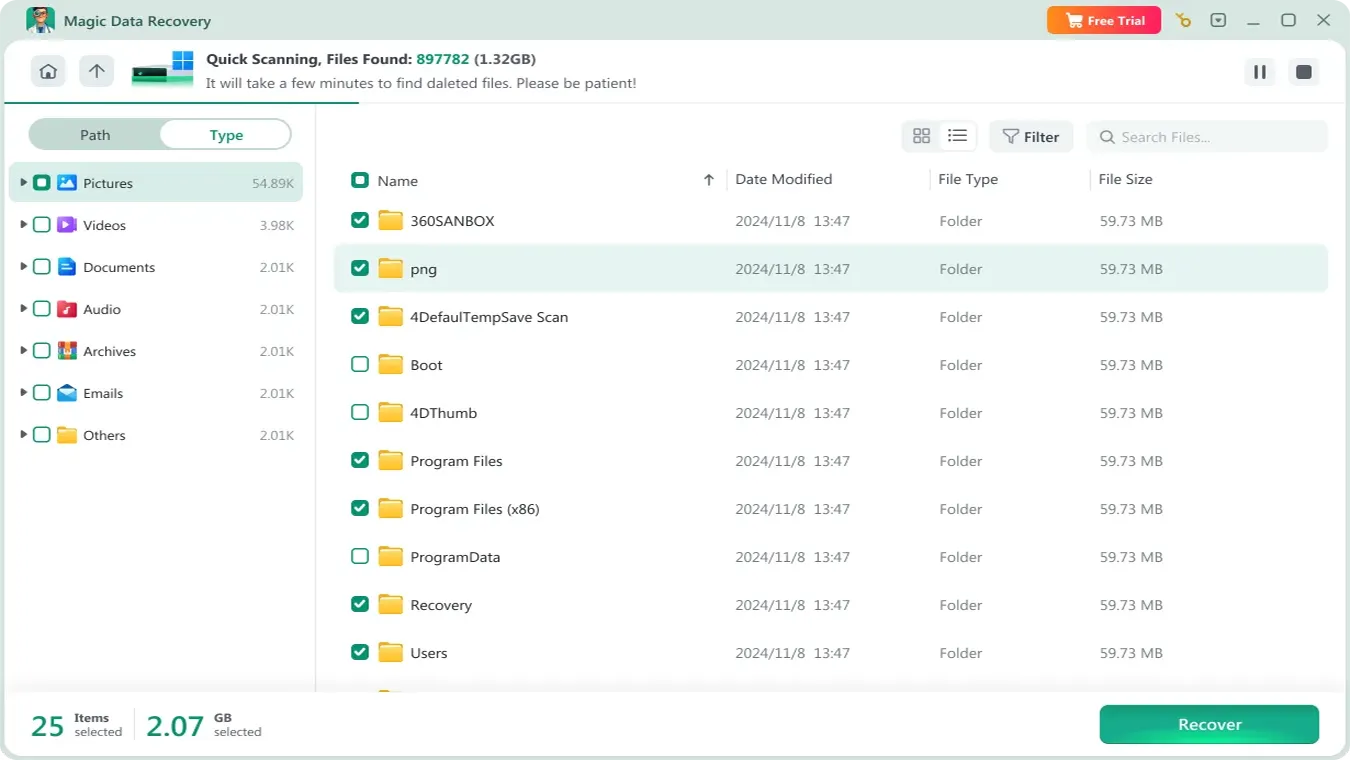
This process searches beyond the visible directory structure, which is especially useful after deletion, quick formatting, or file-system damage.
Step 4: Filter and Preview the Results
Filter the results by:
- File type
- Filename
- Size
- Date
- Folder path, when available
Preview important photos and documents rather than relying only on filenames. A familiar filename does not prove that the file contents remain intact.
For videos, check the available metadata and test the recovered copy after saving. Large recordings can become fragmented, so a video may require more verification than a small image.
For a media-specific workflow, see this guide on how to recover deleted photos from an SD card.
Step 5: Recover Files to Another Drive
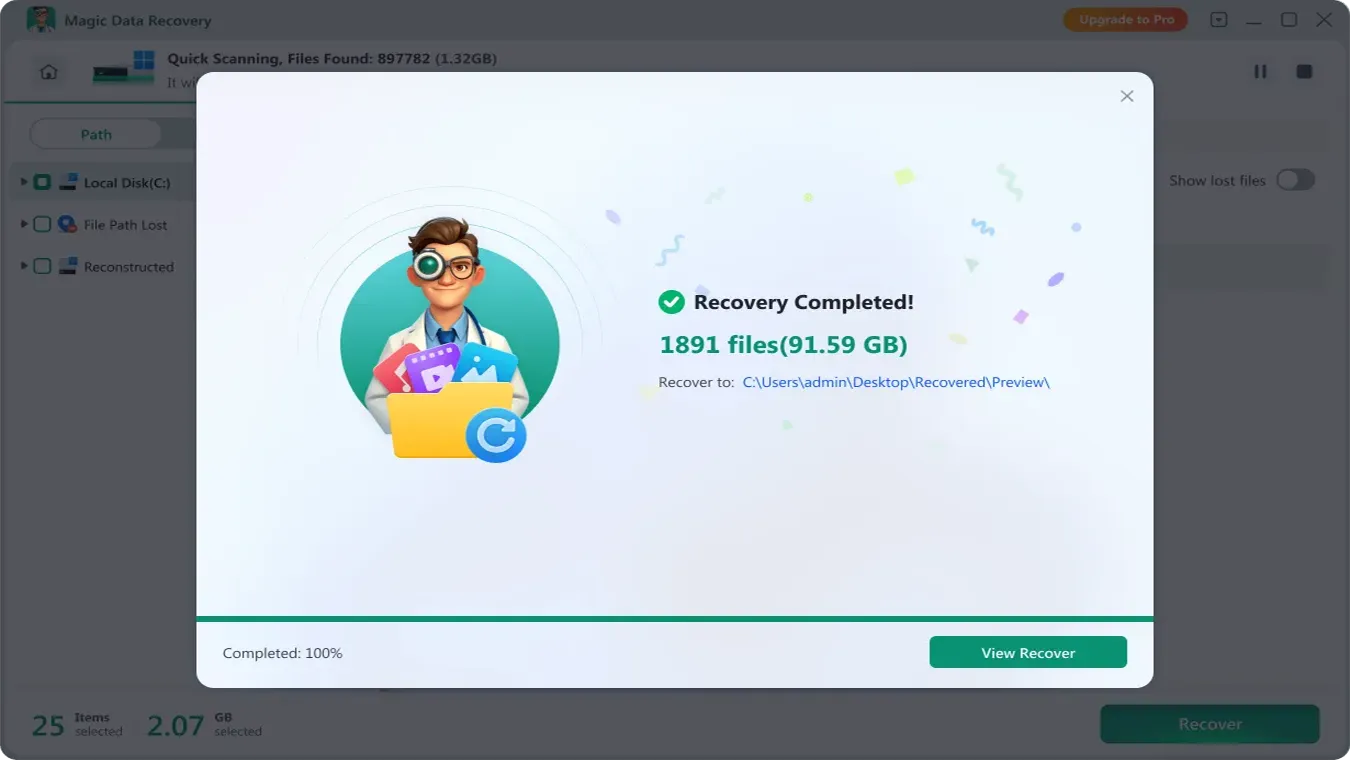
Select the required items and save them to:
- The computer’s internal drive
- A separate external hard drive
- A different USB drive
- Another verified storage device
Do not write recovered content back to the affected SD card during the same recovery session. Saving to the source card could overwrite files that the scan has not restored yet.
Once you confirm that the recovered files open correctly and exist in at least one backup, you can decide whether to test, repair, or format the original card.
If you are looking for a more efficient solution to recover files deleted from SD card, Magic Data Recovery is worth trying because it combines low-level scanning with an interface that ordinary users can follow.
Magic Data Recovery vs Free and Manual Methods
Free utilities can recover files deleted from SD card in simple cases, so paid software should not be the automatic first choice. The better question is whether a method gives you enough control and verification for the value of the lost data.
Windows File Recovery
Advantages:
- Free from Microsoft
- Supports external storage devices
- Can search by extension or filename
- Includes an Extensive scan mode
Limitations:
- Requires command-line syntax
- Provides no visual preview
- Can return files without original names
- May feel difficult for beginners
PhotoRec and Other Signature-Based Tools
Advantages:
- Free and open source
- Supports many file signatures
- Can work when directory information is damaged
Limitations:
- Frequently loses filenames and folder structures
- Produces large result sets
- Requires more manual sorting
- Has a less beginner-friendly workflow
Basic Undelete Utilities
Advantages:
- Simple for recent deletions
- Often quick to scan
- Suitable for low-value, straightforward cases
Limitations:
- May struggle with RAW or formatted cards
- Limited preview or filtering
- Less useful when file-system metadata is badly damaged
Magic Data Recovery
Magic Data Recovery becomes more practical when you need to:
- Recover files deleted from SD card and preview them before saving
- Search a formatted or damaged file system
- Sort thousands of results by file type or other available attributes
- Avoid complicated commands and manual signature settings
- Use one workflow across SD cards, hard drives, USB drives, and other storage media
The recommendation rests on workflow and scenario coverage, not a promise that every file can be restored. No recovery tool can reconstruct data that has been fully overwritten, securely erased, or lost because the memory chips are physically unreadable.
Can You Recover Files from a Formatted or Corrupted SD Card?
When you need to recover files deleted from SD card, deletion, formatting, and corruption require different expectations.
Recovering Files After a Quick Format
A quick-formatted card may still contain file data because the process can reset file-system records without overwriting every data block.
Stop using the card and scan it before recording anything new. The SD Association states that Quick Format removes file and directory entries but does not initialize the data stored in the files.
Learn more about the differences between formatting methods in this quick format guide.
Recovering Files from a Corrupted Card
A corrupted card may:
- Show the wrong capacity
- Appear as RAW
- Request formatting
- Display empty folders
- Disconnect repeatedly
- Become unreadable in a camera
- Show file-system errors in Windows
In these cases, recover the data before attempting repair. This detailed guide explains how to recover files from a corrupted SD card.
Why You Should Not Run CHKDSK First
Avoid using CHKDSK as your first response when files are missing.
CHKDSK can correct logical disk errors, but the /f and /r operations modify file-system structures. On FAT-formatted media, these changes can affect allocation tables and lost file chains.
Read what CHKDSK does, recover important data first, and repair the card only after verifying a safe copy.
Why Recovered Files May Be Missing or Corrupted
Even when software can recover files deleted from SD card, a completed scan does not guarantee that every result will open.
Several factors affect file integrity.
Overwriting
New photos, videos, downloads, or system operations may replace part or all of a deleted file. A partially overwritten file may appear in the results but fail to open.
File Fragmentation
Large videos may occupy non-contiguous storage blocks. If some fragments are missing or overwritten, the software may recover only an incomplete recording.
File-System Damage
Original filenames, creation dates, folder paths, and file sizes depend on file-system metadata. When that metadata is damaged, recovery software may identify the content by signature but assign a generic filename.
Encryption
An SD card configured as encrypted or adopted internal storage may require the original phone and its encryption keys. Removing the card and scanning it on a computer may not produce usable files.
Reader Instability
A poor adapter, incompatible reader, damaged connector, or unstable USB port can interrupt scanning. Try a second compatible reader and USB port before assuming the card has failed.
Physical Failure
Degraded flash memory or a failing controller may return unreadable sectors. Stop repeated DIY attempts when the card:
- Becomes unusually hot
- Has visible cracks or burn damage
- Disappears from Disk Management
- Disconnects with several readers
- Causes the computer to freeze repeatedly
Continued power cycling can worsen some hardware failures.
Common Mistakes That Reduce Recovery Chances
Users who try to recover files deleted from SD card often lose recoverable data through well-intentioned actions.
Avoid these mistakes:
- Continuing to use the camera or phone
- Formatting because Windows requests it
- Saving recovered files back to the same card
- Running repair tools before recovery
- Installing a recovery app onto the affected microSD card
- Recording new photos to “test” whether the card works
- Scanning an unstable card repeatedly
- Trusting thumbnails without opening the recovered files
- Reusing the card before making a second backup
After successful recovery, copy the restored files to at least two separate locations. Then test the SD card with appropriate diagnostic tools or replace it if errors recur.
Conclusion
You can often recover files deleted from SD card when you act quickly and prevent overwriting. Start with backups because they offer the safest restoration. Windows File Recovery suits users who prefer a free command-line tool, while a professional service remains the right option for physical damage.
For most logical data-loss cases, Magic Data Recovery offers a practical balance of guided scanning, file preview, scenario coverage, and ease of use. It handles deletion, quick formatting, and file-system errors without forcing users to manage complex commands.
If the card still appears in Windows, scan it, verify the results, and save recovered files to another drive. You can also review Amagicsoft’s deleted file recovery guide for additional recovery principles.
Supports Windows 7/8/10/11 and Windows Server
FAQs
Can permanently deleted files be recovered from an SD card?
Yes, you may recover files deleted from SD card even after permanent deletion when new data has not overwritten their storage blocks. Stop using the card, connect it through a reader, and scan it with a trusted recovery tool. Recovery becomes less likely after new photos, overwrite formatting, secure erasure, or extensive file-system repair.
Where do deleted files from an SD card go?
When you try to recover files deleted from SD card, remember that deleted files do not move to a special folder on the card in most cases. Instead, the file system marks their directory records and storage space as available. The underlying data may remain temporarily, allowing recovery software to search for unreferenced records and file signatures.
How can I recover deleted files from an SD card without software?
The practical way to recover files deleted from SD card without software is to restore another copy. Check a computer import folder, external backup, NAS, cloud photo service, phone backup, or editing project. Recycle Bin or Trash may help only when the files were previously copied to a computer or the deletion workflow placed them there.
Can I recover files after formatting an SD card?
Recovery may work after a quick format because that process can recreate file-system structures without overwriting every data block. Stop using the card and scan it before saving anything new. An overwrite format writes across the user data area, so normal SD card recovery software is unlikely to restore content erased by that operation.
Should I run CHKDSK before trying to recover deleted files?
No. CHKDSK is a file-system repair utility, not a primary undelete tool. Commands such as /f and /r can change allocation tables, directory entries, and damaged records. When valuable files are missing, recover or image the card first. Run repair operations only after verifying the recovered data on another drive.
Can I recover files deleted from a microSD card used in an Android phone?
Often, yes. To recover files deleted from SD card storage in an Android device, remove the microSD card, connect it to a Windows computer, and use microSD card recovery software. Do not install recovery apps on the affected card. Recovery may fail when Android adopted the card as encrypted internal storage because the files depend on keys stored in the original phone.
Why do recovered photos or videos fail to open?
A file may appear in scan results even when part of its content has been overwritten or cannot be read. Large videos also fragment more often than small photos, which makes reconstruction harder. Preview files, complete the scan, save results elsewhere, and test them with an appropriate viewer. A filename or thumbnail alone does not prove file integrity.
When should I use a professional SD card recovery service?
Choose a professional service when the card is cracked, burned, water-damaged, abnormally hot, missing from Disk Management, or repeatedly disconnecting with different readers. Software needs stable access to the storage device. A laboratory may work directly with the controller or memory chips, although success, cost, and turnaround time vary by the type of damage.

Jason is a data recovery and technical support specialist with over 15 years of hands-on experience. He has worked extensively with frontline users, troubleshooting difficult data loss cases and providing practical recovery solutions for accidental deletion, formatted drives, damaged file systems, lost partitions, system failures, and other recovery emergencies. His expertise also includes backup and restoration, file repair, and disaster recovery, with a strong emphasis on safe, reliable, and technically accurate guidance.