
Unsaved Excel File Recovery Guide
Unsaved excel file recovery is one of the most searched Excel problems for a reason. You spend 30 minutes, an hour, or even half a day editing a workbook, then Excel crashes, Windows restarts, the file closes by mistake, or the workbook simply disappears. In some cases, you reopen Excel and see the Document Recovery pane. In others, nothing appears. Worse, sometimes the file is still there but damaged and cannot open.
Most guides stop at “Go to Recover Unsaved Workbooks.” That advice helps, but it does not cover every real-world scenario. Microsoft explains that Excel may recover files through AutoRecover, Document Recovery, version history, or repair options, yet recovery depends on how the file was stored, whether AutoRecover had time to create a temporary copy, and whether the storage device itself has errors.
This article explains the most effective unsaved excel file recovery methods step by step, and it also shows what to do when Excel’s built-in options are not enough. If the workbook cannot be found, is corrupted, or was lost because of deletion, formatting, or file system issues, recovering the data first is often the safer choice before taking further actions such as formatting the drive.
Table of Contents
What Does Unsaved Excel File Recovery Really Mean?
Unsaved excel file recovery usually refers to getting back a workbook or recent changes that were never manually saved. Excel can sometimes help because it stores temporary recovery data in the background through AutoRecover. After a crash, the Document Recovery pane may show available versions. If you saved the file before, version history may also help, especially in OneDrive or SharePoint.
However, not every case is a true “unsaved” case. Users often use the same phrase for three different problems:
1. The workbook was closed without saving
This is the classic case. Excel may still have a temporary copy.
2. The workbook cannot be found
The file may have been deleted, moved, lost during a crash, or hidden by storage issues.
3. The workbook is present but corrupted
Excel finds the file, but it says the workbook is corrupt or cannot be opened.
Understanding which situation you are dealing with makes unsaved excel files recovery much easier.
How Excel Recovery Works
Excel recovery mainly depends on four built-in mechanisms.
AutoRecover
Microsoft states that AutoRecover saves recovery information periodically while you work. In Office for Mac, Microsoft says the default recovery interval is every 10 minutes. Microsoft also notes that the amount of recovered work depends on how often recovery information is saved.
Document Recovery
If Excel or the system closes unexpectedly, Excel may open the Document Recovery pane the next time you launch the app. It lists recovered files and lets you open, save, review, or delete them.
Recover Unsaved Workbooks
Microsoft support explains that if a file was previously saved, you may find a version under File > Info > Manage Workbook, including versions marked “when I closed without saving.”
Version History
If the workbook lives in OneDrive, SharePoint, or Excel for the web, version history may let you restore an older working version. Microsoft specifically recommends version history for files that became corrupted in Excel for the web.
Unsaved Excel File Recovery: Start With These Built-In Methods
If you need unsaved excel file recovery, try the lowest-risk methods first.
Method 1: Check Document Recovery After a Crash
Reopen Excel after the crash. If the Document Recovery pane appears, review the listed files and save the newest usable copy immediately. Microsoft recommends checking the date and time on each recovered version before deciding which one to keep.
This method works best when:
- Excel crashed unexpectedly
- the workbook was open during the crash
- AutoRecover had time to create a temporary copy
Method 2: Use Recover Unsaved Workbooks
In Excel, go to:
File > Info > Manage Workbook > Recover Unsaved Workbooks
This is one of the most direct unsaved excel files recovery paths. It can open temporary files stored by Excel and let you save a usable copy. Microsoft confirms this recovery path for unsaved versions.
Use this method when:
- you closed Excel by mistake
- you clicked “Don’t Save”
- Excel reopened but did not show Document Recovery
Method 3: Restore a Previous Version
If the workbook was saved to OneDrive or SharePoint, check version history. Microsoft notes that this can help when the current version is damaged or when a bad change needs to be rolled back.
This method is useful when:
- the current file opens incorrectly
- the latest version is corrupted
- you need an earlier clean copy
Method 4: Use Open and Repair for a Corrupted Workbook
If the file is there but will not open, use Excel’s repair feature. Microsoft says Excel may automatically start File Recovery mode, and if not, you can manually choose Open and Repair. If repair fails, Excel may still extract values and formulas.
This method is best when:
- the workbook exists
- Excel says the file is corrupt
- the workbook opens partially or fails with errors
When Excel’s Built-In Recovery Is Not Enough
This is where many articles become incomplete. In practice, unsaved excel file recovery fails for several common reasons:
The temporary file was never created
AutoRecover may not have had enough time to save a recoverable copy.
The file was saved on a failing device
If the drive, USB stick, SSD, or memory card has file system problems, Excel recovery alone may not reach the missing data.
The workbook was deleted or the partition was formatted
At that point, this is no longer only an Excel issue. It becomes a storage-level data loss issue.
The workbook is missing after a system error
A sudden shutdown, drive disconnect, or file system error can make the workbook disappear even if Excel itself worked normally before.
In these cases, formatting the drive immediately is risky. Formatting may make the device usable again, but it can also overwrite recoverable Excel data. Recover first. Format later.
If You Cannot Find the Unsaved Document, Do This First
When users say they need unsaved excel files recovery, they often mean, “I cannot find the workbook anywhere.” Follow this order:
Step 1: Stop using the affected drive
Do not save new files to the same disk, USB drive, or SD card. New writes can overwrite deleted Excel content.
Step 2: Search Excel’s built-in recovery options
Check:
- Document Recovery
- Recover Unsaved Workbooks
- version history if the file was cloud-synced
These are fast and non-destructive first checks.
Step 3: Check Recycle Bin or cloud recycle folder
If the workbook was deleted after being saved, the Recycle Bin or cloud recycle area may still contain it.
Step 4: Use a professional data recovery tool before formatting
If the file is still missing, the safest next move is to scan the storage device for recoverable data.
Why Magic Data Recovery Makes Sense in Advanced Recovery Cases
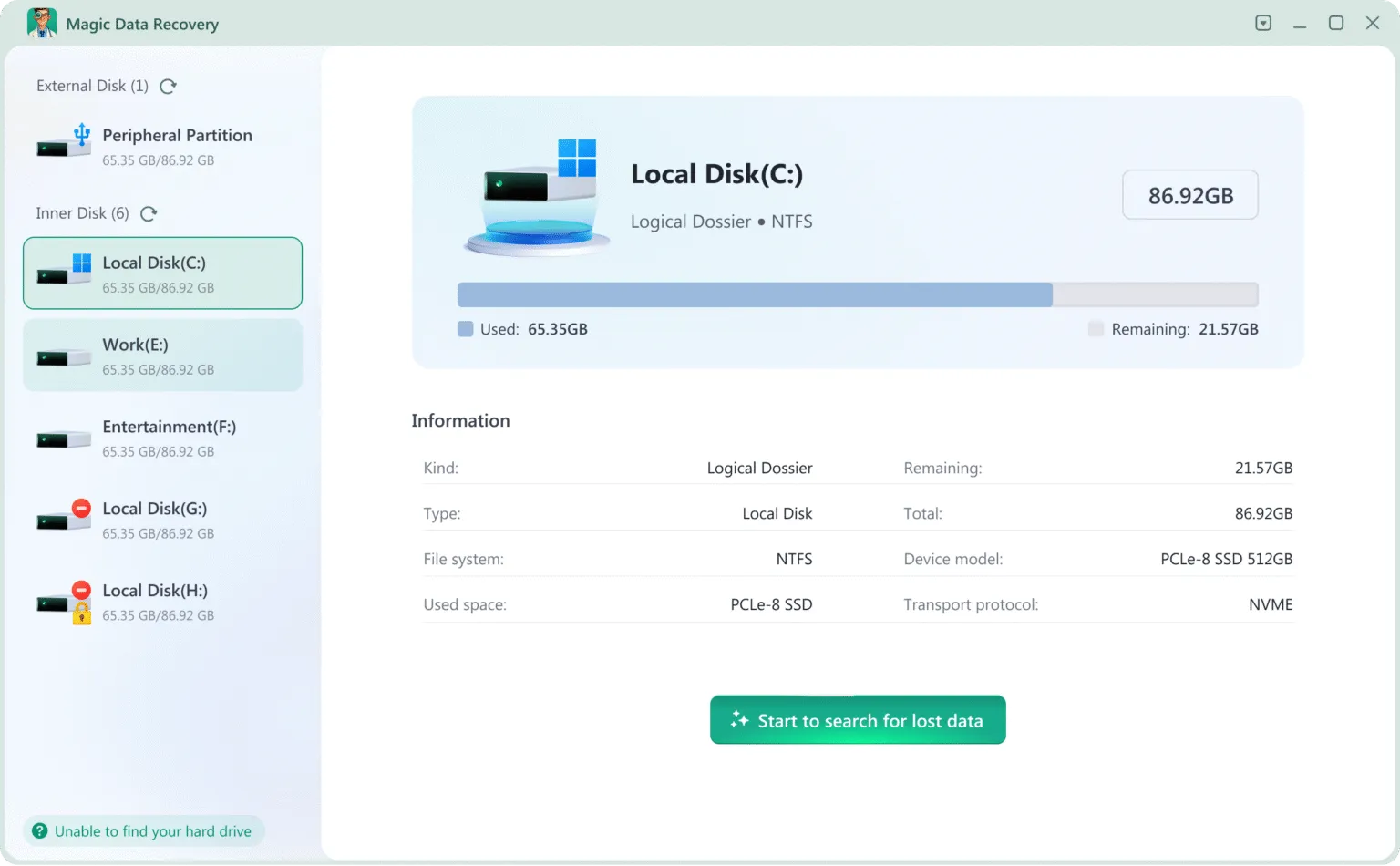
When unsaved excel file recovery turns into missing-file recovery, corrupted storage recovery, or deleted-file recovery, built-in Excel tools may no longer be enough. This is the point where Magic Data Recovery becomes relevant in a practical, problem-solving way.
Core pain points it addresses
Magic Data Recovery helps when Excel’s own recovery path cannot find the workbook because the underlying storage problem is bigger than Excel itself. It is suitable for scenarios such as:
- deleted Excel files
- formatted drives or partitions
- file system errors
- lost files after sudden power loss or device issues
Why this is a better order of operations
If a drive shows file system errors, many users rush to format it. That can be a mistake. Recover the data first, then format if needed. Otherwise, you may reduce the chance of getting the Excel workbook back.
Unique selling points
Instead of only looking for Excel temp files, Magic Data Recovery focuses on storage-level data recovery. That matters when:
- the workbook no longer appears in Excel
- the folder is empty
- the drive became inaccessible
- the file was deleted from the local disk, USB, or external storage
Real-world usage examples
For example, imagine you were editing a budget workbook on a USB drive, removed it unsafely, and now the drive asks to be formatted. Excel cannot recover what it cannot access. In that case, using Magic Data Recovery to scan and restore the workbook before formatting is the safer route.
Another common example is a workbook saved to a partition that suddenly shows file system errors after a crash. Again, recover first. Repair or format later.
Why it can be more reliable than other options
Excel recovery tools only work when Excel still has a temporary version or the file remains reachable. A dedicated recovery tool is often more reliable once the issue moves beyond the application layer and into deletion, formatting, or file system damage.
If you are looking for a more efficient solution for complex loss scenarios, Magic Data Recovery is worth considering.
Supports Windows 7/8/10/11 and Windows Server
Best Recovery Workflow by Scenario
Scenario 1: You closed Excel and clicked “Don’t Save”
Try:
- reopen Excel
- check Document Recovery
- go to Recover Unsaved Workbooks
- save the recovered file immediately
Scenario 2: Excel crashed and the workbook is gone
Try:
- reopen Excel
- review the Document Recovery pane
- choose the latest version by timestamp
- save a new copy with a different name
Microsoft specifically recommends comparing timestamps in Document Recovery to decide which version to keep.
Scenario 3: The workbook exists but is corrupted
Try:
- use Open and Repair
- restore a previous version if cloud-stored
- extract values and formulas if repair fails
Microsoft confirms both Open and Repair and version-history-based restoration as valid approaches.
Scenario 4: The file cannot be found anywhere
Try:
- stop using the drive
- search Excel recovery options
- check recycle locations
- run Magic Data Recovery
- only then consider formatting or repairing the disk
Common Mistakes That Reduce Recovery Success
Formatting too early
This is the biggest mistake. If the storage device is damaged, recover the data first.
Saving new files to the same location
New writes can overwrite the lost workbook.
Assuming AutoSave and AutoRecover are the same
They are not. Microsoft explains that AutoSave mainly applies to Microsoft 365 files stored in OneDrive, while AutoRecover acts as a recovery safety net.
Closing recovered files without saving
Recovered versions can be temporary. Save them immediately.
Relying on one method only
A good unsaved excel files recovery process checks Excel, cloud history, repair options, and storage recovery when necessary.
Prevention Tips After Recovery
Once you complete unsaved excel file recovery, reduce the chance of facing the same issue again:
- save important workbooks earlier, not just at the end
- keep files in OneDrive or SharePoint when possible
- verify recovery settings regularly
- use stable storage devices
- avoid forced shutdowns while Excel is writing data
- keep a recovery tool ready for deletion or file system error cases
Microsoft also recommends storing Microsoft 365 files in OneDrive or SharePoint and using AutoSave as the safest routine for active work.
Conclusion
Unsaved excel file recovery is not one single method. Sometimes Excel can restore the workbook through Document Recovery, Recover Unsaved Workbooks, version history, or Open and Repair. In other cases, the real problem is that the file has been deleted, the storage became corrupted, or the drive now asks to be formatted.
That is why I recommend Magic Data Recovery for advanced cases. It addresses the situations Excel alone cannot solve well, especially deleted files, formatted partitions, and file system errors. More importantly, it supports the safer recovery sequence: restore the data first, then format if necessary. That approach lowers the risk of permanent data loss.
Supports Windows 7/8/10/11 and Windows Server
FAQs
Can I recover an Excel file that I never saved?
Yes, sometimes you can. Excel may keep a temporary AutoRecover copy if enough time passed before the file closed. Start with Document Recovery, then check File > Info > Manage Workbook > Recover Unsaved Workbooks. If nothing appears, the workbook may never have been cached, or the issue may involve storage-level file loss instead.
What should I do if Recover Unsaved Workbooks shows nothing?
That usually means Excel does not have a temporary copy available. First, check whether the file was originally saved elsewhere, including OneDrive, SharePoint, or another folder. Then look in the Recycle Bin. If the file is still missing, stop using the affected drive and try a recovery tool like Magic Data Recovery before making further changes.
Can a corrupted Excel file still be recovered?
Often, yes. If the workbook still exists, try Excel’s Open and Repair option first. If the file was stored in OneDrive or SharePoint, version history may restore an earlier working copy. When corruption is linked to drive errors or file system problems, file recovery software may help recover the workbook before repair or formatting.
Is AutoSave the same as AutoRecover in Excel?
No. They work differently. AutoSave continuously saves supported Microsoft 365 files stored in OneDrive or SharePoint, while AutoRecover creates recovery information to help after a crash or accidental closure. Many users confuse them, but they protect data in different ways and should not be treated as identical features.
Should I format a drive if my Excel file is missing?
Not before recovery. If the drive reports errors or asks to be formatted, recover your data first. Formatting may make the device usable again, but it can also reduce the chance of getting the Excel workbook back. In these cases, use Magic Data Recovery first, then format only after the important files are safely restored.
How does Magic Data Recovery help with Excel file loss?
Magic Data Recovery helps when the issue is no longer just an unsaved workbook inside Excel. It can be useful for deleted files, formatted drives, and file system errors that make Excel documents disappear. That makes it a strong option when built-in Excel recovery finds nothing but the workbook may still exist at the storage level.
Can I recover an unsaved Excel file on Mac?
Yes, in many cases. Microsoft says Office for Mac uses AutoRecover and can save recovery files automatically, with a default recovery interval of 10 minutes. Reopen Excel after a crash and look for recovered files. If no file appears, follow the same logic: avoid overwriting data and move to broader file recovery if needed.
What is the safest recovery order for a missing Excel workbook?
Start with Excel’s built-in tools, then check cloud version history and deleted-item folders. If the workbook is still missing, stop using the storage device immediately. Next, scan it with Magic Data Recovery. Only after recovering your files should you consider formatting, repairing the file system, or making other major changes to the device.

Jason is a data recovery and technical support specialist with over 15 years of hands-on experience. He has worked extensively with frontline users, troubleshooting difficult data loss cases and providing practical recovery solutions for accidental deletion, formatted drives, damaged file systems, lost partitions, system failures, and other recovery emergencies. His expertise also includes backup and restoration, file repair, and disaster recovery, with a strong emphasis on safe, reliable, and technically accurate guidance.