
Computer Data Loss Statistics: Risks, Causes & Recovery
Data loss is no longer a rare technical accident. It is a routine risk for businesses, remote workers, students, and everyday PC users. The latest computer data loss statistics show a clear pattern: people often feel confident about recovery, yet real-world results are much weaker when files vanish after deletion, formatting, corruption, ransomware, or drive failure. IBM reports that the global average cost of a data breach reached $4.4 million in 2025, while Veeam found that 90% of security leaders felt confident about recovery, but only 28% fully restored all affected data after ransomware. Meanwhile, Backblaze’s 2025 drive dataset still shows hardware failures happen at scale, with a 1.36% annualized failure rate across more than 337,000 drives in its environment.
For searchers looking up computer data loss statistics, the real question is not only “How often does data loss happen?” It is also “What usually causes it, what does it cost, and what should I do next?” This guide answers all three. It also explains why recovery tools become relevant only after prevention fails, especially on Windows PCs where users often face deleted files, formatted partitions, and file system errors.
Table of Contents
What Do the Latest Computer Data Loss Statistics Tell Us?
The most useful takeaway from current computer data loss statistics is simple: data loss is common, expensive, and often misunderstood. Many roundup articles focus on giant lists of percentages, but the strongest sources point to a smaller set of practical truths. First, recovery confidence is often higher than real recovery success. Second, backups remain inconsistent. Third, hardware issues, cyber incidents, and human error still dominate the problem landscape.
For example, Veeam reports that 48% of consumers have already lost data, yet only 19% had backups available to restore it, and 81% had to start over from scratch. In business settings, the gap is also obvious: many organizations believe they are prepared, but partial recovery remains common after serious incidents. These data recovery statistics matter because they reveal a behavior gap, not just a technology gap. People still overestimate cloud safety, device reliability, and the quality of their backup habits.
Why Computer Data Loss Statistics Matter in Real Life
Statistics matter when they help users make better decisions. A student losing a thesis on a laptop, a photographer deleting an SD card folder by mistake, or an office worker formatting the wrong drive all face the same reality: once prevention fails, speed and recovery quality become critical.
That is why the best computer data loss statistics should never sit alone. They should guide action. If ransomware victims often fail to restore all data, then backup testing matters. If hard drives still fail every year, then device health checks matter. If consumers lose files without backups, then local recovery tools matter as a second line of defense. CISA and NIST both stress tested backups and recovery preparation as core resilience practices, especially against destructive events and ransomware.
The Most Common Causes Behind Computer Data Loss Statistics
Behind every set of computer data loss statistics, there is usually a very practical reason. In most cases, data does not disappear because of one dramatic event alone. Instead, it is often the result of everyday mistakes, aging hardware, security incidents, or system-level problems that users fail to notice until files become inaccessible. Understanding these root causes makes the statistics more meaningful and helps readers see where prevention and recovery efforts should begin.
1. Human error remains a major factor
In daily Windows use, many data loss cases begin with ordinary mistakes. Users empty the Recycle Bin too soon. They overwrite the wrong folder. They format the wrong partition during reinstall. They interrupt a transfer and end up with corrupted files. This is why file loss statistics are never just about hardware or malware. Human behavior still shapes a large part of the problem, especially in unmanaged personal environments.
2. Hardware failure is still real
Cloud storage has changed habits, but it has not eliminated local risk. Backblaze continues to publish large-scale hard drive failure rates, and its 2025 figures confirm that even mature storage environments still see regular failures. Consumer conditions can be worse because home users often skip cooling, monitoring, and replacement schedules. A failing HDD or SSD can turn a small issue into a major recovery event if users keep writing data after warning signs appear.
3. Ransomware and destructive attacks raise the stakes
Some of the most important computer data loss statistics today come from cyber resilience research. Veeam’s 2026 report shows that among respondents hit by ransomware in the prior 12 months, only 28% fully recovered all affected data, while 44% recovered less than 75%. That is not just a security story. It is a data availability story. Once files are encrypted or corrupted, clean restoration becomes harder than many teams expect.
4. File system and partition errors cause silent loss
Not every loss event is dramatic. Sometimes Windows reports a drive as RAW. Sometimes a partition disappears after an update, unsafe removal, or sudden power loss. In those cases, data may still exist physically, but the file system structure becomes unreadable. These incidents often do not show up in broad public data loss statistics, yet they are common in real support scenarios and often send users searching for recovery software.
The Cost Behind Computer Data Loss Statistics
When people search for computer data loss statistics, they often expect percentages. However, the financial side matters just as much. IBM’s 2025 Cost of a Data Breach report puts the global average breach cost at $4.4 million. That figure reflects organizational incidents, not simple home-PC accidents, but it still shows how quickly lost or inaccessible data becomes a business problem. Downtime, lost productivity, compliance issues, customer churn, and emergency remediation all push the cost far beyond the price of the original files.
For individual users, the cost looks different. The pain often appears as lost time, missed deadlines, broken creative workflows, or irreplaceable memories. A corrupted project folder can mean days of rework. A deleted video archive can erase billable client work. A formatted family drive can remove years of photos. Good computer data loss statistics should make that risk feel concrete, not abstract.
How to Read Computer Data Loss Statistics Without Being Misled
Many ranking pages collect dozens of numbers from mixed-quality sources. That makes them useful for brainstorming, but not always reliable for publishing. When reviewing data loss statistics, use three filters.
First, check whether the source explains its sample and context. Enterprise ransomware data is not the same as consumer file deletion data. Second, watch for old claims recycled without updated evidence. Third, prefer sources that connect the number to a practical lesson. A statistic without context rarely helps the reader solve a problem. This is one reason IBM, Backblaze, Veeam, CISA, and NIST are more useful than anonymous list-style compilations.
Best Practices Inspired by Computer Data Loss Statistics
The good news is that these trends also point to practical ways to reduce risk. Once you understand what the numbers reveal, it becomes easier to build habits and safeguards that lower the chance of serious data loss.
Use the 3-layer approach
A smart response to computer data loss statistics includes prevention, backup, and recovery readiness.
- Prevent avoidable loss with SMART checks, careful file handling, patching, and malware protection
- Back up important data to at least one separate location
- Prepare a recovery path for the moment backups are missing, outdated, or incomplete
CISA recommends maintaining offline, encrypted backups and testing them regularly. NIST also emphasizes backup maintenance and restore testing to reduce the impact of ransomware and other destructive events.
Stop using the affected drive quickly
This is one of the most overlooked lessons behind data recovery statistics. After deletion, formatting, or file system damage, continued use of the drive can overwrite recoverable data. Users often worsen the outcome by installing tools onto the same partition they want to recover.
Match the tool to the scenario
Different loss events need different responses. Backups are best for planned restoration. Built-in repair tools can help with minor logical issues. However, deleted files, formatted partitions, and RAW or damaged file systems often require dedicated recovery software.
When a Recovery Tool Makes Sense on Windows
This is the point where product recommendation becomes natural. If the user has no valid backup and the lost data is on a Windows PC, recovery software can be the most practical option. That is especially true after accidental deletion, partition formatting, or file system errors where the data may still be present but inaccessible.
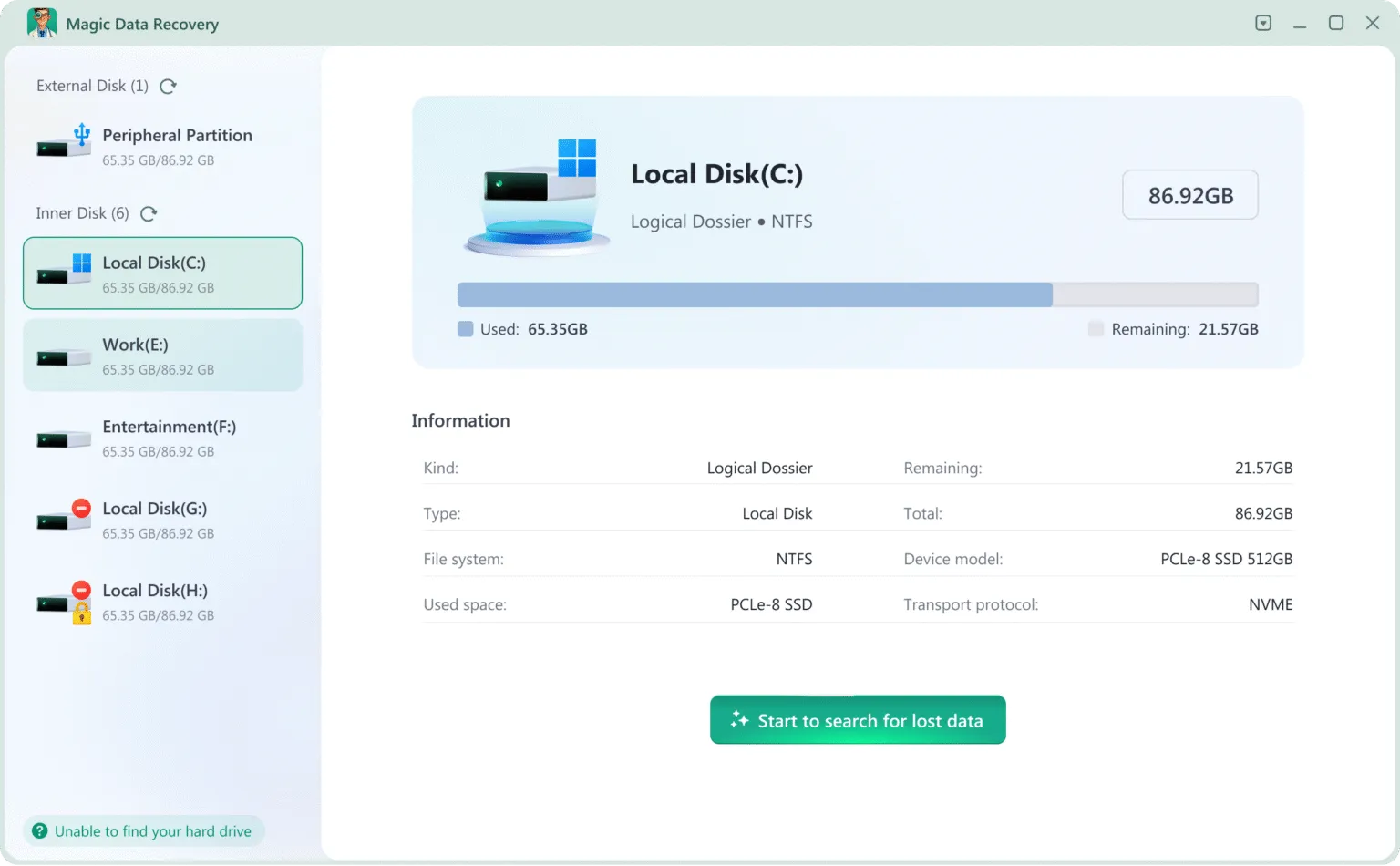
Magic Data Recovery fits that need because it addresses the exact Windows scenarios many users face after data loss. Based on the product scope you provided, it supports recovery of data lost through deletion, formatting, and file system errors. That matters because these are not edge cases. They are among the most common real-life triggers behind consumer and office-side computer data loss statistics.
Why recommend Magic Data Recovery here?
The recommendation should stay problem-focused.
- It targets core pain points: deleted files, formatted drives, and inaccessible data caused by file system problems
- It suits typical Windows recovery scenarios where users need a straightforward workflow rather than a forensic toolkit
- It is easier to justify than risky DIY methods that may overwrite data or fail to scan damaged structures properly
- It makes sense when backups are missing and built-in Windows tools cannot restore the files
For example, imagine a user reformats a partition during Windows reinstallation, or a USB drive suddenly shows a file system error and becomes unreadable. In both cases, a dedicated recovery tool is often more reliable than manual repair attempts because repair commands can sometimes change the file structure before recovery is completed.
If you are looking for a more efficient Windows solution after deletion, formatting, or file system issues, Magic Data Recovery is worth trying.
Tips to Reduce the Risk Behind Computer Data Loss Statistics
The best way to respond to computer data loss statistics is to make them less likely to apply to you.
Build simple habits that work
- Keep one local backup and one separate backup copy
- Test backup restoration, not just backup creation
- Replace aging drives before they fail
- Avoid saving critical files only on the system drive
- Pause all writes to a drive after accidental loss
- Scan first, repair second, when file system errors appear
Avoid common mistakes
- Do not install recovery software on the affected partition
- Do not keep using a failing drive for daily work
- Do not assume cloud sync equals full backup
- Do not run formatting or repair tools before checking recovery needs
Conclusion
The latest computer data loss statistics point to a practical truth: data loss remains common, recovery is often incomplete, and confidence regularly exceeds reality. Hardware still fails. Users still delete important files. Ransomware still disrupts restoration. Backups still go untested. That is why a modern guide should go beyond percentages and help readers prepare for the exact moment something goes wrong.
For Windows users, that preparation should include a reliable recovery option. Magic Data Recovery is a sensible recommendation because it addresses real-world loss scenarios such as deleted files, formatted partitions, and file system errors without forcing users into overly technical workflows. When prevention fails and no clean backup exists, using the right recovery tool can be the difference between temporary disruption and permanent loss.
Supports Windows 7/8/10/11 and Windows Server
FAQs
What are the latest computer data loss statistics showing?
Recent computer data loss statistics show that data loss is still common across both consumer and business environments. Current research highlights a gap between confidence and recovery success, especially after ransomware or major system issues. The strongest pattern is clear: many users think they are protected, but too many still lack tested backups or a practical recovery plan.
What is the most common cause of computer data loss?
There is no single universal cause, but the most common triggers are human error, hardware failure, malware, ransomware, and file system problems. In daily Windows use, accidental deletion and formatting mistakes are especially common. In business settings, broader incidents such as cyberattacks and infrastructure failures play a larger role in overall data loss statistics.
Are hard drives still a major data loss risk today?
Yes. Even in 2025 and 2026, hardware reliability data shows that drive failures still happen at scale. Backblaze’s published figures confirm measurable annualized failure rates across a very large drive population. Home and small office users may face even higher risk because they often skip monitoring, cooling, health checks, and timely replacement of aging drives.
How expensive can data loss become?
For companies, the cost can become very high because data loss often leads to downtime, remediation, compliance work, and customer impact. IBM’s 2025 breach report places the global average cost of a data breach at $4.4 million. For individual users, the financial impact usually appears as lost work time, missed deadlines, or irreplaceable personal files rather than direct breach expenses.
Does cloud storage eliminate data loss risk?
No. Cloud storage helps, but it does not remove risk on its own. Users still lose data through sync errors, accidental deletion, overwritten files, account issues, or ransomware propagation. Some users also mistake synced storage for a full backup. That misunderstanding appears often in modern computer data loss statistics and is one reason recovery gaps remain so common.
What should I do first after losing files on Windows?
Stop using the affected drive as soon as possible. Continued writing can overwrite recoverable data and lower recovery quality. Next, check whether you have a usable backup. If not, choose a recovery method that matches the loss scenario. Deleted files, formatted partitions, and file system errors often need dedicated recovery software rather than immediate repair commands.
When should I use a data recovery tool instead of backup restoration?
Use backup restoration when you have a clean, recent copy of the missing data. Use a recovery tool when there is no usable backup, or when the issue involves deletion, formatting, or logical file system damage. In those cases, the data may still exist on the disk, but Windows can no longer access it normally. That is where recovery software becomes useful.
Why is Magic Data Recovery a reasonable option for Windows users?
It is a reasonable option because it focuses on practical Windows data loss scenarios instead of broad, vague promises. According to your product brief, it supports recovery after deletion, formatting, and file system errors. That makes it relevant when backups are missing and users need a direct way to scan for and restore lost files with less risk than trial-and-error fixes.

Jason is a data recovery and technical support specialist with over 15 years of hands-on experience. He has worked extensively with frontline users, troubleshooting difficult data loss cases and providing practical recovery solutions for accidental deletion, formatted drives, damaged file systems, lost partitions, system failures, and other recovery emergencies. His expertise also includes backup and restoration, file repair, and disaster recovery, with a strong emphasis on safe, reliable, and technically accurate guidance.