
NTFS Journaling File System in Windows: Complete Guide
If you have ever faced a sudden restart, a power outage, or a partition that became unreadable after a crash, you have already seen why the NTFS journaling file system matters. In modern Windows, NTFS is the default file system, and one of its biggest strengths is journaling. That feature helps Windows keep file system metadata consistent and recover more gracefully after errors. Microsoft documents NTFS as the default file system for modern Windows and notes that it uses a transaction-based log and checkpoint information to restore file system consistency after failures.
This guide explains what a windows journaling file system is, how the journaling file system windows users rely on actually works, where NTFS helps, where it does not help, and what to do when file system problems lead to an inaccessible partition or missing files. You will also learn the common mistakes to avoid before trying repairs. The goal is simple: help you understand the technology and make safer recovery decisions. Microsoft also states that NTFS can automatically restore consistency after a system failure and that chkdsk is the standard tool for scanning and repairing NTFS volumes.
Table of Contents
What Is a NTFS Journaling File System?
A NTFS journaling file system is a file system that records pending file system changes in a log before fully committing them to disk. In Windows, NTFS uses transaction-based logging to protect the integrity of important file system metadata. That means if Windows crashes mid-operation, NTFS can replay the log during startup and bring the volume back to a consistent state more quickly than a non-journaling design. Microsoft explicitly says NTFS maintains a transaction-based log file and checkpoint information, and uses that log to restore file system consistency after failure.
In plain terms, journaling is like keeping a written record before updating the main ledger. If something interrupts the process, Windows can check the record and finish or roll back the unfinished metadata work. That is why the windows journaling file system is far more resilient than older file systems such as FAT when unexpected shutdowns happen. Microsoft’s NTFS overview notes that FAT lacks many of the advanced reliability and security capabilities that NTFS provides, while third-party summaries also identify NTFS as the main journaling file system for Windows.
Why NTFS Is the Main Windows Journaling File System
NTFS is the standard choice in modern Windows because it combines journaling with other features that matter in daily use:
- Access Control Lists for granular permissions
- Encryption support
- Disk quotas
- Rich metadata
- Better reliability after crashes
- Support for long paths and large volumes
Microsoft lists NTFS as the default file system for modern Windows and highlights ACLs, encryption, disk quotas, and rich metadata as core features.
That combination is why people searching for journaling file system windows are usually really looking for NTFS. In practical use, NTFS fits common scenarios such as system drives, workstations, external drives used mainly with Windows, and business environments where stability and permissions matter. ReFS exists, but Microsoft positions it mainly around Windows Server resiliency and large-scale storage scenarios, not as the default consumer Windows replacement for NTFS.
How NTFS Journaling Works
Metadata Comes First
The most important thing to understand is this: NTFS journaling primarily protects file system metadata consistency. Metadata includes structures such as directory records, allocation details, and file system bookkeeping. When a failure interrupts an operation, NTFS can use the journal to recover these structures and remount the volume in a more consistent state. Microsoft describes NTFS reliability in terms of a transaction-based log and checkpoint information, and other technical summaries note that the NTFS log records file system changes before they are committed.
Recovery Happens During Restart or Repair
After a crash, NTFS can replay logged operations during the next startup. This reduces downtime and lowers the chance of file system corruption. Microsoft states that NTFS uses the log to automatically restore consistency during startup, and also notes self-healing NTFS for minor corruption plus online repair support through chkdsk for more significant issues.
Journaling Is Not the Same as Backup
This is where many articles stay too vague. A NTFS journaling file system helps preserve file system consistency, but it does not replace backups. It does not guarantee that every unsaved user file change survives a crash. It also does not act as a full version history system. Microsoft’s change journal documentation describes the USN journal as a record of changes and reasons, not a feature that stores enough information to undo changes.
NTFS Log vs USN Change Journal: Not the Same Thing
Many users mix up NTFS journaling with the USN change journal. They are related, but they are not the same.
NTFS Transaction Log
The NTFS transaction log supports file system consistency and recovery after failure. It is part of how NTFS maintains a reliable structure after crashes. Microsoft’s NTFS overview describes this log-and-checkpoint recovery model.
USN Change Journal
The USN change journal tracks changes made to files and directories on an NTFS volume. Microsoft says that when files, directories, and other NTFS objects are added, deleted, or modified, NTFS writes change records to the USN change journal for that volume. It is useful for indexing, backup tools, and change tracking. However, Microsoft also notes that it does not record enough information to undo changes.
So, if someone asks whether the windows journaling file system can restore deleted files just because it keeps a journal, the honest answer is no. Journaling helps consistency. It does not serve as a complete file recovery archive. Microsoft’s own change journal documentation is clear on that limitation.
Real-World Benefits of a Journaling File System Windows Users Depend On
In real use, the journaling file system windows users depend on offers several practical advantages.
Faster Recovery After Crashes
Without journaling, a file system may require longer and more disruptive checks after a crash. With NTFS, Windows can use logged information to restore consistency more efficiently. Microsoft highlights this recovery behavior directly in its NTFS overview.
Lower Risk of Structural Corruption
When a system stops unexpectedly during a file operation, a non-journaling file system is more vulnerable to inconsistent metadata. NTFS reduces that risk by recording critical changes before they are finalized. That is one reason NTFS remains the preferred windows journaling file system for modern Windows installations.
Better Fit for Daily Windows Use
NTFS does more than journaling. It also gives users permission control, compression, encryption, quotas, and better scalability than legacy options. As a result, it works well for personal systems, office PCs, and many external drives used mainly on Windows. Microsoft lists these capabilities as key NTFS advantages.
Common NTFS Problems Even Journaling Cannot Fully Prevent
A NTFS journaling file system improves resilience, but it does not make a drive invincible. Common problems still include:
Sudden Power Loss During Active Writes
Journaling can help restore consistency, but unsaved application data may still be lost. The file system can recover better than older formats, yet the file content you expected may still be incomplete. Microsoft’s reliability description focuses on file system consistency, not guaranteed preservation of every application-level write.
Bad Sectors or Physical Media Damage
If the drive itself has hardware issues, journaling has limited power. Microsoft notes that when NTFS detects a bad sector, it can remap the affected cluster and mark the original cluster unusable, but that does not eliminate every hardware failure scenario. chkdsk /r is also documented as searching for bad sectors and attempting to recover readable information.
File System Corruption Beyond Minor Self-Healing
Microsoft documents self-healing NTFS for minor corruption, but larger problems may still require chkdsk or further action. In severe cases, a partition may show as RAW, become inaccessible, or report that the file or directory is corrupted and unreadable. Microsoft also explains that chkdsk checks file system and metadata errors and repairs them when used with repair switches.
User Mistakes
Formatting the wrong partition, deleting files, forcing a restart during updates, or unplugging external storage without safe removal can still cause data loss. Journaling helps the file system stay more consistent, but it does not erase the consequences of accidental deletion or formatting. The USN change journal also is not designed as an undo system.
How to Check and Fix NTFS File System Issues in Windows
If you suspect NTFS corruption, move carefully. The order matters.
1. Stop Writing New Data
Do not keep copying files to the affected partition. New writes can overwrite recoverable data or make logical corruption harder to handle.
2. Check Symptoms
Common warning signs include:
- The partition asks to be formatted
- Windows reports the drive as RAW
- File names look strange
- The drive opens very slowly
- You see “The file or directory is corrupted and unreadable”
- Event logs show disk or NTFS warnings
3. Run chkdsk Carefully
Windows provides chkdsk to check the file system and metadata for logical and physical errors. Microsoft says chkdsk can repair errors with switches such as /f, /r, /x, or /b, and that several options are NTFS-specific, including /scan, /spotfix, and /l. It also notes that /r locates bad sectors and recovers readable information.
Useful examples:
- chkdsk D: /f — fix logical file system errors
- chkdsk D: /r — scan for bad sectors and try to recover readable data
- chkdsk D: /scan — online scan for NTFS volumes
- chkdsk D: /spotfix — targeted repair on NTFS
Microsoft specifically documents /f, /r, /scan, and /spotfix, and notes that some options apply only to NTFS.
4. Understand the Risk Before Repairing
This is important. If the partition contains critical files and you suspect corruption, repair attempts may change the file system structure. In some cases, safer practice is to recover important data first and repair later. That approach is especially helpful when the partition is inaccessible, the drive has unstable behavior, or the file system looks badly damaged. Microsoft notes that chkdsk actively repairs errors; that is exactly why caution is wise before running it on a volume with critical unrecovered data.
NTFS vs ReFS: Is There a Better Windows File System?
For most ordinary Windows users, NTFS remains the practical answer. It is the default file system on modern Windows and supports boot volumes, permissions, encryption, quotas, and wide compatibility. Microsoft presents ReFS as a resilient file system for Windows Server workloads, with features such as checksums, Storage Spaces integration, and online corruption repair behavior aimed at larger-scale environments.
In other words, ReFS is important, but it does not replace the everyday role of the NTFS journaling file system for most Windows desktops and laptops. So for the search intent behind windows journaling file system and journaling file system windows, NTFS is still the central topic.
Best Practices to Keep an NTFS Volume Healthy
To reduce trouble with the NTFS journaling file system, follow these habits:
- Shut down Windows properly
- Use a UPS if power loss is common
- Eject external drives safely
- Monitor SMART or disk health warnings
- Keep backups of critical files
- Run chkdsk when Windows reports file system problems
- Avoid writing to a suspicious drive until you assess the damage
These are standard best practices because journaling improves resilience, but it does not replace cautious handling, repair discipline, and backup strategy. Microsoft’s documentation on NTFS reliability and chkdsk supports this practical approach.
When a File System Problem Makes a Partition Inaccessible
This is the point where many users get stuck. The windows journaling file system may keep NTFS more consistent after a crash, yet you can still end up with a partition that will not open, appears as RAW, or seems empty. At that stage, the main goal should be preserving recoverable data before aggressive repair steps make the situation worse.
If file system problems have already caused partition access issues or data loss, Magic Data Recovery is a practical recovery option to consider. It fits this situation because the problem is no longer just “how NTFS journaling works.” The real problem is “how do I recover my files safely now?”
Supports Windows 7/8/10/11 and Windows Server
Why recommend Magic Data Recovery here?
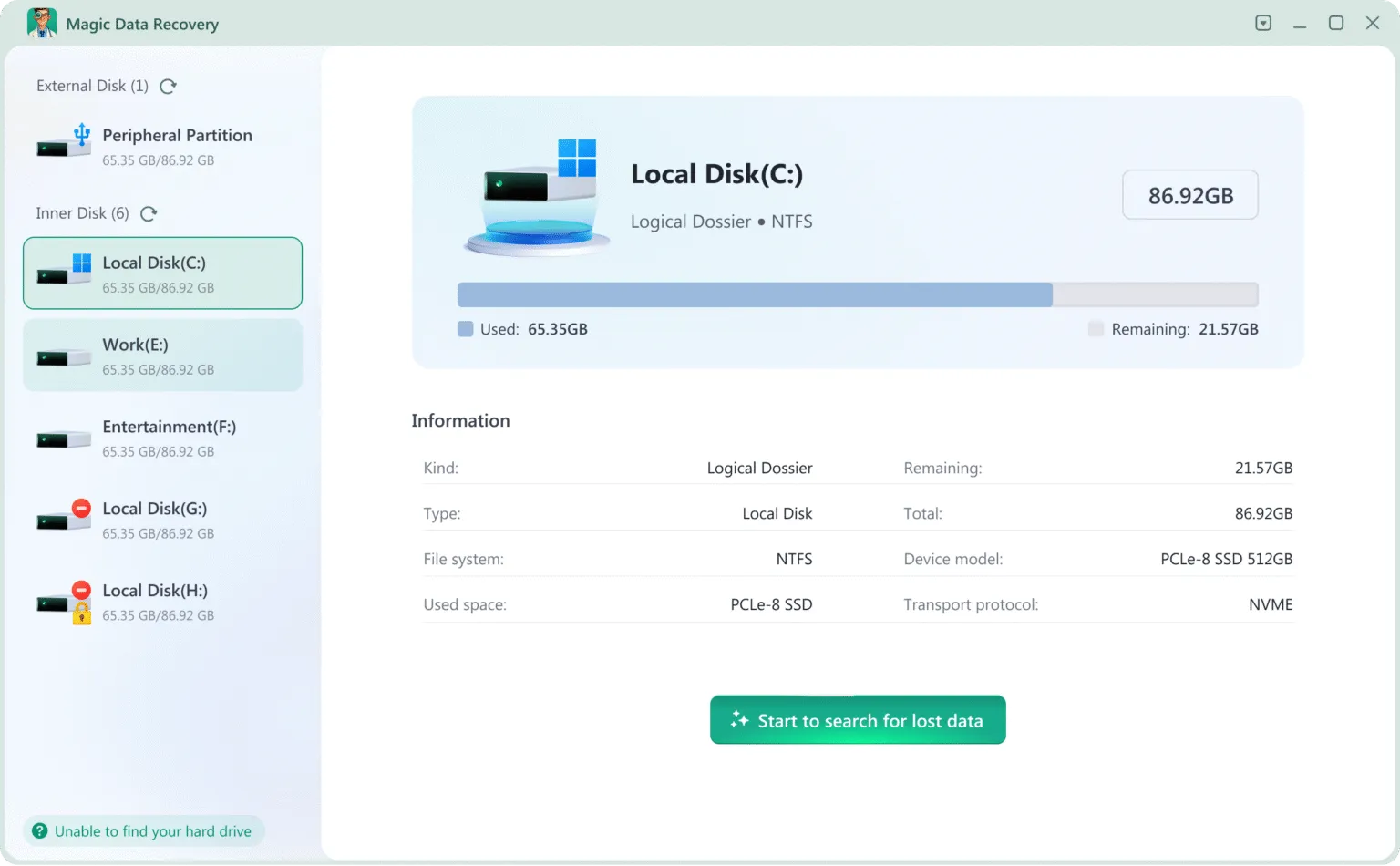
It addresses the real pain point: recovering data when a partition becomes inaccessible because of file system damage. It is also suitable beyond file system issues, including deleted files and formatted partitions, which makes it more useful than a one-case-only solution.
Key advantages
- Helps recover data from file system damage scenarios
- Supports deleted-file recovery
- Supports formatted-partition recovery
- Better aligned with users who need file recovery before deeper repair attempts
- More practical than relying only on system repair tools when the data itself matters most
Example use cases
- An NTFS partition becomes RAW after an improper shutdown
- A drive shows “access denied” or “file system not recognized”
- Important files disappear after formatting the wrong partition
- A damaged volume becomes unreadable after power loss
Why it can be more reliable than repair-first approaches
Built-in tools like chkdsk are designed to check and repair file system errors. That is useful, but repair is not always the first move when valuable data is at risk. In contrast, a recovery-first approach is often safer for inaccessible partitions because it focuses on retrieving files before structural changes are made. If you are looking for a more efficient solution in that situation, Magic Data Recovery is worth trying.
Conclusion
The NTFS journaling file system is the core windows journaling file system used on modern Windows systems. It improves reliability by logging critical file system changes, helping Windows recover consistency after crashes and reducing the risk of metadata corruption. At the same time, journaling is not a backup system, and it does not guarantee recovery from deletion, formatting, or severe partition damage. Microsoft’s NTFS and change journal documentation supports exactly that distinction.
That is why the best strategy is balanced: understand how the journaling file system windows users depend on actually works, use Windows repair tools carefully, and switch to recovery-first thinking when a partition becomes inaccessible or data has already been lost. In those cases, Magic Data Recovery is the recommended option because it is built for the real-world outcomes users care about: recovering data from file system problems, accidental deletion, and formatting mistakes.
Supports Windows 7/8/10/11 and Windows Server
FAQs
What is the NTFS journaling file system in simple terms?
The NTFS journaling file system is the default Windows file system that records key file system changes in a log before fully applying them. This helps Windows restore consistency after crashes or power loss. It mainly protects file system structure and metadata, which improves reliability, but it does not replace backups or full file recovery tools.
Is NTFS the main windows journaling file system?
Yes. NTFS is the default file system for modern Windows and is the main windows journaling file system most users interact with. Microsoft describes NTFS as the standard modern Windows file system and highlights its reliability, permissions, encryption, quotas, and metadata support, all of which make it the primary practical choice on Windows PCs.
Does journaling prevent data loss completely?
No. Journaling helps maintain file system consistency, especially after crashes, but it does not guarantee that all file content or unsaved user work will survive. It is best understood as a reliability mechanism for file system integrity, not a complete protection layer for every data-loss scenario. Backups and recovery tools still matter.
What is the difference between NTFS journaling and the USN journal?
NTFS journaling supports file system consistency and recovery, while the USN change journal tracks file and directory changes on a volume. The USN journal is useful for indexing, backup software, and change monitoring. However, Microsoft notes that it does not contain enough information to undo changes, so it is not the same as full recovery.
When should I run CHKDSK on an NTFS drive?
You should consider chkdsk when Windows reports file system errors, a partition becomes unreadable, the drive appears unstable, or you see messages suggesting corruption. Microsoft documents chkdsk as the built-in tool for checking logical and physical file system errors. Still, if critical files are at risk, recovering data first can be the safer path.
Can CHKDSK recover files from a damaged NTFS partition?
chkdsk can repair file system problems and, with /r, attempt to recover readable information from bad sectors. However, it is not a dedicated file recovery tool. If a partition is inaccessible and important files are missing, a recovery-first approach is often better because the priority is retrieving data before structural repairs change the volume further.
Is ReFS better than NTFS for Windows users?
ReFS offers strong resiliency features, including checksums and Storage Spaces integration, but Microsoft positions it mainly for Windows Server and large-scale storage scenarios. NTFS remains the default and more practical choice for most desktop and laptop users because of broader compatibility, boot support, and established Windows integration.
Why recommend Magic Data Recovery for file system problems?
When file system damage makes a partition inaccessible, the user’s real goal is usually data recovery, not just file system repair. That is why Magic Data Recovery makes sense at the final stage of this topic. It is relevant for file system-related loss, and it also supports deleted and formatted data recovery, which covers more real-world cases.

Jason is a data recovery and technical support specialist with over 15 years of hands-on experience. He has worked extensively with frontline users, troubleshooting difficult data loss cases and providing practical recovery solutions for accidental deletion, formatted drives, damaged file systems, lost partitions, system failures, and other recovery emergencies. His expertise also includes backup and restoration, file repair, and disaster recovery, with a strong emphasis on safe, reliable, and technically accurate guidance.