
Recover Recently Deleted Files Windows 11
If you need to recover recently deleted files windows 11, the first few minutes matter. A deleted document, photo, video, folder, or work file may still be recoverable, but the right method depends on how the file was deleted, where it was stored, and whether new data has overwritten it.
This guide explains the safest ways to restore deleted files on Windows 11. You will learn how to check the Recycle Bin, restore files from backup, use Windows File Recovery, and choose professional recovery software when built-in options are not enough. For a broader recovery overview, you can also visit this deleted file recovery guide from Amagicsoft.
In many real cases, users delete files normally, empty the Recycle Bin, press Shift + Delete, or lose files after formatting, file system errors, or other storage issues. When that happens, Magic Data Recovery can help scan the affected drive and restore lost files safely.
Supports Windows 7/8/10/11 and Windows Server
Table of Contents
Can You Recover Recently Deleted Files on Windows 11?
Yes, you can often recover recently deleted files windows 11 if you act quickly and avoid writing new data to the affected drive. Windows usually does not erase the actual file content immediately after deletion. Instead, it removes the file reference and marks that storage space as available.
However, recovery is not always guaranteed. The chance depends on several factors:
- Whether the file is still in the Recycle Bin
- Whether File History or another backup was enabled
- Whether the file was deleted from an HDD, SSD, USB drive, or external disk
- Whether new files have been saved to the same location
- Whether SSD TRIM has already cleared deleted data blocks
Therefore, the safest first step is simple: stop using the drive where the deleted files were stored. Do not install software, download files, or save recovered data back to the same drive.
What Happens When Files Are Deleted in Windows 11?
To recover recently deleted files windows 11, it helps to understand what deletion actually means.
When you delete a file normally, Windows usually sends it to the Recycle Bin. In that case, restoring it is easy. If you empty the Recycle Bin or use Shift + Delete, Windows removes the file entry from the file system. The data may still exist on the drive until another file overwrites it.
On traditional HDDs, deleted files may remain recoverable for a longer time if the disk has not been heavily used. On SSDs, recovery can be harder because TRIM may clear deleted data quickly. This is why fast action matters.
For deeper background on emptied Recycle Bin cases, read this related guide on how to recover files deleted from Recycle Bin.
Method 1: Restore Recently Deleted Files from Recycle Bin
The Recycle Bin should always be your first stop. It is the fastest and safest way to recover recently deleted files windows 11 after a normal deletion.
Steps to restore files from Recycle Bin
- Open Recycle Bin from the desktop.
- Search for the deleted file or folder.
- Right-click the item.
- Choose Restore.
- Check the original folder where the file was stored.
This method works only if the file was deleted normally and the Recycle Bin has not been emptied. It may not work for files deleted from some removable drives, files removed with Shift + Delete, or files deleted by cleanup tools.
Best for
- Accidental deletion
- Recently deleted desktop files
- Deleted documents, photos, videos, and folders still visible in Recycle Bin
Not suitable for
- Emptied Recycle Bin
- Shift + Delete
- Formatted drives
- RAW drives or file system errors
Method 2: Use Undo Delete Immediately
If you just deleted a file in File Explorer, you may be able to undo the action before doing anything else.
Press:
Ctrl + Z
Alternatively, right-click inside the folder and choose Undo Delete if the option appears.
This is a useful small trick when the deletion happened seconds ago. However, it only works in limited situations. If you restarted the computer, performed other file operations, emptied the Recycle Bin, or deleted files from another app, this method may no longer help.
Method 3: Recover Recently Deleted Files with File History
File History is a Windows backup feature. If it was enabled before deletion, it can help you recover recently deleted files windows 11 without third-party software.
Steps to restore files with File History
- Connect the backup drive if you use an external backup device.
- Open Control Panel.
- Go to System and Security.
- Click File History.
- Choose Restore personal files.
- Browse previous versions.
- Select the files or folders you need.
- Click the restore button.
File History works well for personal folders such as Documents, Pictures, Videos, Music, and Desktop, depending on your backup settings.
Best for
- Users who enabled backup before deletion
- Restoring previous versions of documents
- Recovering folders deleted from protected libraries
Limitation
File History cannot recover files if it was not turned on before the files were deleted. It also may not include every folder unless the backup configuration covers that location.
Method 4: Restore Previous Versions
Windows may offer previous versions of a file or folder if File History, restore points, or backup features were active.
Steps to check previous versions
- Open File Explorer.
- Go to the folder where the file was located.
- Right-click the folder.
- Select Properties.
- Open the Previous Versions tab.
- Choose an available version.
- Click Restore or Open to inspect it first.
This method is especially helpful when a folder was changed, replaced, or partially deleted. For folder-specific recovery examples, you can read this guide on how to recover a deleted folder in Windows.
Method 5: Use Windows File Recovery
Windows File Recovery is Microsoft’s command-line recovery tool. It can help recover deleted files from local storage devices, including internal drives, external drives, and USB devices. However, it is not as beginner-friendly as a graphical recovery tool.
Basic workflow
- Install Windows File Recovery from Microsoft Store.
- Open Command Prompt or Windows Terminal as administrator.
- Run a recovery command based on the source drive, destination drive, and file type.
- Save recovered files to a different drive.
For example, users may recover documents, photos, videos, or specific file extensions with different command modes. However, the exact command format can confuse ordinary users.
Best for
- Advanced users
- Users comfortable with command-line tools
- Local drive recovery when no backup exists
Limitation
Windows File Recovery does not provide a visual preview before recovery. It also requires correct command syntax. If you are not sure which mode or file path to use, a visual tool may be easier and safer.
Method 6: Recover Recently Deleted Files with Magic Data Recovery
When Recycle Bin, File History, and Previous Versions cannot find your files, you need a stronger solution. This is where Magic Data Recovery becomes useful.
Magic Data Recovery is designed to help users recover files lost due to deletion, formatting, file system errors, and other common data loss scenarios. It works on Windows and supports recovery from internal drives, external drives, USB devices, memory cards, and other storage media that Windows can detect.
If your goal is to recover recently deleted files windows 11 without using complex command lines, Magic Data Recovery provides a clearer workflow.
Why Magic Data Recovery is useful
Magic Data Recovery addresses several common recovery pain points:
- It scans for files that Windows can no longer show.
- It supports deleted, formatted, and file-system-error recovery scenarios.
- It lets users preview recoverable files before saving them.
- It helps locate documents, photos, videos, audio files, archives, and more.
- It uses a user-friendly interface for ordinary Windows users.
- It avoids command-line complexity.
You can check the official Magic Data Recovery product page for more details.
How to use Magic Data Recovery
- Download and install Magic Data Recovery.
Do not install it on the same drive where the deleted files were stored.
Supports Windows 7/8/10/11 and Windows Server
- Launch the software.
Select the drive or partition where the files were deleted.
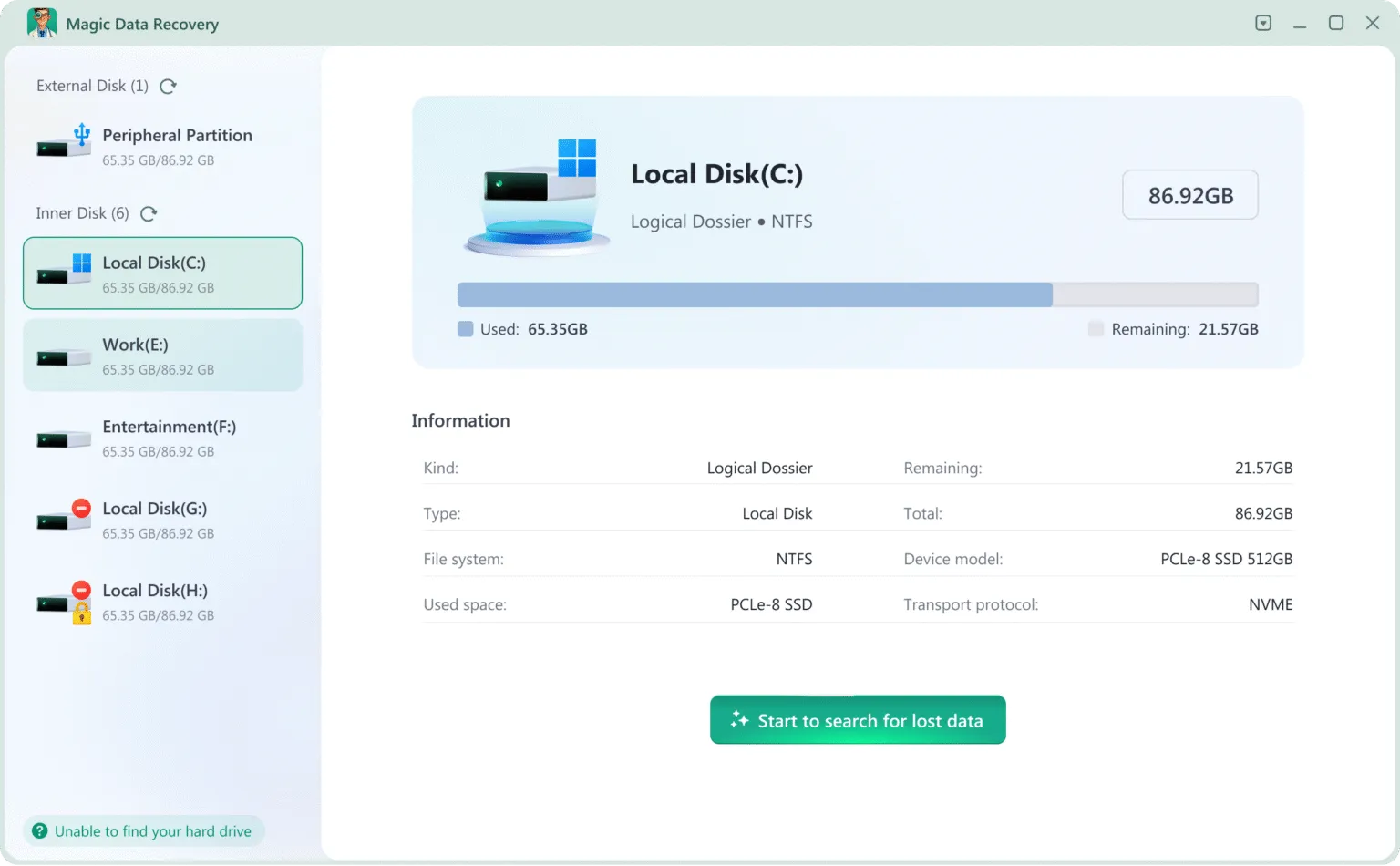
- Start scanning.
Let the software search for recently deleted and lost files.
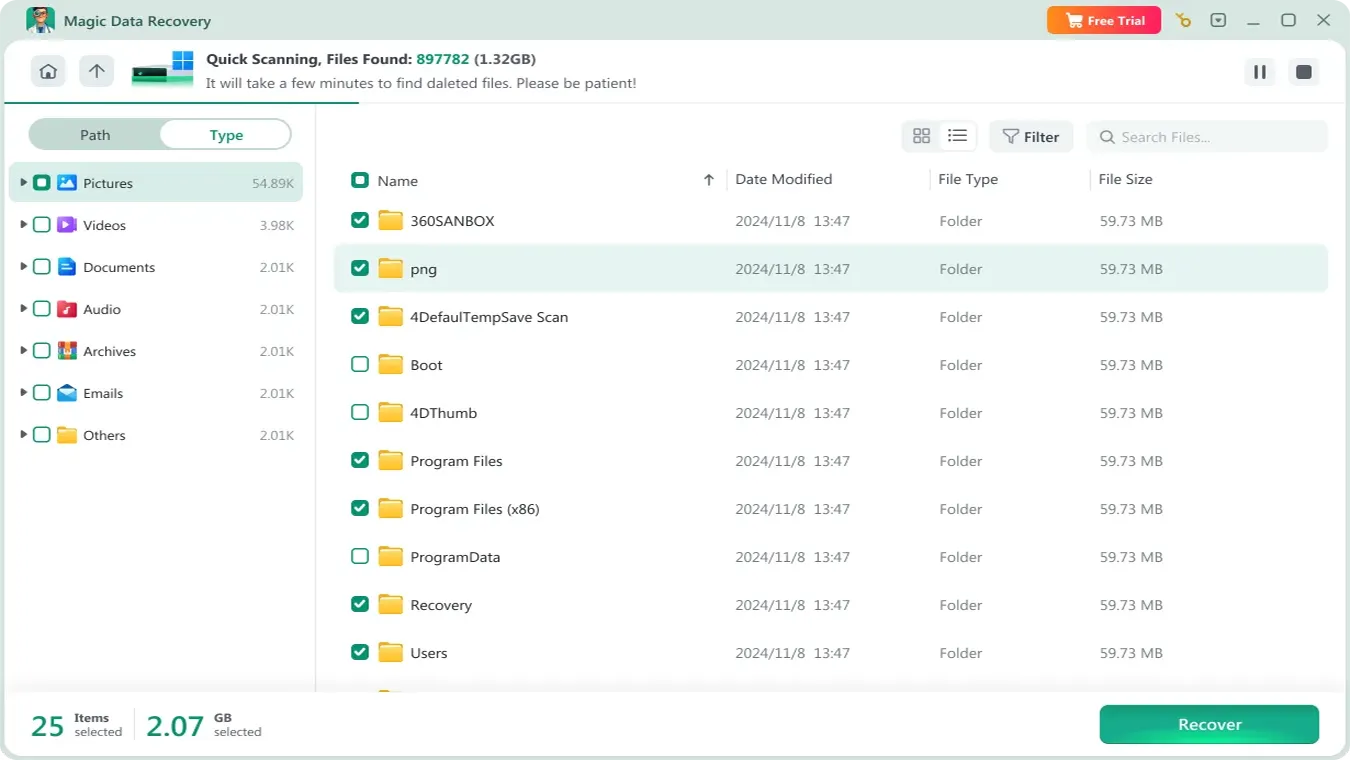
- Preview the results.
Check whether the files are readable and useful before recovery.

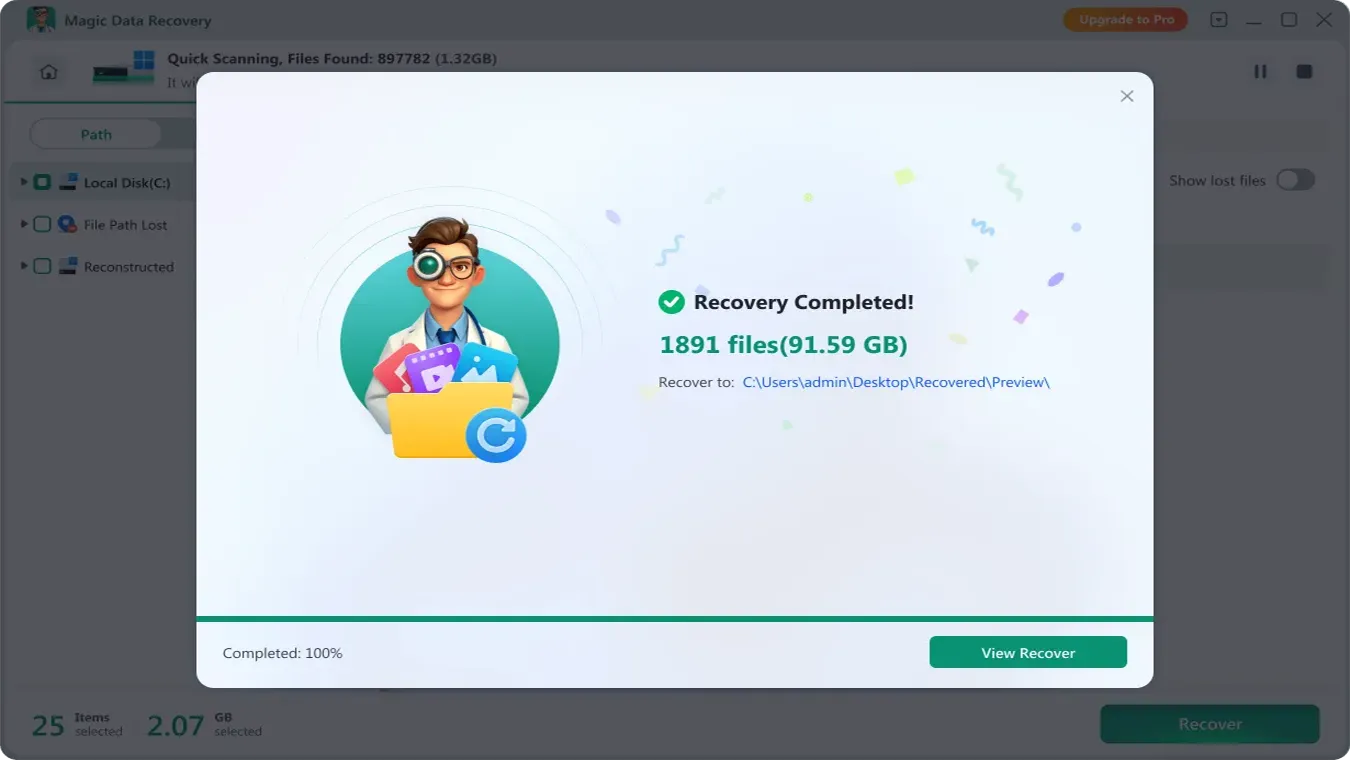
- Recover to a safe location.
Save recovered files to another drive, not the original one.
For step-by-step product instructions, refer to the Magic Data Recovery user guide.
Magic Data Recovery vs Built-in Windows Methods
Built-in Windows tools should always be checked first. They are safe and free when the right backup exists. However, they have clear limits.
Method | Best Use Case | Main Limitation |
Recycle Bin | Normal deletion | Fails after emptying or Shift + Delete |
Undo Delete | Immediate deletion mistake | Only works right after deletion |
File History | Backup-based recovery | Must be enabled before deletion |
Previous Versions | Restoring older folder versions | Depends on backup/restore settings |
Windows File Recovery | Advanced local recovery | Command-line workflow |
Magic Data Recovery | Deleted, formatted, and file-system-error recovery | Recovery depends on overwrite status |
In practical terms, Magic Data Recovery is more reliable when Windows no longer shows the file, no backup exists, or the deletion happened together with formatting, drive errors, or file system problems.
If you need a broader Windows recovery workflow, this guide on how to recover lost files on Windows may also help.
What to Do Before Recovering Deleted Files
Before trying to recover recently deleted files windows 11, follow these best practices:
Stop using the affected drive
Every new file can overwrite deleted data. Avoid downloads, installations, updates, and file transfers on the same drive.
Do not restore files to the original location
Always recover files to another drive. This prevents recovered files from overwriting other deleted data.
Check backups first
Look at File History, OneDrive, external backups, and previous versions before scanning the drive.
Avoid random repair commands
Commands like CHKDSK may help with disk errors, but they can also change file system structures. If your files are important, recover data first and repair the disk later.
Act faster on SSDs
SSD recovery may become difficult sooner because of TRIM. Start recovery as soon as you notice the loss.
Common Mistakes That Reduce Recovery Success
Many failed recovery cases happen because users act too late or use the wrong workflow. Avoid these mistakes:
- Installing recovery software on the same drive
- Saving recovered files back to the source drive
- Continuing to use the computer after deletion
- Formatting the drive again
- Running disk repair before data recovery
- Trying too many tools repeatedly on an unstable drive
- Ignoring unusual drive noises or hardware failure signs
If the drive makes clicking sounds, disconnects frequently, or is not detected at all, software may not be the right first choice. In that case, professional hardware recovery may be safer.
When Should You Use Recovery Software?
You should consider recovery software when:
- The file is not in Recycle Bin
- The Recycle Bin was emptied
- Shift + Delete was used
- File History was not enabled
- Previous Versions are unavailable
- Windows File Recovery feels too complex
- Files disappeared after formatting
- The drive shows file system errors
- A folder structure is missing
For users who want a simpler and more visual solution, Magic Data Recovery is a practical choice. It gives you a structured way to scan, preview, and restore files instead of relying on guesswork.
To compare recovery steps in more detail, you can also read Amagicsoft’s guide on how to retrieve deleted files.
How to Improve Your Recovery Chance
To improve your chance to recover recently deleted files windows 11, follow this order:
- Check Recycle Bin.
- Try Ctrl + Z if the deletion just happened.
- Check File History.
- Check Previous Versions.
- Search OneDrive or other cloud backups.
- Use Windows File Recovery if you are comfortable with commands.
- Use Magic Data Recovery if no built-in method works.
- Save recovered files to another drive.
This order keeps the process safe and logical. It also avoids unnecessary scanning when a simple restore option still exists.
Conclusion
Learning how to recover recently deleted files windows 11 is not only about choosing a tool. It is about choosing the right method at the right time. If the files are still in Recycle Bin, restore them directly. If backups exist, use File History or Previous Versions. If no backup is available, recovery software becomes the more practical option.
Magic Data Recovery is recommended because it solves the core problem that built-in Windows tools often cannot handle: files that are no longer visible, permanently deleted, lost after formatting, or affected by file system errors. It offers a visual workflow, file preview, support for common storage devices, and a safer recovery process for ordinary users.
If you are looking for a more efficient solution, you can try Magic Data Recovery and start from this deleted file recovery guide. You can also visit the Magic Data Recovery purchase page when you are ready to recover important files with the full version.
Supports Windows 7/8/10/11 and Windows Server
FAQs
How do I recover recently deleted files in Windows 11?
Start with the Recycle Bin. If the files are there, right-click and choose Restore. If the Recycle Bin is empty, check File History, Previous Versions, or cloud backups. When no backup exists, use recovery software like Magic Data Recovery to scan the original drive and restore files to another location.
Can I recover recently deleted files Windows 11 after emptying Recycle Bin?
Yes, recovery may still be possible after emptying the Recycle Bin, especially if the deleted data has not been overwritten. Stop using the affected drive immediately. Then use a reliable recovery tool to scan for deleted file records and recover the files to a different drive.
Where do recently deleted files go in Windows 11?
Normally deleted files go to the Recycle Bin first. After the Recycle Bin is emptied or Shift + Delete is used, Windows removes the file reference and marks the space as reusable. The actual data may remain on the drive until new data overwrites it.
Can File History recover recently deleted files?
Yes, File History can restore deleted files if it was enabled before the deletion happened. It saves backup versions of selected personal folders. However, it cannot recover files from folders that were never included in the backup or from a system where File History was not turned on.
Is Windows File Recovery good for Windows 11 deleted file recovery?
Windows File Recovery can help recover deleted files from local drives, but it uses command-line operations. It may be suitable for advanced users who understand recovery modes, paths, and file extensions. Beginners may prefer a graphical tool that offers scanning, filtering, previewing, and easier file selection.
Can I recover Shift + Deleted files in Windows 11?
Yes, Shift + Deleted files may be recoverable if the storage space has not been overwritten. Since these files bypass the Recycle Bin, you should stop using the drive immediately. Then check backups or use recovery software to scan the original location and save recovered files elsewhere.
Why should I not save recovered files to the same drive?
Saving recovered files to the same drive can overwrite other deleted data that has not yet been restored. This may reduce the chance of recovering additional files. Always use another internal drive, external drive, USB storage device, or separate partition as the recovery destination.
Is Magic Data Recovery suitable for Windows 11 users?
Yes, Magic Data Recovery is suitable for Windows 11 users who need to recover deleted, formatted, or otherwise lost files. It provides a visual recovery workflow, supports common storage devices and file types, and helps users preview files before recovery. It is especially useful when built-in Windows methods cannot find the missing files.

Jason has over 15 years of hands-on experience in the computer data security industry. He specializes in data recovery, backup and restoration, and file repair technologies, and has helped millions of users worldwide resolve complex data loss and security issues.