
Recover Lost Files on Windows: Complete Guide
Losing an important document, folder, video, or photo can feel stressful, especially when the file is not in the Recycle Bin. The good news is that you still have several practical ways to recover lost files on Windows, as long as you act quickly and avoid writing new data to the affected drive.
This guide explains how file loss happens, what you should do first, how to use built-in Windows recovery options, and when professional recovery software becomes the better solution. If you need a simpler way to recover lost data from deletion, formatting, file system errors, system reinstallation, or virus damage, Magic Data Recovery can help you scan, preview, and restore files with fewer technical steps.
Supports Windows 7/8/10/11 and Windows Server
Table of Contents
Why Files Get Lost on Windows
A lost file does not always mean the file content has disappeared immediately. In many cases, Windows only removes the file’s index information and marks its storage space as available. Until new data overwrites that space, recovery may still be possible.
Common causes include:
- Accidental deletion or Shift + Delete
- Emptying the Recycle Bin
- Formatting the wrong drive
- File system corruption or RAW drive errors
- Failed Windows update or system reinstall
- Virus or malware damage
- Power failure during file transfer
- Damaged USB drive, SD card, HDD, or SSD
Therefore, the first rule is simple: stop using the affected drive. Do not download new files, install software, copy folders, or save recovered files back to the same location.
What to Do First Before Trying Recovery
Before using any advanced method to recover lost files, take these steps:
- Stop using the drive immediately.
New files may overwrite the deleted data.
- Check the Recycle Bin.
If the file was deleted normally, you may restore it in seconds.
- Search by file name or extension.
Sometimes a file is moved, renamed, or hidden.
- Check cloud sync folders.
OneDrive, Google Drive, or Dropbox may still have a copy.
- Use a different drive for recovery.
Save recovered files to an external disk, USB drive, or another partition.
These actions improve your chance of recovery and reduce the risk of permanent loss.
Method 1: Recover Lost Files from the Recycle Bin
The Recycle Bin is the easiest place to start. If you deleted a file with the Delete key or right-click menu, Windows may keep it there.
Steps
- Open the Recycle Bin from the desktop.
- Search for the missing file name.
- Right-click the file.
- Choose Restore.
- Check the original folder.
This method works well for recently deleted files. However, it will not help if you used Shift + Delete, emptied the Recycle Bin, deleted files from an external drive, or lost data after formatting.
Method 2: Search for a Missing or Hidden File
Sometimes users think they need to recover lost files, but the files are only hidden or moved.
Try these checks:
- Open File Explorer and search by file name.
- Search by extension, such as .docx, .xlsx, .jpg, or .mp4.
- Enable hidden items in File Explorer.
- Check Downloads, Desktop, Documents, Pictures, and temporary folders.
- Review recent files in Microsoft Word, Excel, Photoshop, or other apps.
This step is especially useful when you remember part of the file name but cannot find the original location.
Method 3: Recover Lost Files Windows 10 with File History
If File History was enabled before the file loss happened, it can restore previous versions of files from backed-up folders.
Steps
- Open Control Panel.
- Go to File History.
- Click Restore personal files.
- Browse previous versions.
- Select the file or folder.
- Click the restore button.
This is one of the safest ways to recover lost files windows 10, because it uses an existing backup. However, many users only discover File History after losing files. If it was not enabled, this method will not work.
Method 4: Restore Previous Versions
Windows may store previous versions of folders through File History or restore points.
Steps
- Right-click the folder where the file was stored.
- Choose Properties.
- Open the Previous Versions tab.
- Select a version created before the file was lost.
- Click Open to check it.
- Click Restore if it contains the missing file.
This method is useful for overwritten documents, accidentally changed folders, or deleted files from common user folders. Still, it depends on whether Windows created previous versions earlier.
Method 5: Use Windows File Recovery
Windows File Recovery is Microsoft’s command-line recovery tool. It can help recover files from local storage devices such as internal drives, external drives, and USB devices. However, it requires command-line input, so beginners may find it less friendly.
A typical command looks like this:
- winfr C: E: /regular /n \Users\YourName\Documents\
In this example, Windows scans drive C and saves recovered files to drive E.
This method can help technical users, but it has limitations. You need to know the source drive, destination drive, recovery mode, and file path. For many everyday users, a visual recovery tool is easier and less risky.
Method 6: Recover Lost Photos from SD Cards, Cameras, and Drives
Photos are among the most commonly lost files. Users often need to recover lost photos after deleting camera images, formatting an SD card, removing a memory card too early, or transferring files incorrectly.
Before recovery:
- Do not take new photos on the same card.
- Remove the SD card from the camera.
- Use a card reader instead of connecting the camera directly.
- Scan the card with recovery software.
- Save recovered photos to a computer drive, not the same card.
Photo recovery often works best when the storage card has not been reused. If you continue shooting new images, old photo data may be overwritten.
When Built-In Methods Are Not Enough
Built-in Windows tools are helpful, but they usually depend on backups, previous versions, or command-line skills. They may not solve more complex cases, such as:
- The Recycle Bin was emptied.
- The drive was formatted.
- The partition became RAW.
- The file system shows errors.
- Windows was reinstalled.
- A virus deleted or damaged files.
- The missing file came from a USB drive, SD card, or external HDD.
- You need to recover many file types at once.
At this stage, dedicated data recovery software becomes more practical.
Recommended Solution: Magic Data Recovery
Magic Data Recovery is designed for users who need a clear and efficient way to recover lost files without complex commands. It supports recovery from accidental deletion, formatted drives, file system errors, system reinstallation, virus damage, and other common data loss scenarios.
It can recover documents, photos, videos, audio files, archives, emails, and many other data types. According to Amagicsoft, Magic Data Recovery supports more than 5000 file formats, including DOCX, XLSX, PDF, JPG, PNG, RAW images, MP4, MOV, ZIP, RAR, PST, and more.
Core Pain Points It Solves
Magic Data Recovery is useful when:
- You cannot find a lost file in the Recycle Bin.
- File History was never enabled.
- Windows File Recovery feels too technical.
- A USB drive or SD card asks to be formatted.
- A partition disappears or becomes inaccessible.
- You need to recover lost photos from a camera card.
- You want to preview files before restoring them.
Key Advantages
Magic Data Recovery offers several practical benefits:
- Wide file format support: 5000+ file formats.
- Multiple device support: HDDs, SSDs, USB drives, SD cards, memory cards, external drives, and more.
- Beginner-friendly workflow: Select, scan, preview, and recover.
- Preview before recovery: Check whether files are recoverable before saving.
- Useful filters: Search by file type, size, date, or name.
- Safer recovery habit: Save recovered files to a different location.
Unlike manual methods, Magic Data Recovery does not require command-line knowledge. Compared with backup-only methods, it can help even when no backup exists, as long as the original data has not been overwritten.
How to Recover Lost Files with Magic Data Recovery
Follow these steps:
Step 1: Install the Software Safely
Download and install Magic Data Recovery. If possible, install it on a different drive from the one where files were lost. For example, if files disappeared from drive D, install the software on drive C or use another computer.
Supports Windows 7/8/10/11 and Windows Server
Step 2: Select the Affected Drive
Open the program and choose the drive, partition, USB device, SD card, or external disk where the missing files were stored.
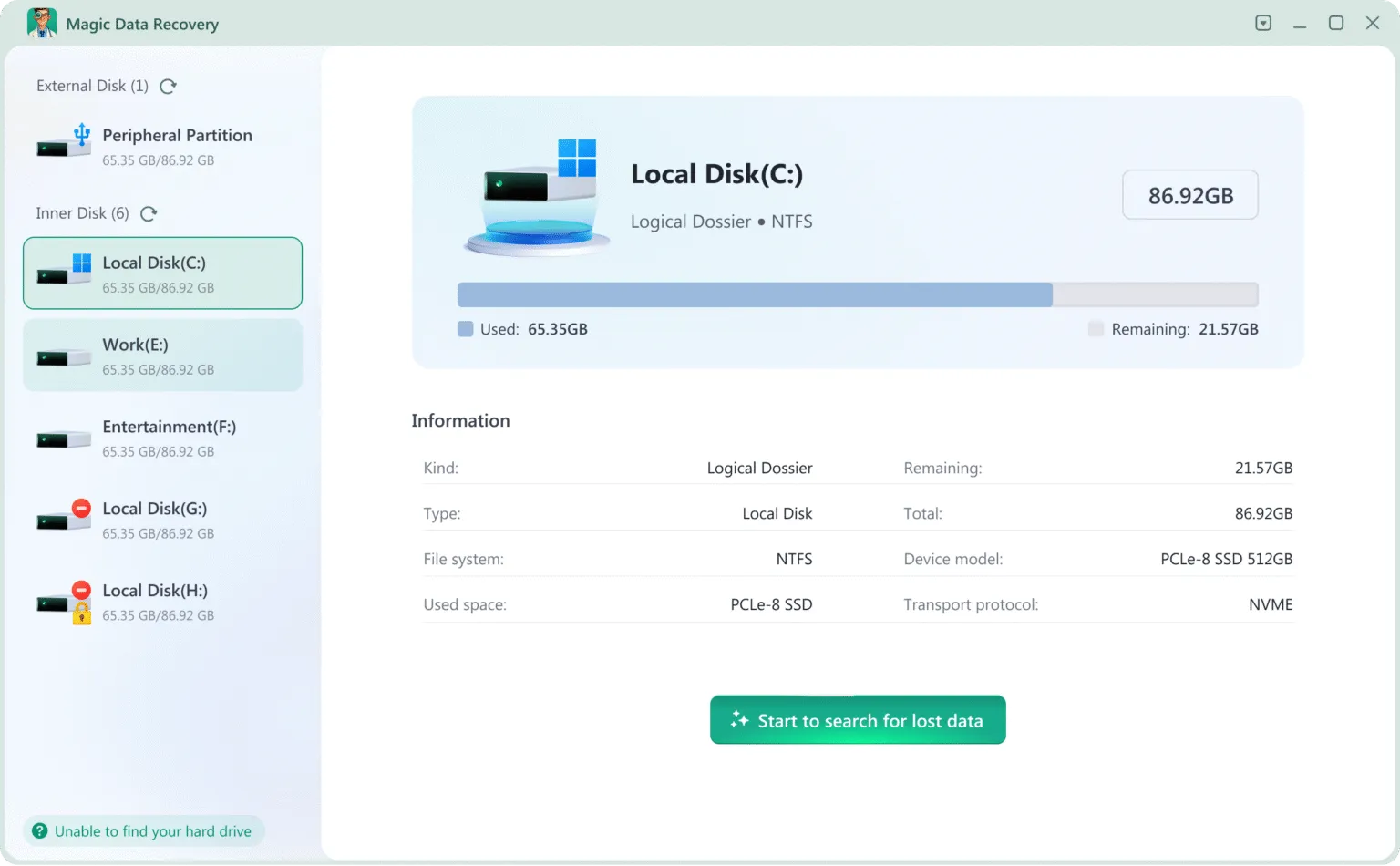
Step 3: Start the Scan
Run a scan to search for deleted, formatted, corrupted, or missing files. For larger drives, the scan may take longer, but deeper scanning can find more results.
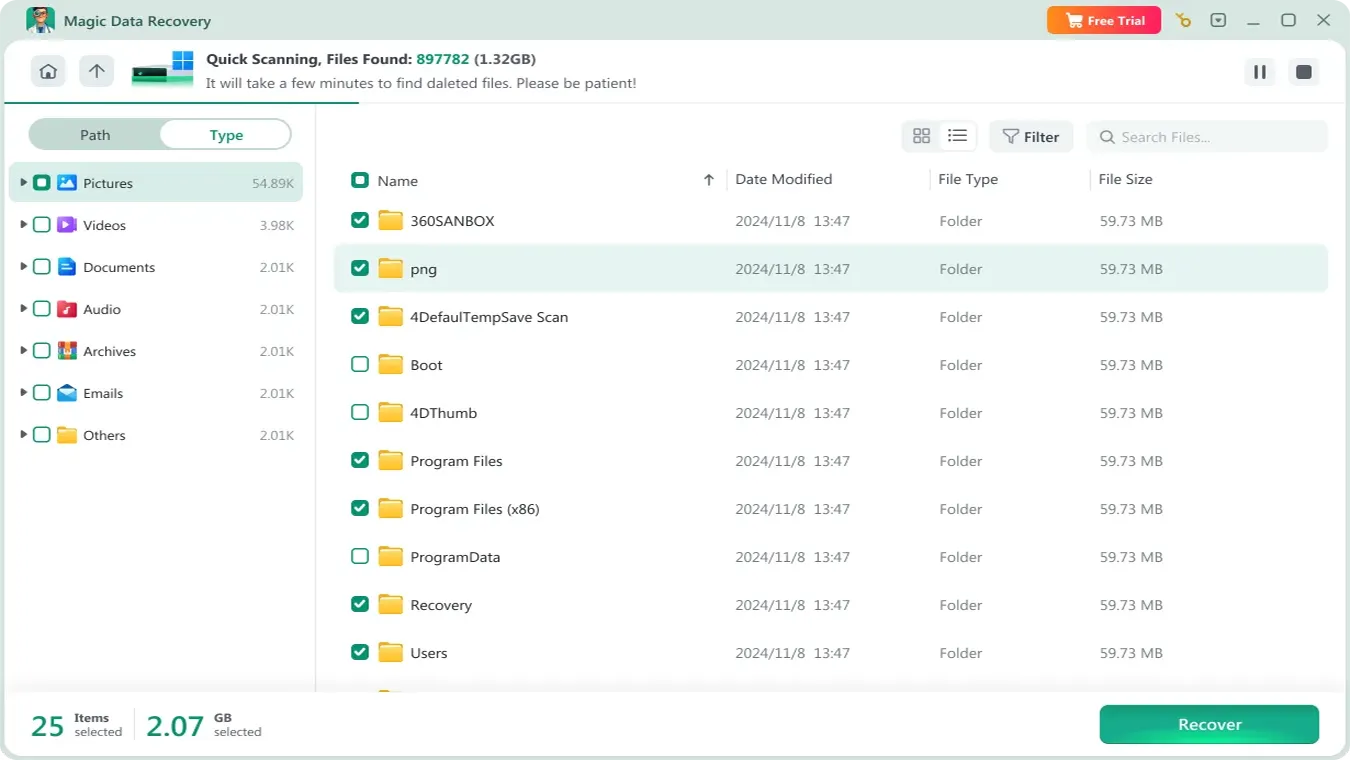
Step 4: Preview Recoverable Files
Use file type filters or search by name to find what you need. Preview documents, photos, videos, and other files when available.

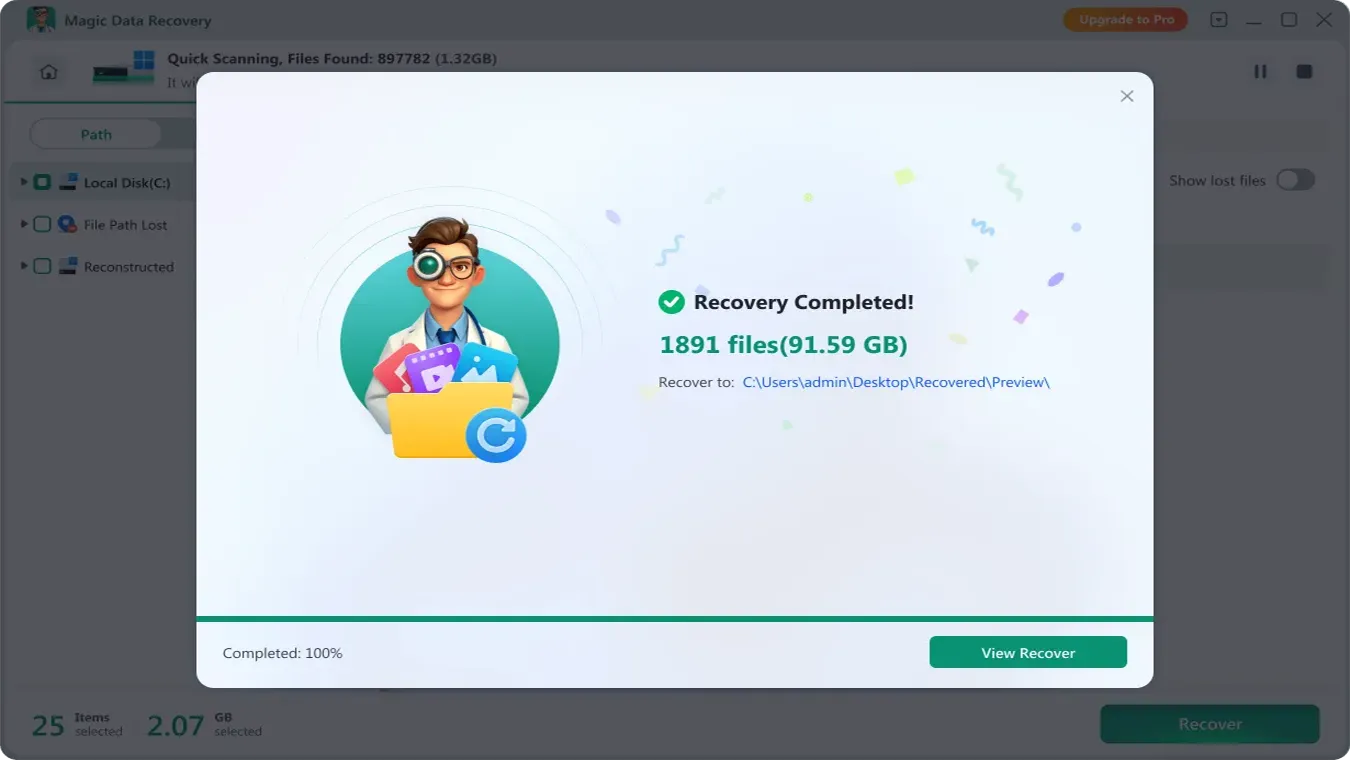
Step 5: Recover and Save to Another Drive
Select the files and save them to a safe location. Never restore them to the original drive before recovery finishes, because that may overwrite other lost data.
Magic Data Recovery vs Built-In Windows Methods
Method | Best For | Limitations |
Recycle Bin | Recently deleted files | Does not work after emptying or Shift + Delete |
File History | Backed-up files | Must be enabled before data loss |
Previous Versions | Older folder versions | Depends on restore points or backup settings |
Windows File Recovery | Technical users | Command-line interface can be difficult |
Magic Data Recovery | Deletion, formatting, RAW drives, virus damage, photo recovery | Recovery depends on whether data was overwritten |
For ordinary users, Magic Data Recovery offers a better balance between usability, recovery depth, and supported scenarios.
Tips to Improve Your Recovery Success Rate
To increase your chance to recover lost data, follow these best practices:
- Stop using the affected drive immediately.
- Do not format the drive when Windows asks you to.
- Do not install recovery software on the same drive.
- Do not save recovered files to the source drive.
- Recover the most important files first.
- Use preview to confirm file quality.
- Create regular backups after recovery.
These tips matter because deleted data can remain recoverable only until Windows or another app overwrites the same storage space.
How to Prevent File Loss in the Future
Recovery is helpful, but prevention is better. After you recover lost files, build a safer backup routine.
Use the 3-2-1 backup rule:
- Keep 3 copies of important files.
- Store them on 2 different types of media.
- Keep 1 copy off-site or in the cloud.
You can also enable File History, use OneDrive or another cloud service, create system restore points, and keep an external drive for weekly backups.
Conclusion
When you need to recover lost files, start with simple methods such as the Recycle Bin, File History, Previous Versions, and cloud backups. If those options fail, avoid using the affected drive and switch to a dedicated recovery tool.
Magic Data Recovery is recommended because it solves the most common recovery pain points in one workflow. It supports deleted files, formatted drives, file system errors, system reinstallations, virus damage, and 5000+ file formats. More importantly, it lets users scan, preview, and recover files without needing technical commands.
If you are looking for a more efficient solution to recover lost data, especially from Windows drives, USB devices, SD cards, or external storage, Magic Data Recovery is worth trying.
FAQs
Can I recover lost files after emptying the Recycle Bin?
Yes, you may still recover lost files after emptying the Recycle Bin if the original data has not been overwritten. Stop using the drive immediately and scan it with reliable data recovery software. The sooner you act, the better your chance of finding complete and usable files.
How can I recover lost files Windows 10 without software?
You can recover lost files Windows 10 without software by checking the Recycle Bin, File History, Previous Versions, Backup and Restore, or cloud storage. However, these methods usually require a previous backup or restore point. If no backup exists, recovery software may be necessary.
Why should I not save recovered files to the same drive?
Saving recovered files to the same drive can overwrite other lost data that has not yet been restored. This reduces your recovery success rate. Always save recovered files to another drive, such as an external disk, USB device, or different internal partition.
Can I recover lost photos from a formatted SD card?
Yes, you can often recover lost photos from a formatted SD card if you stop using the card immediately. Do not take new photos or copy files to it. Use recovery software to scan the card, preview images, and save recovered photos to your computer.
Is Magic Data Recovery suitable for beginners?
Yes. Magic Data Recovery is designed with a simple workflow: select the drive, scan, preview files, and recover them. It avoids complex command-line steps, which makes it suitable for ordinary users who need to recover lost files from Windows drives, USB devices, SD cards, or external disks.
What types of files can Magic Data Recovery restore?
Magic Data Recovery supports more than 5000 file formats, including documents, photos, videos, audio files, archives, emails, and databases. Common examples include DOCX, XLSX, PDF, JPG, PNG, RAW photos, MP4, MOV, ZIP, RAR, and PST files.
Can I recover lost data after reinstalling Windows?
In many cases, yes. You may recover lost data after reinstalling Windows if the files were not overwritten during installation or later use. Stop using the computer as much as possible, connect the drive to another PC if needed, and scan it with recovery software.
What is the best way to avoid losing files again?
The best way is to create regular backups. Use File History, cloud sync, and an external drive. For important work files and photos, follow the 3-2-1 backup rule: keep three copies, use two storage types, and keep one copy off-site or in the cloud.

Jason is a data recovery and technical support specialist with over 15 years of hands-on experience. He has worked extensively with frontline users, troubleshooting difficult data loss cases and providing practical recovery solutions for accidental deletion, formatted drives, damaged file systems, lost partitions, system failures, and other recovery emergencies. His expertise also includes backup and restoration, file repair, and disaster recovery, with a strong emphasis on safe, reliable, and technically accurate guidance.