
How to Recover Files After Factory Reset
A Windows factory reset can fix system problems, remove unwanted apps, and make a PC feel fresh again. However, it can also create a stressful situation when important documents, photos, videos, downloads, or work files disappear. If you need to recover files after factory reset, the most important rule is simple: stop using the affected computer as much as possible.
When Windows resets a PC, the recovery result depends on the reset option you chose, the storage device type, encryption status, and how much new data has been written afterward. In some cases, backups can restore everything quickly. In other cases, you need a deeper scan. This guide explains how to recover files after factory reset Windows 11 and how to recover files after factory reset Windows 10 with safe, practical methods.
If your factory reset removed data in a way similar to formatting or reinstalling Windows, you can also start from Amagicsoft’s formatted drive recovery guide to understand how formatted or reset storage recovery works and how to use the best tool Magic Data Recovery.
Supports Windows 7/8/10/11 and Windows Server
Table of Contents
Can You Recover Files After Factory Reset?
Yes, you may be able to recover files after factory reset, but recovery is not always possible. It depends on what happened during and after the reset.
Windows usually provides two reset choices:
Reset Option | What It Does | Recovery Outlook |
Keep my files | Reinstalls Windows while keeping personal files | Usually safer, but apps and settings may be removed |
Remove everything | Removes personal files, apps, and settings | Recovery may be possible if data was not overwritten |
Clean data enabled | Cleans the drive more deeply | Recovery becomes much harder |
Cloud download | Downloads Windows again before reinstalling | Does not directly decide recovery chance |
Local reinstall | Uses local Windows files to reinstall | Does not directly decide recovery chance |
In real cases, many users choose “Remove everything” because they want to fix a serious system issue. After the reset, they realize that Desktop, Documents, Pictures, or Downloads folders are missing. If the drive has not been overwritten, recovery software may still find some lost files.
However, you should not expect every file to return. SSDs, BitLocker encryption, full drive cleaning, and heavy computer use after the reset can reduce recovery chances.
What to Do First After a Factory Reset
Before trying to recover files after factory reset, protect the remaining data. Wrong actions can make recoverable files unrecoverable.
Take these steps first:
- Stop saving new files to the PC.
- Do not reinstall large apps or games.
- Do not download recovery software to the same drive where files were lost.
- Do not run disk cleanup tools.
- Avoid defragmenting or optimizing the drive.
- Prepare another drive to save recovered files.
- If possible, use another computer to download recovery software.
For example, if your files were on drive C:, do not install anything new to C:. Instead, download the recovery tool on another computer or install it on a different drive. This reduces the risk of overwriting lost files.
Why Factory Reset File Recovery Is Different from Simple Deletion
Simple deletion usually removes a file reference and sends the item to the Recycle Bin. A factory reset changes much more. It may remove user accounts, reinstall Windows, replace system folders, and create new files during setup. Therefore, recover files after factory reset is more complex than ordinary deleted file recovery.
The reset process may affect:
- User profile folders
- Desktop files
- Documents and Downloads
- App data
- Browser downloads
- Local project folders
- Email archives
- Photos and videos
- Old Windows system files
In addition, Windows may write new setup files, drivers, updates, and user profile data after the reset. Each new write action can overwrite old file sectors. That is why fast action matters.
How to Recover Files After Factory Reset Windows 11
If you need to recover files after factory reset Windows 11, start with backup-based methods first. They are safer because they do not scan or modify the reset drive. If backups fail, use recovery software.
Method 1: Check Windows Backup and OneDrive
Windows 11 often encourages users to sign in with a Microsoft account. As a result, some Desktop, Documents, and Pictures files may have synced to OneDrive before the reset.
Check these places:
- OneDrive folder on the current PC
- OneDrive web account
- OneDrive Recycle Bin
- Windows Backup restore options
- External backup drives
- Other synced folders such as Google Drive or Dropbox
This method works best if sync or backup was enabled before the reset. If no backup exists, move to a deeper recovery method.
Method 2: Check File History
File History can restore earlier versions of personal files, but only if it was enabled before data loss.
Follow these steps:
- Connect the backup drive used for File History.
- Open Control Panel.
- Go to System and Security.
- Open File History.
- Choose Restore personal files.
- Browse available versions.
- Restore needed files to a safe location.
File History is useful for documents, pictures, videos, and desktop files. However, it cannot recover files that were never backed up.
Method 3: Use Magic Data Recovery for Windows 11
When backup methods fail, Magic Data Recovery becomes a practical solution. It helps users scan storage devices for lost, deleted, formatted, or inaccessible files. More importantly, it provides a visual workflow, so users do not need to rely on command-line recovery.
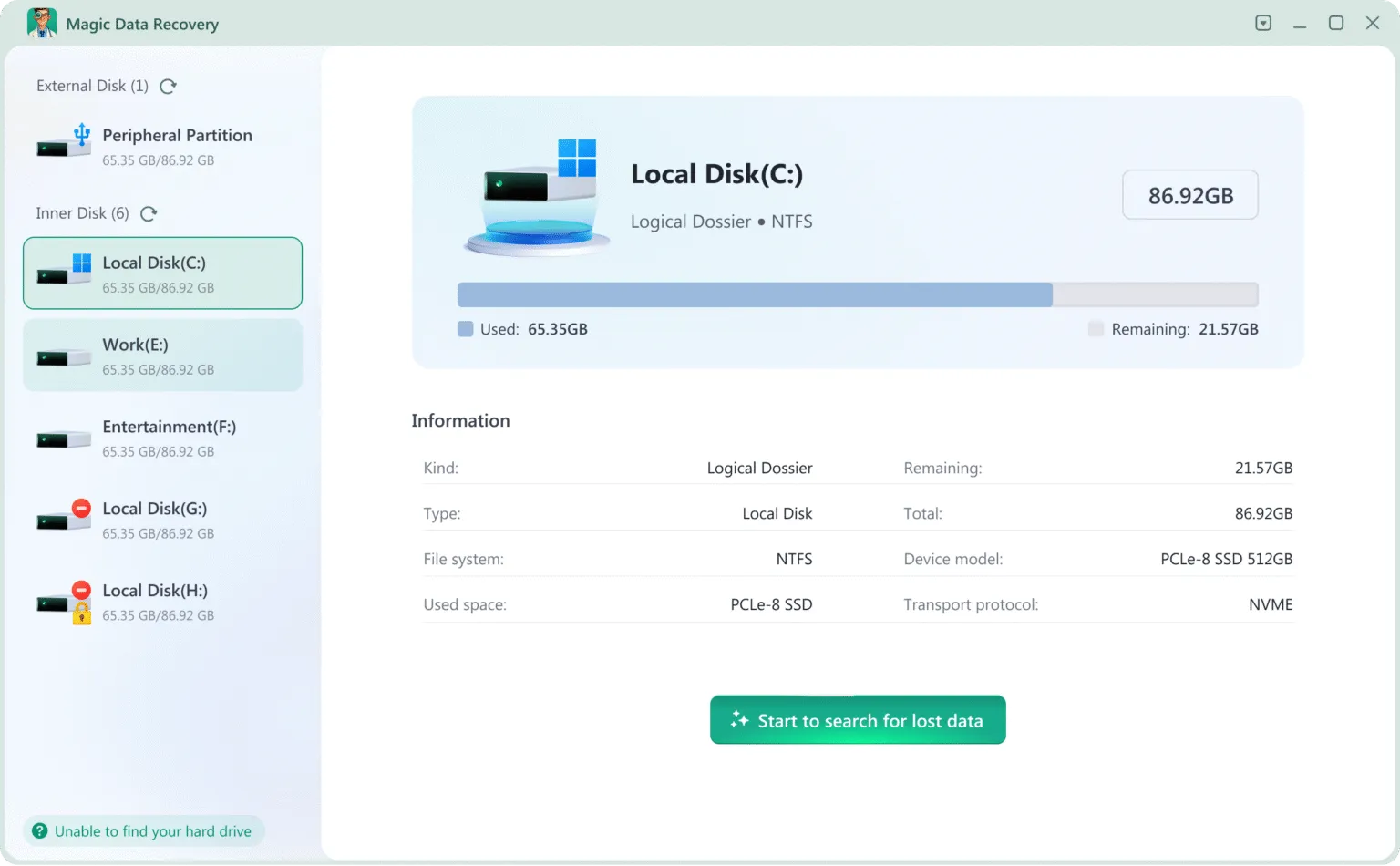
Use Magic Data Recovery when:
- Files disappeared after factory reset
- No backup exists
- File History was not enabled
- Windows File Recovery feels too complex
- You need to preview files before recovery
- The drive has file system errors
- The reset caused folders to disappear
Follow these steps:
1. Download and install Magic Data Recovery on a safe drive.
Supports Windows 7/8/10/11 and Windows Server
2. Launch the software.
3. Select the drive or partition where the lost files were stored.
4. Click the scan option to search for lost data.
5. Filter results by file type, name, or path.
6. Preview recoverable files.
7. Recover selected files to another storage device.
The preview step is especially helpful. It lets you check whether the file is usable before saving it. This is more reliable than restoring many unknown files blindly.
How to Recover Files After Factory Reset Windows 10
The process to recover files after factory reset Windows 10 is similar to Windows 11, but the menu paths may look slightly different. Windows 10 users should also start with backups before scanning the reset drive.
Method 1: Search Old Backup Locations
First, check whether your files exist outside the reset drive. Many users forget about older copies.
Look in these locations:
- External hard drives
- USB flash drives
- SD cards
- NAS folders
- Email attachments
- Old laptop drives
- OneDrive or Google Drive
- Export folders from apps
This simple check can save time. If you find the files in a backup, copy them to the PC only after the reset system is stable.
Method 2: Try File History or Previous Versions
If File History was enabled, you may restore previous versions of folders.
Steps:
- Open File Explorer.
- Go to the folder where the file used to exist.
- Right-click the folder.
- Select Restore previous versions.
- Choose a version.
- Open it to confirm the files.
- Restore or copy files to a safe location.
For a broader hard drive recovery workflow, you can also read Amagicsoft’s guide on how to recover files from hard drive Windows 10.
Method 3: Use Windows File Recovery
Windows File Recovery is a Microsoft command-line recovery tool. It can help recover deleted files from local storage devices, including internal drives and external drives. However, it requires correct command syntax and a separate destination drive.
A basic command may look like this:
- winfr C: D: /regular /n \Users\YourName\Documents\
In this example, Windows File Recovery scans drive C: and saves results to drive D:. You should never save recovered files back to the same source drive.
This method may help advanced users. Still, many ordinary users prefer a visual tool with file preview, filters, and clearer recovery steps.
Method 4: Scan with Magic Data Recovery
If you want a simpler way to recover files after factory reset Windows 10, Magic Data Recovery is a better fit for most non-technical users. It scans the selected drive, shows recoverable files, supports preview, and lets you save files to another device.
It can help in common logical data loss scenarios, including:
- Deleted files
- Formatted drives
- Missing folders
- File system errors
- RAW or inaccessible partitions
- Lost files after reset or reinstall
- Files missing from internal or external drives
For users comparing free and guided recovery options, Amagicsoft’s data recovery freeware guide also explains why scan, preview, and safe recovery location matter.
Magic Data Recovery vs Built-in Windows Methods
Windows built-in tools are useful, but they have limits. The best solution depends on your situation.
Method | Best For | Limitation |
Recycle Bin | Recently deleted files | Usually not useful after factory reset |
OneDrive | Synced files | Only works if sync was enabled |
File History | Backed-up personal folders | Must be enabled before reset |
Windows File Recovery | Advanced command-line recovery | Harder for beginners |
Magic Data Recovery | No-backup recovery, formatted/reset drives, file preview | Requires another safe location to save files |
Recovery service | Physical drive failure | Costs more and takes longer |
Magic Data Recovery is recommended because it focuses on the actual recovery problem: files that Windows no longer shows. Unlike backup tools, it can scan the storage device for lost data. Unlike command-line tools, it gives ordinary users a clearer process.
Supports Windows 7/8/10/11 and Windows Server
When Recovery Is More Likely to Work
You have a better chance to recover files after factory reset when:
- You used “Remove everything” without Clean data.
- The drive is an HDD.
- You stopped using the PC quickly.
- You did not reinstall large programs.
- You did not copy many new files to the drive.
- The files were not encrypted.
- The lost files were stored on a non-system partition.
- The recovery scan can preview files correctly.
For example, if you reset Windows 10 on an HDD and stopped using it immediately, recovery may still find documents and photos. On the other hand, if you reset a BitLocker-encrypted SSD, cleaned the drive, and used the PC for several days, recovery becomes much less likely.
When Recovery May Fail
No recovery method can restore files in every situation. Be careful with articles or tools that promise complete recovery.
Recovery may fail when:
- The drive was fully cleaned during reset.
- New data overwrote old file sectors.
- SSD TRIM cleared deleted blocks.
- BitLocker encryption keys are missing.
- The drive has physical damage.
- The file was already overwritten before the reset.
- The recovered file preview is corrupted.
If the drive makes clicking sounds, disconnects often, or cannot appear in BIOS or Disk Management, do not keep scanning it. In that case, a professional data recovery service may be safer.
Common Mistakes to Avoid
Many users damage their recovery chances after a factory reset. Avoid these mistakes:
Installing Software on the Same Drive
If lost files were on C:, installing recovery software on C: may overwrite them. Use another computer or another drive whenever possible.
Saving Recovered Files Back to the Source Drive
Always save recovered files to another disk. For example, scan C: and save to D: or an external drive.
Running Cleanup or Optimization Tools
Cleanup tools may remove temporary data, old file references, or recoverable fragments. Wait until recovery finishes.
Continuing Normal PC Use
Browsing, downloading, syncing, and updating Windows all create new data. Reduce activity until recovery is complete.
Assuming System Restore Will Recover Personal Files
System Restore mainly targets system files, drivers, and settings. It is not a complete personal file recovery method.
Practical Recovery Workflow
Use this order when you need to recover files after factory reset:
- Stop using the reset PC.
- Check OneDrive, Google Drive, Dropbox, or other cloud accounts.
- Check external backup drives.
- Try File History or Previous Versions.
- Check whether Windows File Recovery suits your skill level.
- Use Magic Data Recovery to scan the affected drive.
- Preview files before recovery.
- Save recovered files to another storage device.
- Back up recovered files immediately.
This order keeps safer methods first and deeper scan methods later. It also reduces unnecessary writes to the affected drive.
Why Recommend Magic Data Recovery?
Magic Data Recovery is a practical choice for users who need to recover files after factory reset without relying only on backups. It supports common data loss scenarios such as deletion, formatting, file system errors, inaccessible partitions, and reset-related data loss. It also helps users preview files before recovery, which reduces guesswork.
Compared with built-in Windows tools, Magic Data Recovery offers a more visual and beginner-friendly workflow. Compared with basic undelete tools, it fits more complex cases, such as formatted drives, missing partitions, and file system problems. For users dealing with NTFS structure issues, Amagicsoft also provides a dedicated explanation of Master File Table recovery, which helps explain why file records matter during recovery.
If you need a tool that can scan, filter, preview, and restore files to a safe location, Magic Data Recovery is worth trying before you give up on lost files.
How to Prevent File Loss Before the Next Reset
After recovery, create a safer backup routine. A factory reset should never be the only step in system repair.
Use these habits:
- Back up important folders before every reset.
- Keep at least one external backup.
- Use cloud sync for key documents.
- Export browser bookmarks and passwords.
- Save license keys and installer files.
- Create a Windows recovery drive.
- Keep BitLocker recovery keys in a safe place.
- Test your backups occasionally.
These steps reduce the need to recover files after factory reset in the future.
Conclusion
Learning how to recover files after factory reset is about choosing the right method in the right order. Start with backups, OneDrive, File History, and Previous Versions. Then consider Windows File Recovery if you are comfortable with commands. If those methods do not work, use a dedicated recovery tool before the drive receives more new data.
Magic Data Recovery is recommended because it gives Windows users a clear way to scan lost data, preview recoverable files, and save them to another safe location. It is especially useful when files disappear after reset, formatting, file system errors, or other logical data loss scenarios.
If your reset removed important files and you need a focused recovery workflow, start with Amagicsoft’s formatted drive recovery guide and try Magic Data Recovery to check whether your files can still be found.
Supports Windows 7/8/10/11 and Windows Server
FAQs
Can I recover files after factory reset without backup?
Yes, you may be able to recover files after factory reset without backup if the lost data has not been overwritten. Stop using the PC immediately, avoid installing programs on the affected drive, and scan the original storage device with reliable recovery software. Recovery is more likely on HDDs than SSDs, especially if Clean data was not enabled.
How do I recover files after factory reset Windows 11?
To recover files after factory reset Windows 11, first check OneDrive, Windows Backup, File History, and external backup drives. If no backup exists, use a recovery tool such as Magic Data Recovery to scan the original drive. Preview found files before recovery, then save them to another drive instead of the reset partition.
How do I recover files after factory reset Windows 10?
To recover files after factory reset Windows 10, check File History, Previous Versions, OneDrive, and external backups first. If these methods fail, scan the affected drive with data recovery software. For best results, do not install software or save new files on the same drive where the lost files were stored.
Does factory reset permanently delete files?
A factory reset can remove personal files, apps, and settings, but whether files are permanently deleted depends on the reset option. If Clean data was enabled or the drive was overwritten, recovery becomes difficult. If only file references were removed and no new data overwrote them, recovery software may still find some files.
Can Windows File Recovery recover files after factory reset?
Windows File Recovery may help in some cases, especially when lost files remain on a local storage device and have not been overwritten. However, it uses command-line operations and requires a separate destination drive. Users who want file preview, filtering, and a visual workflow may find Magic Data Recovery easier to use.
Is it possible to recover files after factory reset on SSD?
It may be possible, but SSD recovery is harder because TRIM can clear deleted data blocks after reset or deletion. Encryption can also reduce recovery chances. Stop using the SSD immediately and scan as soon as possible. If the files cannot be previewed after scanning, they may have been cleared or overwritten.
Should I use System Restore to recover files after reset?
System Restore is not the best method for personal file recovery. It mainly restores system settings, drivers, and registry changes. It usually does not recover documents, photos, videos, or downloads removed during a factory reset. Use backups, cloud storage, File History, Windows File Recovery, or dedicated recovery software instead.
Where should I save recovered files?
Always save recovered files to a different storage device. If you scan drive C:, save the recovered files to drive D:, an external hard drive, or a USB drive. Saving files back to the same drive can overwrite other recoverable data and reduce the chance of recovering remaining files successfully.

Jason is a data recovery and technical support specialist with over 15 years of hands-on experience. He has worked extensively with frontline users, troubleshooting difficult data loss cases and providing practical recovery solutions for accidental deletion, formatted drives, damaged file systems, lost partitions, system failures, and other recovery emergencies. His expertise also includes backup and restoration, file repair, and disaster recovery, with a strong emphasis on safe, reliable, and technically accurate guidance.