
Recover Files Corrupted Hard Drive Safely
A corrupted hard drive can make valuable documents, photos, videos, or project folders disappear without warning. Windows may ask you to format the disk, show the partition as RAW, report that the location is unavailable, or freeze whenever you open the drive.
If you searched recover files corrupted hard drive, the most important rule is simple: recover the data before trying to repair the disk. This guide explains how to identify the failure type, choose the safest recovery method, and avoid actions that may reduce recoverability. For broader file-loss scenarios, start with Amagicsoft’s deleted file recovery guide.
Table of Contents
Quick Answer: How to Recover Files from a Corrupted Hard Drive
To recover files corrupted hard drive data safely:
- Stop using the affected drive.
- Check for clicking, grinding, overheating, burning smells, or repeated disconnections.
- If the drive is physically unstable, power it off and contact a professional recovery lab.
- If Windows still detects it normally, restore from a backup or scan it with data recovery software.
- Install the recovery tool on another disk.
- Save recovered files to a separate healthy drive.
- Repair, format, or replace the corrupted drive only after the files are secure.
The correct order is diagnose → recover → verify → repair. Reversing that order may turn a recoverable logical problem into permanent data loss.
Can You Recover Files from a Corrupted Hard Drive?
In many logical corruption cases, yes. A hard drive may become inaccessible because its file system, partition information, directory records, or boot records are damaged. The underlying file content can remain on the storage media even though Windows cannot display it through File Explorer.
However, no software can guarantee recovery in every case. Results depend on whether the original sectors remain readable, whether new data has overwritten them, and whether the drive has physical damage. A stable drive that appears in Disk Management offers a more suitable software-recovery opportunity than a disk that clicks, vanishes, or reports the wrong capacity.
It is also important to separate two different problems:
- Corrupted drive: The storage structure is damaged, so files become inaccessible or disappear.
- Corrupted file: The file is present, but its internal content is incomplete or damaged, and the original application cannot open it.
This article mainly explains how to recover files corrupted hard drive situations. A later section covers what to do when recovered files are themselves corrupted.
Diagnose the Drive Before You Attempt Recovery
Signs of Logical Hard Drive Corruption
Logical corruption affects the data structure rather than the physical components. Common signs include:
- Windows says, “You need to format the disk before you can use it.”
- The volume appears as RAW in Disk Management.
- A folder or drive returns “Location is not available.”
- Files disappear after a crash, power loss, unsafe removal, or malware event.
- The disk shows a valid capacity but cannot be opened.
- The computer detects the drive consistently, and it makes no unusual mechanical sounds.
A RAW volume often means Windows cannot recognize the file system. It does not automatically mean every file has been erased. Read the RAW hard drive recovery guide for a focused explanation of this condition.
Signs of Physical Hard Drive Damage
Physical failure requires a different response. Stop software recovery when the drive:
- Makes persistent clicking, grinding, scraping, or repeated spin-up sounds.
- Overheats quickly or smells burned.
- Disconnects every few seconds.
- Does not appear in BIOS, Disk Management, or a USB adapter.
- Shows an obviously incorrect capacity.
- Has been dropped, flooded, crushed, or exposed to a power surge.
Seagate notes that persistent hard clicking, clunking, or grinding can indicate a physical problem. Repeated scans, CHKDSK operations, and power cycles may place additional stress on an unstable HDD. In this situation, shut it down and use a professional data recovery service. oader comparison of physical and logical failures, see the guide to recover files from a broken hard drive.
Drive condition | Recommended first action | Avoid |
Stable, detected, no unusual sounds | Recover data with a backup or software | Formatting or repair before recovery |
RAW or inaccessible but stable | Scan the drive and save files elsewhere | Initializing the disk |
System drive will not boot | Connect it to another Windows PC when practical | Reinstalling Windows on the same disk |
Clicking, grinding, or overheating | Power off and contact a recovery lab | Software scans and repeated restarts |
Not detected anywhere | Check one known-good cable or port, then seek help | Endless reconnect attempts |
What to Do Before You Recover Files Corrupted Hard Drive Data
1. Stop All Writes to the Affected Disk
Do not download files, install software, create folders, defragment the drive, or copy recovered data back to it. New writes may overwrite data that recovery software could otherwise locate.
For an external drive, disconnect it until you are ready to perform a controlled recovery attempt. For a corrupted secondary internal drive, avoid opening applications that store caches or working files on that volume.
2. Do Not Format or Initialize the Drive
Windows may offer to format an unreadable disk. Cancel that prompt while you still need the files. Formatting creates a new file system and changes disk metadata. Likewise, initializing a disk in Disk Management writes new partition information.
If the drive was already formatted accidentally, recovery may still be possible. Follow the formatted hard drive recovery guide and avoid further use.
3. Delay CHKDSK Until Important Files Are Safe
CHKDSK is a repair utility, not a dedicated undelete tool. Microsoft explains that it checks a volume’s file system and metadata for logical and physical errors. Parameters such as /f and /r instruct it to fix errors or search for readable information in bad sectors. Because those operations modify the volume, protect irreplaceable data before using them on a badly corrupted disk. and details and limitations, review what CHKDSK does. If bad sectors are involved, the HDD bad sector guide explains the difference between logical and physical damage.
4. Prepare a Healthy Destination Drive
The destination must be different from the corrupted source. It should also have enough free space for all selected files. A separate external drive is usually clearer and safer than another folder on the same physical disk.
5. Check the Connection Once
For an external hard drive, try one known-good USB port, cable, power adapter, or computer. A connection problem can imitate corruption. Seagate recommends basic checks such as changing the cable, port, or computer when troubleshooting an external drive. isk remains stable after the change, continue with recovery. If it repeatedly disappears or makes abnormal noises, stop testing.
Best Ways to Recover Files from a Corrupted Hard Drive
Method 1: Restore Files from a Backup or File History
A verified backup is the safest recovery method because it avoids scanning the damaged source drive. Check:
- File History or Previous Versions.
- OneDrive or another cloud service.
- An external backup disk.
- NAS snapshots.
- Application-specific backups.
- Copies sent by email or shared with coworkers.
In Windows, navigate to the folder that previously contained the file, right-click it, and choose Restore previous versions when File History or another compatible backup created a restorable version. Microsoft documents this workflow in its File History recovery instructions. or:** Files that existed before corruption and were backed up.
Limitation: It cannot restore newer files that were never included in a backup.
Method 2: Copy Still-Accessible Critical Files
If the drive opens normally, stays connected, and shows no physical warning signs, copy the most important files to another disk before doing anything else. Start with small, irreplaceable documents rather than one huge folder transfer.
Stop if the drive becomes unusually slow, disconnects, or begins making noise. Direct copying is not a substitute for controlled recovery when the file system is RAW or unstable.
Method 3: Recover Files with Magic Data Recovery
When backups are unavailable and Windows still detects the drive, Magic Data Recovery offers a practical way to recover files corrupted hard drive data without first formatting or repairing the source.
It addresses several common pain points:
- Files lost after deletion, formatting, file-system errors, RAW status, operating system reinstallation, or virus damage.
- Inaccessible folders that File Explorer cannot browse.
- Mixed file sets containing documents, photos, videos, audio, archives, and other common formats.
- Users who need visual scanning, filtering, and preview instead of a command-line workflow.
Magic Data Recovery supports common Windows file systems and storage devices that remain visible to Windows. Its documented workflow follows a straightforward sequence: select the drive, scan it, preview available files, and save the selected results to another location. advantage is the separation of recovery from repair. The software searches for available file records and signatures without requiring users to run CHKDSK or format the volume first. This approach is more appropriate than a repair utility when the immediate goal is data extraction.
How to Use Magic Data Recovery
1. Install it on a healthy drive.
Do not install the program on the corrupted disk. If the affected volume is C:, use another computer or a separate Windows environment where possible.
Supports Windows 7/8/10/11 and Windows Server
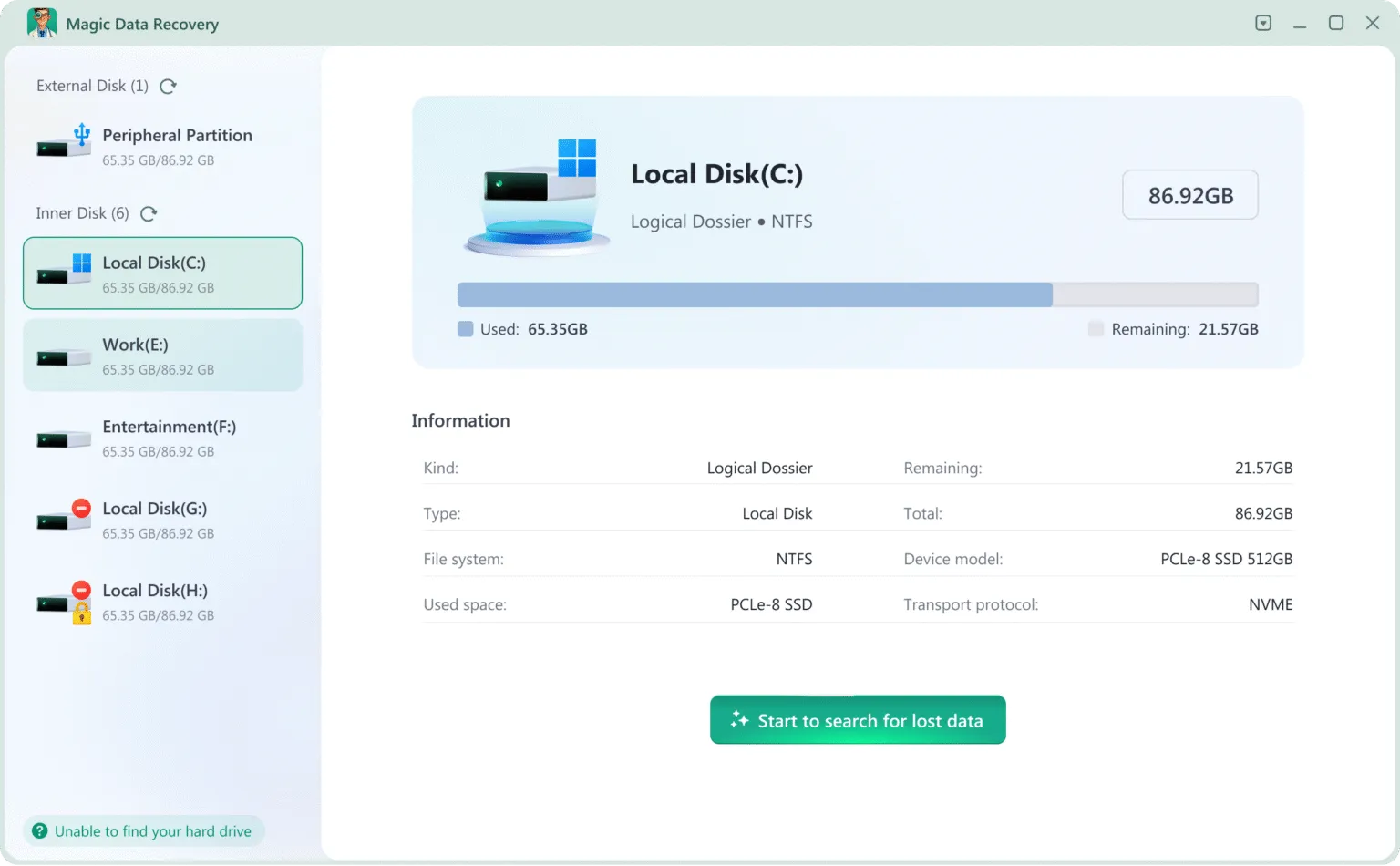
2. Connect and select the corrupted drive.
Launch the program and choose the affected HDD, external hard drive, or partition. The disk must remain detectable by Windows for software recovery.
3. Start the scan.
Allow the scan to examine the drive for existing, lost, deleted, or reconstructed files. Avoid using the source disk during this process.
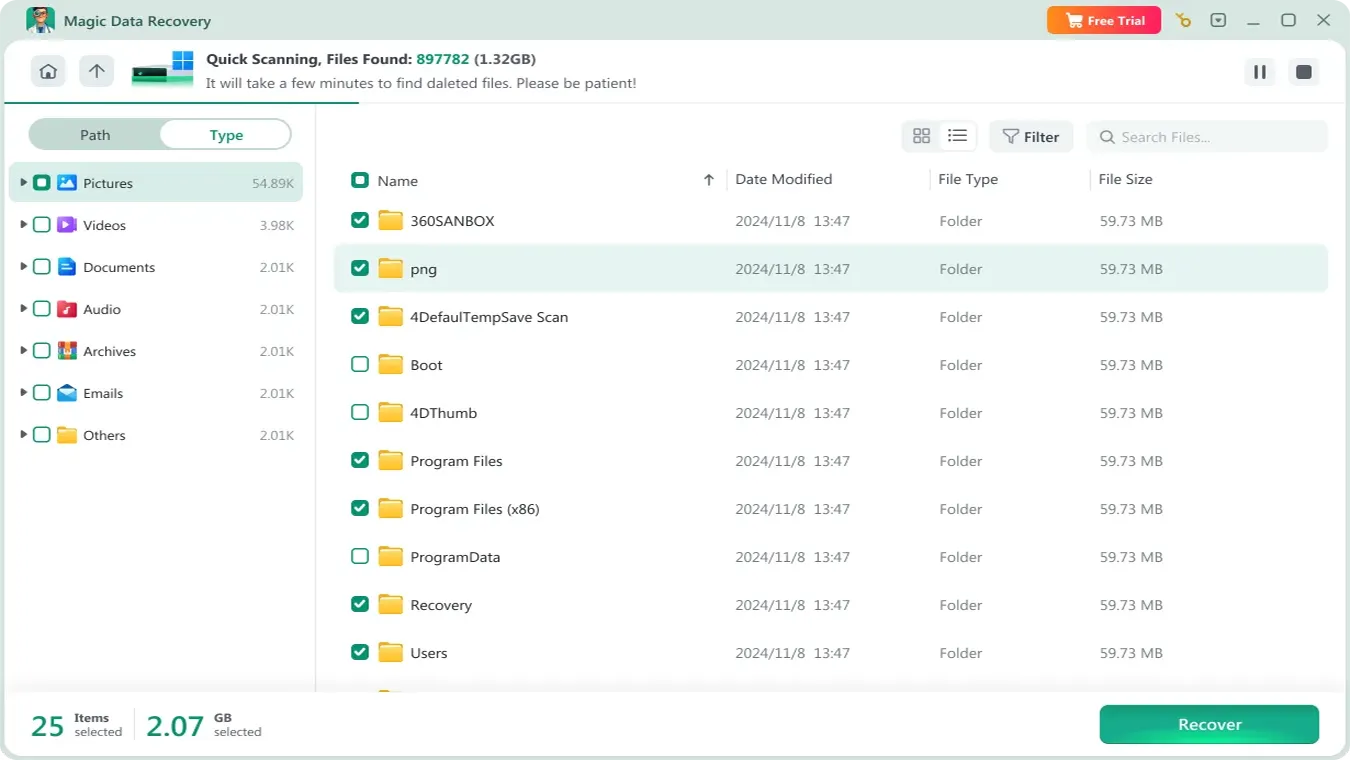
4. Filter and preview results.
Search by filename or extension and browse file-type categories. Preview important files when supported. A successful preview provides a useful quality check, although it cannot guarantee that every large or fragmented file is complete.
5. Recover to another disk.
Select the files you need and save them to a healthy destination. Never recover them back to the corrupted source.
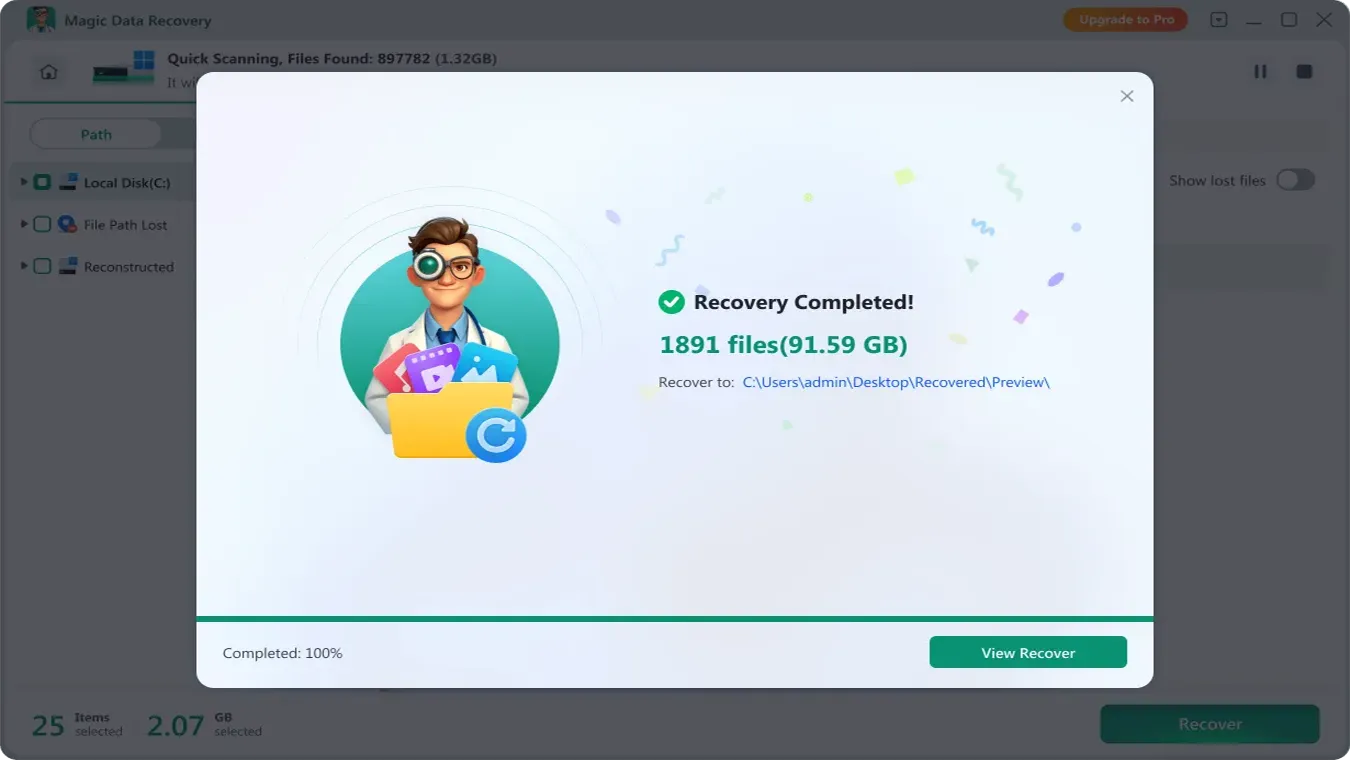
6. Verify the recovered data.
Open representative documents, images, videos, and archives from the destination. Check critical project files before repairing or reformatting the original drive.
The official Magic Data Recovery user guide provides additional device, file-system, and workflow details.
Why Magic Data Recovery Is More Reliable Than Repair-First Methods
“More reliable” does not mean guaranteed. It means the workflow better matches the immediate objective.
Option | Main purpose | Best use | Key limitation |
File History or backup | Restore a previous copy | A valid backup exists | Cannot restore unbacked-up files |
Direct file copy | Transfer readable files | Drive is stable and accessible | Fails on RAW or inaccessible volumes |
Magic Data Recovery | Locate and extract lost or inaccessible data | Logical corruption and detectable drives | Cannot repair mechanical damage |
Windows File Recovery | Command-line deleted-file recovery | Technical users with a recognized drive | Less convenient for browsing complex results |
CHKDSK | Check and repair file-system errors | After important data is safe | Modifies the source volume |
Professional lab | Hardware-level recovery | Physical failure or non-detection | Higher cost and a more involved process |
Magic Data Recovery is especially useful when users need to recover files corrupted by an inaccessible storage structure but want to avoid command syntax. It also covers more loss scenarios than a basic undelete utility, including formatting and file-system errors.
Most importantly, it does not position physical failure as a software problem. If the disk clicks, overheats, or disappears from Windows, software recovery is not the appropriate next step.
Method 4: Try Windows File Recovery
Microsoft’s Windows File Recovery is a command-line application for recovering files deleted from local storage, including internal drives, external drives, and USB devices. It can be useful when the drive is recognized and the loss involves deletion. l command uses this structure:
winfr source-drive: destination-drive: /mode /switches
The source and destination must be different drives. Because the tool uses commands and primarily targets deleted-file recovery, it may be less approachable when a corrupted volume has complex folder damage or when you need to inspect many file types visually.
Best for: Advanced Windows users recovering deleted local files.
Limitation: It does not replace professional hardware recovery and may not be the easiest option for a RAW or unstable disk.
Method 5: Connect a Non-Booting System Drive to Another PC
If Windows cannot boot from the corrupted system disk, avoid reinstalling the operating system on that drive. Instead:
- Shut down the computer.
- Remove the disk if the hardware design allows it.
- Connect it to a healthy Windows PC through SATA, a compatible enclosure, or a USB adapter.
- Confirm whether Disk Management detects it.
- Copy accessible files or scan the disk with recovery software.
- Save all results to a separate device.
This method reduces writes from the original operating system and lets you work from a stable environment. Magic Data Recovery’s user guide also recommends connecting an affected disk to a healthy PC where practical and stopping software attempts when physical damage is present. removal when the computer is under warranty, uses soldered storage, or requires unfamiliar disassembly.
Method 6: Use a Professional Data Recovery Lab
A laboratory is the correct option when the drive has physical damage, critical business data, severe instability, or no detection after a basic connection check. Professional technicians can work with specialized imaging equipment and controlled hardware procedures.
Do not open a hard drive at home. Also avoid freezer tricks, hitting the enclosure, or repeatedly turning the disk on to “see if it works.”
How to Fix a Corrupted Hard Drive After Recovery
Once your files are safely stored and verified, you can troubleshoot the original disk.
Run Windows Error Checking or CHKDSK
For a drive with a recognized file system and no physical warning signs:
- Open File Explorer.
- Right-click the drive and select Properties.
- Open Tools.
- Under Error checking, choose Check.
Advanced users can open Command Prompt as administrator and use:
chkdsk X: /f
Replace X: with the correct drive letter. The /f parameter fixes detected file-system errors.
The following command performs a more intensive check:
chkdsk X: /r
Microsoft states that /r locates bad sectors and attempts to recover readable information. It also includes the functionality of /f. Use it only after protecting important data because it can take much longer and places more read activity on the drive. for Malware
Run Windows Security or another trusted security product if corruption followed a malware alert, suspicious executable, or mass file changes. Recover clean copies to a protected destination and scan them before reopening.
Assign a Drive Letter
If the partition appears healthy in Disk Management but is missing from File Explorer, it may lack a drive letter. Right-click the volume, choose Change Drive Letter and Paths, and assign an unused letter.
Do not format a RAW or unallocated volume merely to make it appear in File Explorer.
Reformat the Drive
If recovery is complete and the file system cannot be repaired reliably, formatting can restore a usable file system. Choose NTFS for a Windows-focused drive or exFAT when broad device compatibility is necessary.
Formatting is not proof that the hardware is healthy. Test the disk and monitor it. If errors return, replace it.
Replace a Failing Drive
Recurring bad sectors, repeated corruption, unstable detection, and abnormal noises are replacement signals. A repaired file system cannot reverse physical wear or mechanical damage.
Migrate the recovered data to a healthy disk and retire the unreliable drive.
“Recover Files Corrupted” Can Mean Two Different Things
The keyword recover files corrupted is ambiguous. It may refer to recovering files from a corrupted hard drive or repairing files that have already been recovered but will not open.
When the Drive Is Corrupted
Use a recovery-first workflow:
- Stop writing to the disk.
- Scan the detected drive.
- Recover files to another location.
- Verify the results.
- Repair or replace the source afterward.
When the Individual File Is Corrupted
Data recovery software can retrieve available data, but it cannot recreate bytes that were overwritten or never read successfully. Try these options:
- Restore an earlier version from File History, cloud version history, or a backup.
- Open the file in another compatible application.
- Use the application’s built-in repair feature, such as Microsoft Office Open and Repair.
- Recover another copy from email, collaboration storage, or an exported version.
- Use a reputable file-specific repair tool for photos, videos, archives, or documents.
This distinction improves expectations. Magic Data Recovery is designed to recover lost or inaccessible files from storage devices. It should not be described as a universal repair tool for every damaged file.
Common Mistakes That Reduce Recovery Chances
Running CHKDSK Before Recovering Important Data
CHKDSK may resolve logical errors, but it changes file-system structures. When the disk is seriously corrupted, recover essential files first.
Formatting Because Windows Prompts You
The prompt means Windows cannot use the current file system. It does not prove that the data is gone. Cancel the prompt and evaluate recovery options.
Installing Recovery Software on the Source Drive
Installation writes new data. Always use a different drive or working computer.
Saving Recovered Files Back to the Same Disk
Recovery output can overwrite data that has not yet been found. Use a separate destination.
Repeatedly Scanning a Physically Failing HDD
A mechanical drive can deteriorate during prolonged reads. Clicking, grinding, overheating, and repeated disconnection require professional assessment.
Assuming Every Previewed File Will Be Perfect
Preview provides a valuable verification step, but large or fragmented files can still contain unreadable sections. Open several recovered files and validate the most important data before repairing the source.
How to Prevent Future Hard Drive Corruption
Use a simple prevention plan:
- Keep at least one local backup and one separate or cloud copy of critical files.
- Eject external drives safely before disconnecting them.
- Use a surge protector or uninterruptible power supply for important systems.
- Keep Windows and security software updated.
- Avoid filling a drive completely.
- Monitor recurring errors, slow reads, and bad-sector warnings.
- Replace drives that show repeated instability.
- Test backups regularly instead of assuming they work.
A backup is only useful when it can be restored. Periodically open sample files and confirm that version history or scheduled backup jobs are running.
Conclusion: Recover First, Repair Second
The safest way to recover files corrupted hard drive data is to identify whether the failure is logical or physical before taking action. Use a backup whenever one exists. If the drive remains stable and visible to Windows, Magic Data Recovery is a practical option because it supports deletion, formatting, file-system errors, RAW drives, operating system reinstall loss, and virus-related scenarios through a clear scan, preview, and recovery workflow.
The recommendation is conditional and specific: use the software for detectable drives with logical data loss, not for clicking or mechanically damaged hardware. Save results to another device, verify critical files, and only then run repair tools or format the source.
For additional recovery paths, return to Amagicsoft’s deleted file recovery solutions.
If you are looking for a more efficient Windows-based solution, try Magic Data Recovery before performing repairs that alter the corrupted disk.
Supports Windows 7/8/10/11 and Windows Server
FAQs About Recover Files Corrupted Hard Drive
Can I recover files from a corrupted hard drive without formatting it?
Yes, if Windows still detects the drive and the damage is logical. Cancel any formatting prompt, stop writing new data, and scan the disk with recovery software or restore files from a backup. Save recovered items to another healthy drive. If the HDD clicks, overheats, or disconnects repeatedly, stop and contact a professional lab.
Should I run CHKDSK before I recover files from a corrupted hard drive?
Usually, protect important files first. CHKDSK repairs file-system structures and therefore changes the source volume. That may be acceptable after recovery, but it is not the safest first action on a severely corrupted or unstable disk. Recover or back up critical data, verify the copies, and then use CHKDSK to troubleshoot the drive.
Can Magic Data Recovery recover files from a RAW hard drive?
Magic Data Recovery can scan a RAW hard drive when Windows still detects the physical device. It is designed to locate files without requiring you to format the volume first. Install the program on another disk, scan the RAW drive, preview available files, and save selected results to a separate healthy storage device.
What if the corrupted hard drive is not showing in Disk Management?
First, test one known-good cable, port, power adapter, or computer. If the disk still does not appear in Disk Management, software cannot scan it through Windows. Do not initialize it or repeatedly power-cycle a noisy drive. Important data may require a professional recovery service that can diagnose controller, firmware, or mechanical problems.
Can I recover files corrupted after a power outage?
Often, yes. A power interruption can damage file-system metadata or interrupt a write operation while leaving much of the underlying data readable. Stop using the drive, avoid CHKDSK and formatting until important files are safe, and restore from a backup or run a recovery scan. Files being written during the outage may be incomplete.
Why do recovered files not open after hard drive recovery?
A recovered file may be incomplete because some sectors were unreadable, overwritten, or missing from damaged metadata. Try another recovered copy, restore a previous version, or use the original application’s repair function. Data recovery retrieves available content, but it cannot recreate bytes that no longer exist on the source storage.
Is a corrupted external hard drive easier to recover than an internal drive?
Not necessarily, but an external drive can be easier to isolate and connect to another computer. Recoverability still depends on the damage type, device stability, overwriting, and sector readability. Test one cable or port, then use software only if the drive remains detected and quiet. Physical symptoms require professional help.
Can I continue using a hard drive after repairing its corruption?
You may reuse it temporarily if diagnostics show no hardware problems and the issue does not return. However, repeated corruption, bad sectors, unstable detection, or abnormal sounds make the drive untrustworthy. Keep verified backups, monitor the disk closely, and replace it when errors recur rather than relying on another repair.

Jason is a data recovery and technical support specialist with over 15 years of hands-on experience. He has worked extensively with frontline users, troubleshooting difficult data loss cases and providing practical recovery solutions for accidental deletion, formatted drives, damaged file systems, lost partitions, system failures, and other recovery emergencies. His expertise also includes backup and restoration, file repair, and disaster recovery, with a strong emphasis on safe, reliable, and technically accurate guidance.