
How to Recover Files Deleted from Network Drive
Need to recover files deleted from network drive after a shared project folder, spreadsheet, database, or media file disappeared? Start by identifying the computer, Windows server, or NAS that physically stores the shared folder. A mapped drive such as Z: is only a remote access path. Therefore, the safest recovery method must target the host storage rather than the employee’s local PC.
This deleted file recovery guide explains the broader principles of restoring deleted data. The guide below focuses specifically on network shares, mapped drives, Windows file servers, and NAS storage.
Recovery may still be possible through a network recycle bin, Windows Previous Versions, server backups, snapshots, or storage-level recovery software. However, speed matters. Stop new writes to the affected share, determine where the files were physically stored, and try the least invasive method first.
Table of Contents
Can You Recover Files Deleted from Network Drive?
Yes, you can often recover files deleted from network drive, but the correct solution depends on the storage architecture and the protection features configured before deletion.
A network drive may point to:
- A shared folder on another Windows computer
- A Windows file server
- A Synology, QNAP, or other NAS device
- A RAID or enterprise storage server
- A folder backed up to another server or cloud repository
- A locally cached or synchronized copy
The mapped drive letter does not reveal the underlying disk structure. For example, Z: on an employee’s computer may map to \\FILESERVER\Projects, while the real files are stored on the server’s D: volume.
Consequently, running recovery software against Z: from the employee’s computer usually does not provide the sector-level access required for deleted-file scanning.
Quick Network Drive Recovery Decision Table
Storage situation | Where the deleted data resides | Best first method | Magic Data Recovery usage |
Shared folder on another Windows PC | Host computer’s internal or external disk | Previous Versions, backups, or host protections | Install it on the host PC or connect the host disk locally |
Windows file server | Server volume containing the shared folder | VSS Previous Versions or server backup | Install it on the server and scan the physical volume |
Synology or QNAP NAS | NAS volume or RAID storage pool | NAS recycle bin, snapshots, or backup | It cannot scan the mapped path directly |
RAID, SAN, or degraded array | Multiple disks and RAID metadata | Snapshot, backup, or specialist recovery | Do not scan individual member disks without reconstructing the array |
Offline Files or synchronized copy | Local client disk and remote server | Check both the local cache and server copy | Scan the client disk only if a real local copy existed |
Where Do Files Deleted from a Network Drive Go?
When you delete a local file, Windows normally moves it to the local Recycle Bin. A network share works differently. Your computer sends a deletion request to the remote system that controls the file system.
As a result, the deleted item usually bypasses the client computer’s Recycle Bin.
Do not assume that the file automatically appears in the server desktop’s Recycle Bin either. A standard SMB network deletion may remove the file entry immediately unless the server, NAS, or another protection tool provides a dedicated network recycle bin.
Synology allows administrators to enable a Recycle Bin for individual shared folders. QNAP can retain deleted shared-folder files inside an @Recycle directory when its Network Recycle Bin feature is enabled.
If no recycle bin, snapshot, or backup contains the missing file, deleted data may remain on the host storage until new writes overwrite it. Therefore, successful network drive file recovery begins with stopping write activity.
What to Do Before Network Drive File Recovery
Before trying to recover files deleted from network drive, take the following precautions.
- Pause access to the affected share. Ask users to close files and stop uploads, synchronization, exports, database activity, and automated jobs.
- Identify the UNC path. Note the actual path, such as \\SERVER01\Finance, rather than relying only on the Z: drive letter.
- Locate the host volume. Ask the administrator which physical disk or server partition stores the shared folder.
- Record the missing items. Write down file names, extensions, folder paths, approximate sizes, owners, and the likely deletion time.
- Check for malware. If many files disappeared or changed together, isolate the server before restoring data.
- Avoid formatting or initialization. Do not accept prompts asking Windows to initialize or format an inaccessible disk.
- Avoid premature CHKDSK repairs. File system repairs may modify metadata before recovery.
- Prepare another storage location. Never save restored files to the original affected volume.
Consider a common office scenario. A user deletes Q3-Budget.xlsx from Z:\Finance. The local Recycle Bin remains empty because Z: maps to \\FILESERVER\Finance.
IT should pause writes to the share, identify the server volume containing the Finance folder, check available snapshots and backups, and scan that server volume only if the safer options fail.
How to Recover Files Deleted from Network Drive: 6 Methods
Use the following methods in order. This approach begins with quick, low-risk options and progresses toward storage-level recovery.
Method 1: Undo the Network File Deletion
If the deletion occurred seconds ago and the same File Explorer window remains open, press Ctrl + Z. You can also right-click an empty area inside the folder and look for Undo Delete.
This method may work when:
- No other file operation has occurred
- File Explorer remains open
- The deletion came from the current Windows session
- The server still supports the undo request
Undo may become unavailable after another file operation, sign-out, application restart, or deletion by another user. It also cannot be trusted for command-line deletion, application-driven removal, or permanent deletion.
Method 2: Check the NAS or Server Network Recycle Bin
For Synology, QNAP, or another managed NAS, sign in to the administrative interface or ask the storage administrator to inspect the recycle folder for the affected share.
On Synology, the Recycle Bin must have been enabled for that shared folder before the deletion. On QNAP, open the corresponding @Recycle directory, locate the missing file, and select the recovery command.
QNAP’s documentation confirms that protected files can be restored from its Network Recycle Bin when the feature is active.
This is often the best way to recover files deleted from network drive shared folders because it can preserve:
- Original file names
- Folder structure
- Modification dates
- File ownership
- Access permissions
A recycle-bin restore is also less invasive than scanning raw storage sectors.
Method 3: Restore Previous Versions on Windows Server
Windows Server can use Volume Shadow Copy Service, commonly called VSS, to create point-in-time copies of shared folders.
Microsoft explains that Shadow Copies of Shared Folders allow users to recover deleted or changed files stored on a network resource.
Follow these steps:
- Open File Explorer.
- Browse to the affected network folder.
- Right-click the folder that originally contained the deleted file.
- Select Properties.
- Open the Previous Versions tab.
- Select a version created before the deletion.
- Click Open to inspect the snapshot.
- Locate the missing files.
- Copy them to a temporary safe location.
- Verify the files before moving them back to the live share.
Opening and copying is generally safer than immediately clicking Restore. Restoring an entire folder may overwrite newer documents or reverse legitimate changes made after the snapshot.
If no versions appear, possible reasons include:
- VSS was never enabled
- The affected volume was excluded
- The required snapshot expired
- Shadow-copy storage became full
- The server administrator deleted old snapshots
- The shared folder moved to another volume
Previous Versions is highly effective, but it only works when an appropriate snapshot already exists.
Method 4: Restore from a Server, NAS, or Cloud Backup
Backups remain the most dependable solution when the deleted file existed at the most recent backup point.
Ask the administrator to inspect:
- Windows Server Backup
- NAS backup applications
- Snapshot Replication
- Cloud backup repositories
- Versioned synchronization services
- Tape or offline backups
- Application-aware database backups
- Disaster recovery systems
Compare the backup timestamp with the deletion time. If possible, restore the files to a temporary folder instead of immediately overwriting the live network share.
Then verify:
- File contents
- File size
- Folder structure
- Modification dates
- Ownership and permissions
- Database or application compatibility
Backups may not include changes created after the last successful backup job. For example, a midnight backup cannot restore a document created and deleted at 3:00 p.m. the following day.
If the newest backup is too old, continue to storage-level recovery while keeping the affected volume as inactive as possible.
Method 5: Use Magic Data Recovery on the Host Server
When recycle bins, Previous Versions, and backups fail, Magic Data Recovery provides another recovery path for logical data loss.
The software can help with:
- Accidental deletion
- Permanent deletion
- Accidental formatting
- RAW or inaccessible partitions
- File system errors
- Lost folder structures
- Malware-related deletion
- Missing files after system problems
It uses a scan, preview, and recover workflow and supports Windows storage devices and supported Windows Server environments.
Important Network Drive Limitation
Magic Data Recovery cannot directly scan a network drive only through a mapped letter such as Z: or a UNC path such as \\SERVER\Share.
To recover files deleted from network drive, you must install the program on the Windows server or host computer that physically stores the shared folder.
Another option is to connect the underlying disk or a compatible sector-level disk image to a working Windows computer.
This distinction is critical:
- Incorrect approach: Install the program on an employee workstation and scan Z:
- Correct approach: Install it on the file server and scan the physical D: volume that contains the shared folder
- Alternative approach: Shut down the host safely, connect its disk to another Windows PC, and scan the locally attached disk
When Magic Data Recovery Is a Good Fit
Magic Data Recovery is suitable when:
- A shared folder was permanently deleted from a Windows server
- The server has no usable VSS snapshot
- The backup does not contain the latest files
- A server volume was accidentally formatted
- A partition appears RAW
- File system errors caused folders to disappear
- Malware removed files without physically damaging the drive
- The affected disk remains visible and mechanically healthy
For more server-specific information, see the server data recovery guide.
When the deletion involved Shift + Delete on a Windows host folder, the Shift-deleted file recovery guide provides additional recovery precautions.
How to Recover Files Deleted from a Mapped Network Drive with Magic Data Recovery
Step 1: Stop Writes to the Server Volume
Temporarily disable the affected share, change it to read-only access, or disconnect users when business operations allow.
Also pause:
- Synchronization services
- Database applications
- Scheduled exports
- Backup rotation jobs that write to the same volume
- Thumbnail or indexing services
- Antivirus quarantine actions
The goal is to prevent deleted sectors from being reused.
Step 2: Install Magic Data Recovery Safely
Install Magic Data Recovery on a different physical disk or an unaffected server volume.
Do not install it on the partition that previously stored the deleted shared folder. Installation files, temporary data, and scan records could overwrite recoverable sectors.
Supports Windows 7/8/10/11 and Windows Server
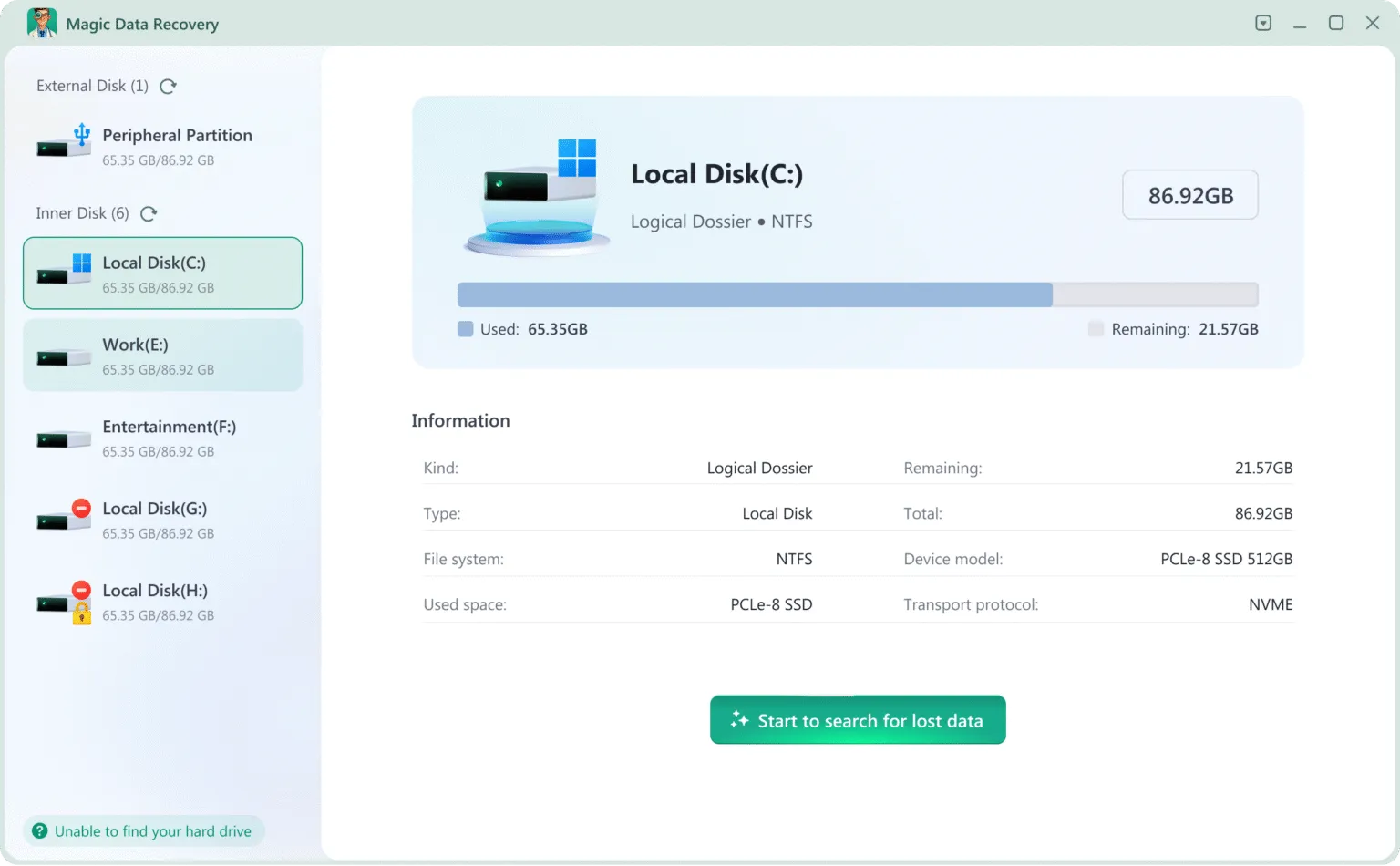
Step 3: Select the Physical Disk or Partition
Launch the software on the host computer or Windows server.
Select the actual physical disk or partition containing the network share. Do not select only the mapped network drive displayed on a client workstation.
For example:
- Network path: \\FILESERVER\Projects
- Employee mapping: Z:
- Actual server location: D:\Shared\Projects
- Correct scan target: The server’s D: volume
Step 4: Start the Storage Scan
Begin scanning the affected volume. Allow the scan to examine the storage for deleted file records, lost directory information, and recognizable file content.
Avoid using the volume for normal business activity while the scan runs.
Step 5: Filter the Results
Search by:
- Original file name
- File extension
- File type
- Modification date
- Approximate size
- Original directory
- Project or customer name
The official Magic Data Recovery user guide explains its search, filtering, preview, and recovery workflow.
Step 6: Preview Important Files
Preview recoverable documents, photos, videos, archives, or other supported files whenever possible.
A file name in the scan results does not always mean that its contents remain intact. Previewing helps determine whether the required file is readable before you restore it.
Step 7: Save Files to Another Drive
Recover the selected files to:
- A separate internal disk
- An external drive
- Another server
- A temporary recovery workstation
- A verified backup destination
Never restore the files to the affected server volume during the same recovery session.
Step 8: Validate the Recovered Data
Before moving the restored files back to production, check:
- Whether documents open correctly
- Whether archives extract successfully
- Whether videos play from beginning to end
- Whether spreadsheets retain formulas
- Whether databases pass consistency checks
- Whether folder relationships remain understandable
- Whether access permissions need to be recreated
This host-side workflow is more reliable than attempting to recover deleted files from mapped network drive paths from an employee workstation. The host server has direct access to the underlying storage sectors.
Why Magic Data Recovery Is More Reliable Than Manual Guesswork
Manual recovery methods depend on protection that already existed.
A recycle bin works only if it was enabled. Previous Versions requires a usable snapshot. A backup helps only when it captured the file before deletion.
Magic Data Recovery fills the gap when those safeguards are unavailable and you still need to recover files deleted from network drive storage.
Its relevant advantages include:
- Direct scanning of the host storage
- Support for deletion, formatting, and file system errors
- File search and filtering
- File preview before recovery
- Support for FAT, exFAT, NTFS, ReFS, and other listed file systems
- Support for common documents, images, videos, audio, archives, and email files
- A straightforward workflow for users and administrators
- Selective recovery to another storage destination
The supported file systems and file categories are listed in the official product guide.
However, no recovery software can restore data that has already been overwritten, securely erased, or destroyed by severe physical damage. Recovery results depend on the condition of the storage and the amount of writing that occurred after deletion.
Method 6: Contact a Professional for RAID or Physical Failure
Stop self-service attempts and contact a professional recovery service when:
- A server disk clicks or grinds
- The disk repeatedly disconnects
- A RAID array is degraded and another disk has failed
- The NAS cannot detect its storage pool
- A RAID controller has failed
- The array configuration is unknown
- Multiple disks were removed without labeling their order
- The server suffered fire, liquid, electrical, or mechanical damage
- Business-critical data requires forensic handling
- Regulatory rules require a documented chain of custody
Do not:
- Initialize an unknown disk
- Create a new storage pool
- Format RAID member disks
- Rebuild the array repeatedly
- Change the disk order
- Scan each RAID disk as though it contained complete files
- Replace several disks at the same time without documenting the array
RAID recovery requires the correct disk order, stripe size, parity layout, starting offset, and controller information. An incorrect rebuild can overwrite metadata or distribute new parity data across recoverable content.
Which Recovery Method Should You Choose?
Method | Best use case | Prior setup required | Main limitation |
Undo Delete | Deletion that happened seconds ago | No | Undo history changes quickly |
Network recycle bin | Recent deletion on a protected NAS or server | Yes | Must be enabled before deletion |
Previous Versions | Windows file server protected by VSS | Yes | A suitable snapshot must exist |
Backup restore | Business data covered by backup | Yes | Recent work may be missing |
Magic Data Recovery | Logical deletion, formatting, or file system loss | No backup required | Must scan the host disk locally |
Professional service | Physical damage or complex RAID loss | No | More expensive and slower |
For most incidents, check recycle bins, snapshots, and backups before scanning the disk.
If these methods fail and the underlying host storage remains healthy, Magic Data Recovery offers a controlled way to recover files deleted from network drive storage without depending on an existing backup.
Common Mistakes That Reduce Recovery Success
Avoid these mistakes when you try to recover files deleted from network drive storage.
Continuing to Use the Shared Folder
Other users may create database logs, temporary documents, thumbnails, synchronized copies, or application cache files. Each write can overwrite deleted sectors.
Scanning the Mapped Drive from the Wrong Computer
A mapped drive is a remote path, not a locally attached disk. Recovery software needs direct access to the host storage or a sector-level image.
Running CHKDSK Before Recovering Data
CHKDSK repairs file system structures. During this process, it may change metadata, remove damaged references, or convert file fragments into generic recovered items.
Recover important data before attempting file system repair.
Restoring an Entire Snapshot Without Reviewing It
Rolling back a complete live folder can overwrite newer files. Open the snapshot and copy only the missing items whenever possible.
Saving Recovered Files to the Same Volume
Writing restored data to the affected disk may overwrite other deleted files that have not yet been recovered.
Rebuilding RAID Without Confirming Its Layout
Incorrect disk order, stripe size, parity rotation, or offset can produce corrupted results. Document the original configuration and obtain specialist help when uncertain.
Assuming a Server Recycle Bin Always Exists
The local Windows Recycle Bin does not normally protect network-share deletion. Server-side protection must be configured separately.
How to Prevent Future Network Drive Data Loss
After you recover files deleted from network drive, strengthen the storage environment.
- Enable a recycle bin for every important NAS shared folder
- Configure VSS Shadow Copies on Windows file-server volumes
- Create frequent snapshots
- Use an appropriate snapshot retention policy
- Maintain versioned backups on separate storage
- Keep at least one offline or immutable backup
- Restrict Delete permissions
- Apply least-privilege access
- Enable file-access auditing for sensitive shares
- Protect administrator accounts with multifactor authentication
- Test file-level restoration regularly
- Document each share’s host server and physical volume
- Train users to report accidental deletion immediately
- Use application-aware backups for databases
- Monitor backup failures and available snapshot space
Recovery software provides an important safety net. Nevertheless, it should complement snapshots and backups rather than replace them.
Conclusion
The safest way to recover files deleted from network drive is to identify the physical host first, stop new writes, and follow the recovery methods in the correct order:
- Undo the deletion
- Check the network recycle bin
- Restore Previous Versions
- Restore from backup
- Scan the host storage
- Use a professional service when hardware or RAID failure is involved
Magic Data Recovery is recommended when built-in methods fail and the loss occurred on a healthy Windows server or host disk. It supports deletion, formatting, inaccessible partitions, and file system error scenarios. Its preview workflow also helps users verify files before saving them.
Most importantly, Magic Data Recovery must run on the server or computer that stores the network share, or scan the underlying disk locally. It cannot directly recover data by scanning only a mapped network path.
For more information about deleted-file scenarios and safe recovery practices, visit Amagicsoft’s deleted file recovery.
Supports Windows 7/8/10/11 and Windows Server
FAQs About Recovering Files Deleted from a Network Drive
Can I recover files deleted from network drive if they are not in my Recycle Bin?
Yes, you can often recover files deleted from network drive storage even when the local Recycle Bin is empty. Check the NAS network recycle bin, Windows Previous Versions, server snapshots, and backups first. If none contains the file, stop writes and scan the physical host disk rather than the mapped drive shown on the employee’s computer.
Why are network drive files not in the local Recycle Bin?
A mapped drive is a remote share rather than a local file system. When you delete a file, the client computer asks the host server or NAS to remove it. Therefore, the local Recycle Bin usually does not receive the item. Recovery depends on server-side recycle protection, snapshots, backups, or scanning the underlying host storage.
Can Magic Data Recovery scan a mapped network drive directly?
No. To recover files deleted from network drive storage, Magic Data Recovery needs direct access to the physical disk or partition. Install it on the Windows server or host computer containing the shared folder. Alternatively, connect the underlying disk or compatible disk image to another Windows computer and scan it locally.
How do I recover files deleted from network drive folders on Windows Server?
First, pause write activity on the affected share. Right-click the parent folder, open Properties, and check Previous Versions for a VSS snapshot created before deletion. If no suitable version exists, inspect server backups. When these options fail, run recovery software on the server and scan the actual physical volume containing the shared folder.
Can I recover deleted files from a Synology or QNAP network drive?
Start with the NAS recycle bin, snapshots, and backup applications. Synology and QNAP offer native shared-folder recovery features when administrators enable them before deletion. If those options fail, do not casually remove or scan individual RAID disks. Stop unnecessary NAS activity and consult the vendor, recovery software support, or a RAID recovery specialist.
Does Previous Versions always recover files from a network share?
No. Previous Versions works only when the host uses VSS or another compatible snapshot system and still retains a restore point from before deletion. The tab may be empty if snapshots were disabled, expired, deleted because of limited storage, or configured on another volume. Open and verify a snapshot before restoring any files.
Can overwritten files be recovered from a network drive?
A previous version or backup may restore an overwritten file even when undelete software cannot. Storage-level recovery becomes less likely after new data replaces the original sectors. Check VSS snapshots, version history, application backups, and cloud copies first. Stop further writes promptly because ongoing server activity may overwrite additional recoverable file content.
What is the safest way to recover files deleted from network drive storage?
Identify the host server and affected physical volume, pause writes, and check server-side recycle bins, snapshots, and backups. If those methods fail, scan the host disk locally and save recovered files elsewhere. For degraded RAID arrays, clicking disks, unknown storage layouts, or critical business data, stop self-service attempts and use a professional recovery service.

Jason is a data recovery and technical support specialist with over 15 years of hands-on experience. He has worked extensively with frontline users, troubleshooting difficult data loss cases and providing practical recovery solutions for accidental deletion, formatted drives, damaged file systems, lost partitions, system failures, and other recovery emergencies. His expertise also includes backup and restoration, file repair, and disaster recovery, with a strong emphasis on safe, reliable, and technically accurate guidance.