
Recover Files From a Computer: 7 Safe Methods
Losing a work document, family photo, project folder, or downloaded file can make it feel as though the data has vanished permanently. However, a recover files computer problem can have several causes. The file may be misplaced, moved to the Recycle Bin, permanently deleted, removed during formatting, hidden by a file system error, or trapped on a computer that no longer starts.
This guide explains how to choose the safest recovery method. You can begin with the deleted file recovery guide, then move from built-in Windows options to deeper scanning with Magic Data Recovery when no usable backup remains.
Supports Windows 7/8/10/11 and Windows Server
Table of Contents
Quick Answer: How Do I Recover Files From My Computer?
To recover files from a computer, stop saving new data to the affected drive and identify what happened. Check File Explorer search and the Recycle Bin first. Next, review cloud storage, File History, and Previous Versions.
If the files were permanently deleted, the drive was formatted, or Windows reports a file system error, scan the original storage device with recovery software. Always save restored files to a different drive. For any recover files computer task, protecting the original storage device should come before attempting repairs.
Recover Files Computer Data: Choose the Right Method First
A broad recover files computer search can point to very different problems. The best method depends on the loss scenario, not only the file type.
What happened? | Best first action | When to use recovery software |
The file suddenly disappeared | Search the PC, Recent files, and hidden folders | When Windows cannot locate the original file |
You pressed Delete | Open the Recycle Bin and restore it | When the Recycle Bin is empty |
You used Shift + Delete | Stop using the affected drive | When no backup or cloud copy exists |
You emptied the Recycle Bin | Check File History and cloud trash | When no saved version remains |
You formatted a partition or drive | Do not format it again | Scan the affected storage device |
Windows asks you to format a drive | Cancel the prompt | Scan before attempting repairs |
The computer will not boot | Connect the drive to another PC when possible | When the disk is detected but files remain inaccessible |
The hard drive clicks or grinds | Shut down the device | Contact a professional recovery service |
This scenario-first approach helps users avoid methods that cannot solve their specific computer file recovery problem.
What to Do Before Computer File Recovery
Your first actions can strongly affect the recovery result. Follow these precautions before you try to recover deleted files on a PC.
Stop Writing New Data to the Affected Drive
Deleting a file usually removes its file-system reference and marks its storage space as reusable. New downloads, updates, temporary files, and application installations may reuse that space.
Therefore, reduce computer activity immediately. If the lost file was on a secondary drive, disconnect that drive until you are ready to scan it. Continuing to use the device increases the possibility that new data will overwrite deleted content.
Do Not Install Recovery Software on the Same Drive
Suppose a deleted folder was stored on drive C:. Installing a recovery program on C: may write new data over recoverable sectors.
Whenever possible, install the program on another partition, an external drive, or a separate computer. Save recovered files somewhere other than the source drive for the same reason.
Separate Logical Loss From Physical Damage
Recovery software addresses logical problems such as deletion, formatting, RAW file systems, damaged directory structures, and inaccessible partitions. It cannot repair broken read/write heads or other failed hardware.
Repeated clicking, grinding, or clunking may indicate a physical drive problem. Shut down the device and consider a professional recovery laboratory instead. Storage manufacturers and recovery specialists recommend stopping software-based attempts when a drive produces persistent abnormal noises.
Identify the Source and Recovery Destination
Write down the original location, approximate file name, extension, size, and deletion date. Also prepare a different drive with enough free space for the restored data.
This small step makes every recover files computer method safer and more efficient.
7 Safe Ways to Recover Files on a Computer
Start with the least invasive option. Move to the next method only when the previous one does not apply.
Method 1: Search for Missing or Moved Files
A file that appears deleted may simply be renamed, moved, hidden, or opened from a different Windows user profile.
- Open File Explorer.
- Select This PC to search all available locations.
- Enter the full name, part of the name, or an extension such as *.docx, *.xlsx, *.jpg, or *.pdf.
- Sort the results by Date modified, Type, or Size.
- Check Desktop, Documents, Downloads, Recent files, and the application’s recent-document list.
- In File Explorer, enable View > Show > Hidden items.
Immediately after an accidental move or deletion, press Ctrl + Z in the same folder. This command may reverse the action without requiring a scan.
This simple check resolves many recover files computer cases in which the data was never actually deleted.
Method 2: Restore Files From the Recycle Bin
For a recent normal deletion, the Recycle Bin is the fastest how to recover deleted files solution.
- Open the Recycle Bin from the desktop or Windows search.
- Locate the file and check its original location.
- Right-click it and choose Restore.
- Open the original folder and confirm that the file works.
Windows normally returns restored items to their original folders. The Recycle Bin will not help after Shift + Delete, an emptied bin, some large-file deletions, or deletion from certain removable and network locations.
For a more detailed workflow, see how to recover files after deleting them from the Recycle Bin.
Method 3: Check OneDrive, Cloud Trash, and App Recovery
Many users save Desktop, Documents, or Photos through OneDrive without realizing that folder syncing is active. Sign in to the relevant cloud account, open its Recycle Bin or Trash, and look for the missing item.
Also check version history when the file still exists but contains unwanted changes.
For Microsoft Office files, inspect the application’s Recent, Recover Unsaved Documents, or AutoRecover options. These features solve a different problem from disk scanning. They restore a saved cloud version, temporary copy, or application backup rather than undeleting raw disk data.
If OneDrive was involved, follow this dedicated OneDrive file recovery guide before scanning the local drive.
Method 4: Recover Files With File History or Previous Versions
File History can restore deleted content or an earlier version when Windows created a backup before the loss.
- Open File Explorer and browse to the folder that previously contained the file.
- Right-click the folder.
- Choose Restore previous versions.
- Select an available version.
- Use Open to inspect it before choosing Restore or Restore to.
Microsoft documents the same folder-based workflow for File History restoration.
This method is safe and free, but it only works when a usable backup or previous version already exists. In a recover files computer workflow, File History should come before disk scanning because it restores an existing copy without modifying deleted sectors.
For additional Windows-specific steps, read how to restore files in Windows 10.
Method 5: Use Windows File Recovery
Windows File Recovery is Microsoft’s command-line tool for files that are no longer in the Recycle Bin. It scans local internal drives, external drives, and USB devices.
Microsoft notes that Windows File Recovery does not recover directly from cloud storage or network file shares.
The basic command structure is:
winfr source-drive: destination-drive: [/mode] [/switches]
For example:
winfr C: E: /regular /n \Users\Name\Documents\*.docx
In this example, Windows scans drive C: for Word documents and writes found files to drive E:. The source and destination must be different.
Windows File Recovery can work well for users who understand drive letters, file paths, recovery modes, and command syntax. However, it may feel difficult when the original folder is unknown or when you need to inspect many file types.
Method 6: Recover Files With Magic Data Recovery
When the Recycle Bin is empty, no backup exists, or the storage device has been formatted or become inaccessible, Magic Data Recovery provides a visual file recovery software for PC workflow.
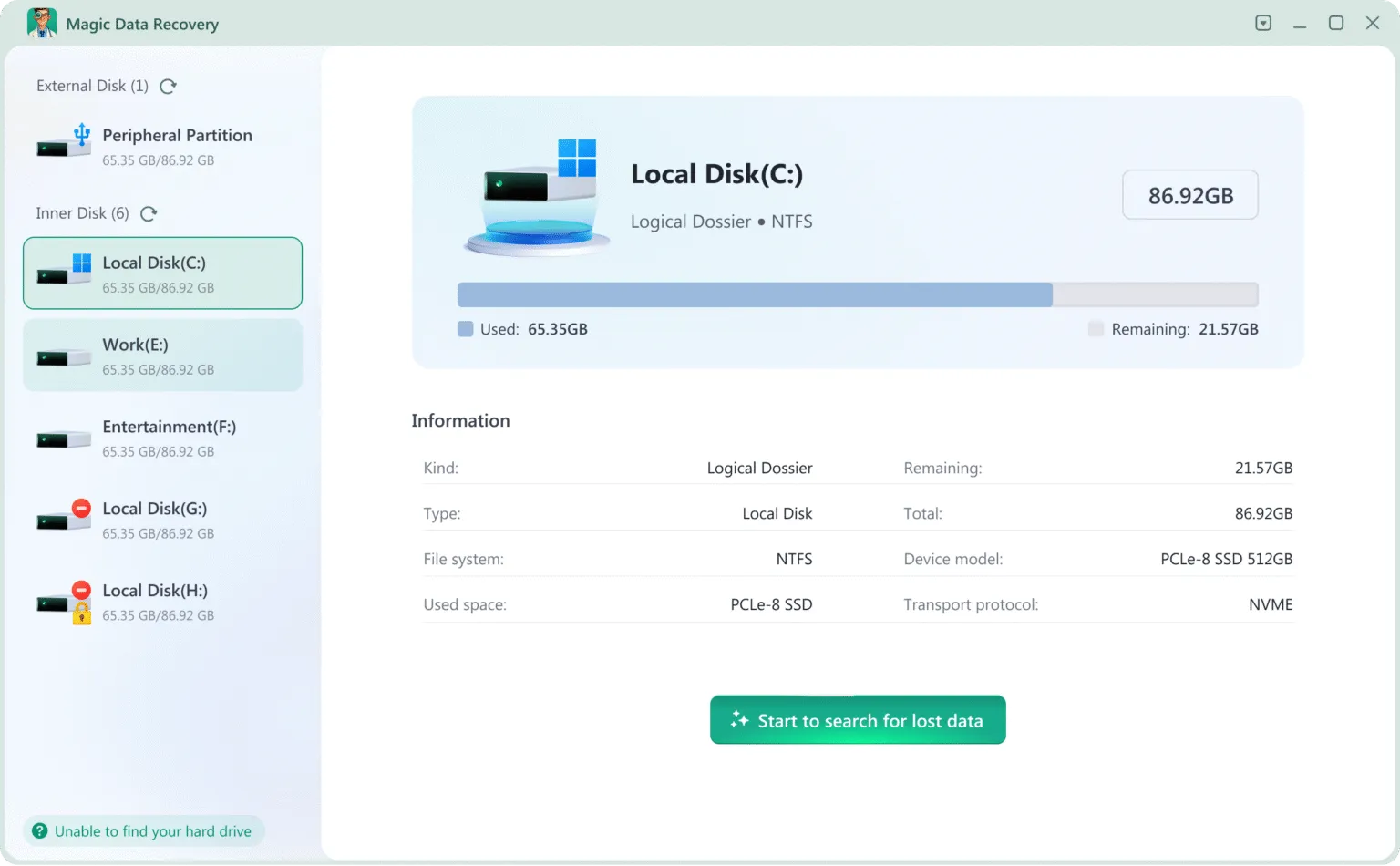
It addresses the main problems behind a recover files computer request:
- Accidental deletion and Shift + Delete
- Files removed after emptying the Recycle Bin
- Formatted drives and partitions
- File system errors and RAW storage
- Data lost after Windows reinstallation or system problems
- Missing documents, photos, videos, archives, emails, and other common file types
- Internal drives, external drives, USB devices, memory cards, and other connected storage
This wider coverage makes Magic Data Recovery useful when a recover files computer problem involves more than a recently deleted file.
Unlike backup methods, Magic Data Recovery does not require a copy created before the loss. Unlike command-line recovery, it lets users select a drive, scan it, filter results, preview supported files, and recover selected items through a guided interface. Its official product workflow follows the same scan, preview, and recovery process.
How to Use Magic Data Recovery
1. Install safely. Download and install Magic Data Recovery on a healthy drive, not the location where the files disappeared.
Supports Windows 7/8/10/11 and Windows Server
2. Select the source. Launch the software and choose the affected disk, partition, or connected device.
3. Start the scan. Allow the scan to continue, especially after formatting or a file system error.
4. Filter the results. Search by name, file type, path, size, or date when available.
5. Preview important files. Open supported previews to confirm that you selected the correct version.
6. Recover to another drive. Save the restored data to a separate internal partition, external disk, or USB drive.
Consider an office user who deletes a project folder, empties the Recycle Bin, and then discovers that File History was never enabled. Windows File Recovery may require several command attempts. Magic Data Recovery offers a clearer scan-and-preview route.
However, no responsible recovery tool should promise that every file will return. If new data has overwritten the original sectors, the file may be incomplete or unrecoverable.
For users seeking a more efficient recover files from computer solution, Magic Data Recovery is worth trying before making further changes to the affected drive.
Method 7: Recover Files From a Computer That Will Not Boot
A failed Windows installation does not always mean the internal drive has failed. If the computer powers on but Windows cannot start, avoid resetting or reinstalling the system until you protect important data.
Possible approaches include:
- Start from a trusted recovery environment and copy accessible files to an external drive.
- Remove the internal HDD or removable SSD and connect it to another Windows PC with a compatible enclosure or adapter.
- If the drive appears normally, copy essential files first.
- If folders are missing, the partition is inaccessible, or Windows shows a format prompt, scan the connected drive with Magic Data Recovery.
Connecting a working internal drive to another computer can provide access to files from a non-booting PC. When the drive remains detected but its folders are inaccessible, a logical recovery scan may help.
The Amagicsoft guide to recovering information from a hard drive explains the connect-to-another-PC approach. The system recovery and lost data guide covers files lost after reset, restore, or operating-system recovery.
Do not remove a soldered SSD, open a hard drive casing, or repeatedly power a mechanically damaged disk. When the hardware is unstable, professional service is safer than a home recover files computer attempt.
Which Computer File Recovery Method Is Best?
Recovery option | Best for | Requires prior backup? | Main limitation |
Search and Ctrl + Z | Moved, renamed, or immediately deleted files | No | Cannot restore permanently deleted data |
Recycle Bin | Recent normal deletion | No | Fails after permanent deletion |
Cloud trash or version history | Synced files | Yes, through sync or cloud retention | Depends on retention settings |
File History or Previous Versions | Backed-up folders and older copies | Yes | Must exist before the loss |
Windows File Recovery | Deleted local files | No | Requires command-line input |
Magic Data Recovery | Deletion, formatting, file system errors, inaccessible storage | No | Cannot restore overwritten data or repair hardware |
Professional recovery service | Physically damaged or highly unstable devices | No | Higher cost and longer turnaround |
For most users, the correct order is straightforward: use an existing copy first, use a logical recovery scan second, and choose a professional laboratory when hardware shows physical failure.
Can You Recover Files After Formatting or a File System Error?
Logical recovery may still be possible, but you should avoid actions that write new information to the device. Therefore, a recover files computer plan for formatted or inaccessible drives should prioritize scanning before repair.
After Quick Formatting
A quick format recreates key file-system structures and makes the volume available for new data. Do not copy files to it, format it again, or reinstall Windows on it.
Instead, scan the entire affected drive and recover the results to another storage device. Recovery can become more difficult on SSDs when TRIM clears unused blocks.
When a Drive Becomes RAW or Requests Formatting
A RAW status means Windows cannot interpret the file system normally. Cancel any format prompt.
Running repair operations before recovery may change file-system metadata. Consequently, copy accessible data or scan the device before attempting repairs.
After Resetting or Reinstalling Windows
Recovery depends on the reset or installation option you selected and how much new data Windows wrote afterward.
Stop installing applications and downloading files. Then scan the affected disk from another drive or another computer.
After Virus Damage or Unexpected File-System Errors
Disconnect the computer from the network if malware may still be active. After containing the threat, scan the storage from a clean environment.
Magic Data Recovery can help locate files lost through logical damage. However, it does not decrypt ransomware-encrypted content or repair physically damaged media.
These cases explain why a broad recover files computer guide should cover more than accidental deletion.
Common Mistakes That Reduce Recovery Chances
Avoid these actions during computer file recovery:
- Continuing normal work on the affected drive
- Installing recovery software on the source partition
- Saving recovered data back to the same drive
- Formatting a drive because Windows requests it
- Running repair commands before protecting critical files
- Repeatedly scanning a clicking or disconnecting hard drive
- Assuming System Restore restores personal documents
- Recovering every scan result without previewing important files first
A safe workflow protects the source, identifies the loss type, and uses a separate recovery destination.
How to Prevent Future File Loss
Recovery is a fallback, not a replacement for backup. Use a practical 3-2-1 approach: keep multiple copies, store them on different types of media, and retain one copy away from the main computer.
Enable OneDrive or another cloud service for active folders. Configure File History or scheduled backup software, and periodically test whether you can restore several files. Recovery specialists also recommend maintaining redundant backups and verifying them through test restorations.
Additionally, monitor drive health, keep security software updated, and replace storage devices that show recurring errors. Clear file naming and folder organization can also prevent misplaced files from being mistaken for deleted data.
Conclusion
The safest way to solve a recover files computer problem is to match the method to the cause. Search for moved files, restore recent deletions from the Recycle Bin, check cloud storage and File History, and use Windows File Recovery when you are comfortable with commands.
For permanent deletion, formatting, file system errors, or inaccessible but detected storage, Magic Data Recovery is recommended because it combines broad logical recovery support with a clear scan, preview, and recover process.
It does not make unrealistic promises. The software cannot repair physical hardware or restore sectors that new data has overwritten. However, it fills the gap when backups and Windows built-in tools are unavailable.
Start with the deleted file recovery, protect the source drive, and recover important data to a separate location.
Supports Windows 7/8/10/11 and Windows Server
FAQs About Recover Files Computer
Can I recover permanently deleted files from my computer?
Yes, permanently deleted files may remain recoverable when new data has not overwritten their storage space. Stop using the affected drive, check File History and cloud backups, and then scan the original disk with Magic Data Recovery or Windows File Recovery. Always save recovered items to another drive to avoid overwriting additional files that may still be recoverable.
How can I recover files from a computer without software?
Check the Recycle Bin, press Ctrl + Z immediately after deletion, search the computer by file name or extension, and review OneDrive or another cloud trash folder. You can also use File History or Previous Versions when they were enabled before the loss. Without a backup, permanently deleted data usually requires a disk-scanning recovery tool.
Can Magic Data Recovery recover files after formatting?
Magic Data Recovery can scan logically formatted drives and look for recoverable files, provided the device remains detectable and new data has not overwritten the original content. Stop using the formatted drive, install the software elsewhere, complete the scan, preview important results, and save recovered files to a separate storage device rather than the formatted source.
Where do restored Recycle Bin files go?
Windows normally returns restored Recycle Bin items to their original folders. Check the “Original location” column before selecting Restore so you know where to look. If the original folder no longer exists or the drive is disconnected, reconnect the device or create an appropriate destination. Recovery software, by contrast, lets you choose a new safe output location.
Can I recover files from a computer that will not turn on?
Yes, when the storage drive itself still works. Remove the HDD or removable SSD only when the hardware design allows it, connect it to another Windows computer with a compatible adapter, and copy accessible data. If the drive is detected but files remain missing or inaccessible, scan it. For clicking, burned, or undetected hardware, use professional help.
Does System Restore recover deleted personal files?
Usually no. System Restore mainly reverses changes to Windows system files, drivers, registry settings, and installed programs. It is not designed as a personal document backup. To recover deleted photos, documents, or videos, use the Recycle Bin, File History, Previous Versions, cloud backup, Windows File Recovery, or a dedicated data recovery program based on the loss scenario.
Why should I recover files to a different drive?
Writing restored files to the source drive can overwrite other deleted data that has not yet been recovered. A separate destination preserves the original evidence and reduces avoidable damage during the scan-and-save process. Use an external drive, USB device, or another internal partition with enough capacity, then verify important files before repairing the source disk.
When should I stop using recovery software and contact a professional?
Stop software-based recovery when a hard drive clicks, grinds, smells burned, disappears repeatedly, or is not detected consistently. These signs may indicate physical or electrical failure rather than logical data loss. Continued power cycles and scans can make the condition worse. A professional recovery laboratory has controlled equipment for damaged drives that ordinary software cannot repair.

Jason is a data recovery and technical support specialist with over 15 years of hands-on experience. He has worked extensively with frontline users, troubleshooting difficult data loss cases and providing practical recovery solutions for accidental deletion, formatted drives, damaged file systems, lost partitions, system failures, and other recovery emergencies. His expertise also includes backup and restoration, file repair, and disaster recovery, with a strong emphasis on safe, reliable, and technically accurate guidance.