
Hasleo Data Recovery Review & Alternatives
Hasleo Data Recovery is worth considering when a Windows file disappears after Shift + Delete, an emptied Recycle Bin, or accidental formatting. Yet a scan that finds a filename is not proof that the file can be restored intact. Free recovery limits, drive type, and licensing also affect your choice. This review examines published recovery tests alongside features and pricing, then explains when another data recovery tool may help if backups and built-in recovery methods fail.
We compare Hasleo Data Recovery, Recuva, Windows File Recovery, and Magic Data Recovery. Editorial disclosure: Amagicsoft develops Magic Data Recovery. The real-world results cited below were published by different reviewers, including one Amagicsoft-run test. We independently checked those reports, but did not run the four products under identical conditions. Therefore, this is an evidence-based review, not a head-to-head recovery-rate ranking. For a closer look at storage problems, see Amagicsoft’s hard drive recovery solutions.
Table of Contents
Quick Picks: Which Windows Recovery Tool Fits?
Need | Consider | Why |
Restore up to 2 GB for free | Hasleo Data Recovery | The Free edition advertises a 2 GB default allowance for eligible home users. |
Restore recently deleted local files using a GUI | Recuva Free | A straightforward Windows interface and deep-scan option. |
Avoid a paid license and use commands | Windows File Recovery | Microsoft’s free command-line utility has no published GB quota. |
Try another scanner after built-in methods fail | Magic Data Recovery | GUI scanning and previews, with a documented 500 MB free allowance. |
These picks reflect suitability and cost, not a universal winner. First check the Recycle Bin, File History, or cloud version history; an intact backup is safer than a fresh disk scan.
Hasleo Data Recovery vs Alternatives: Features and Limits
Decision factor | Hasleo | Recuva | Windows File Recovery | Magic Data Recovery |
Platform | Windows | Windows | Windows 10/11 | Windows |
Interface | GUI | GUI | Command line | GUI |
Free recovery | 2 GB by default | Free | Free | 500 MB |
Search methods | Deleted File / Deep Scan | Standard / Deep Scan | Regular / Extensive | Drive scan and filters |
Preview | Supported formats | Supported formats | No integrated preview | Supported formats |
Main trade-off | Advanced features restricted by edition | Pro extras and Windows-only scope | No graphical file browser | Smaller free allowance |
Best fit | General home recovery | Routine deletion | Technical users | A second GUI assessment |
Hasleo Data Recovery Testing Methodology: Published Results
Evidence Sources and Selection Rules
To evaluate Hasleo Data Recovery fairly, we reviewed completed, publicly documented recovery attempts from Remontka.pro (Hasleo), Digital Trends (Recuva Professional), CleverFiles (Windows File Recovery), and Amagicsoft (Magic Data Recovery). We included reports that identify a storage or data-loss scenario and provide concrete outcomes rather than unsubstantiated recovery-rate advertising.
The test authors chose their own drives, sample files, software versions, scan modes, and verification methods. We did not obtain their original recovered files or reproduce their experiments. Independent editorial reporting and vendor-published testing are labeled separately; the primary Hasleo Data Recovery experiment is historical, and CleverFiles also develops competing recovery software. Thus, comparisons of file counts should stay within each published experiment.
Published Hands-on Recovery Results
Software | Test environment and scenario | Published observation | Verification boundary |
Hasleo Data Recovery | USB flash drive, 50 mixed files; reformatted from FAT32 to NTFS | 32/50 files restored: 31 photos and 1 PSD. The reviewer reported those 32 files were undamaged; documents and videos were not recovered. | Older version, cross-file-system format, no published SHA-256 audit |
Recuva Professional | External HDD, 163 files; separate deletion and quick-format attempts | 163/163 restored after deletion; 158/163 after formatting. Some recovered items had generated names. | Tested paid Professional, not Recuva Free; no complete hash-verification table |
Windows File Recovery | Windows 11 Pro 23H2; 16 GB NTFS USB, 753-file dataset | 743/753 recovered after deletion in about 1 minute. Separate format and corruption tests reportedly produced about 700 files each. | Competing vendor’s test; different loss modes; no per-file hash audit |
Magic Data Recovery | Windows 11, 500 GB HDD; 35 deleted mixed files | Amagicsoft reported 35/35 recovered files opened normally; completed scan 37 minutes. | First-party test against Donemax, not Hasleo; no published file-by-file hash results |
How to read these numbers: The Hasleo Data Recovery 32/50 result comes from a 2018 format test; it does not predict current version 6.8 performance. Recuva’s 163/163 and 158/163 results came from two separate scenarios on a particular HDD. Windows File Recovery’s roughly 700 files in the other tests should not be combined into a single formatting success percentage. Magic Data Recovery’s 35/35 is a company-reported file-open result, not an independently verified comparison with Hasleo.
In addition, an Ask Leo! case report from 2024 describes a Hasleo scan lasting more than 24 hours that found more candidates than Recuva but did not restore the document that mattered most. This illustrates why a long result list is not equivalent to successful restoration.
How We Interpret Recovery Quality
We apply the same four definitions when interpreting reports:
- Found: The application lists a candidate filename or signature.
- Previewable: Supported content appears in the preview window.
- Recovered: The program exports a file to another storage location.
- Intact: The file opens and works correctly; an exact SHA-256 match provides stronger byte-level evidence.
Not every publication establishes all four stages. Consequently, we do not compute a cross-product Hasleo Data Recovery success rate or assign a tested speed winner. The separately prepared 22-file synthetic benchmark dataset has passed 22/22 source-file SHA-256 checks, but its proposed Hasleo/Recuva/WinFR/MDR Windows recovery runs have not been executed. Source-file verification is not a recovery outcome.
1. Hasleo Data Recovery Review: Free Limit and Real-World Evidence
Best for: Windows home users with deleted files or a logically formatted, readable drive, especially when the expected export is no more than 2 GB.
Main Features and Workflow
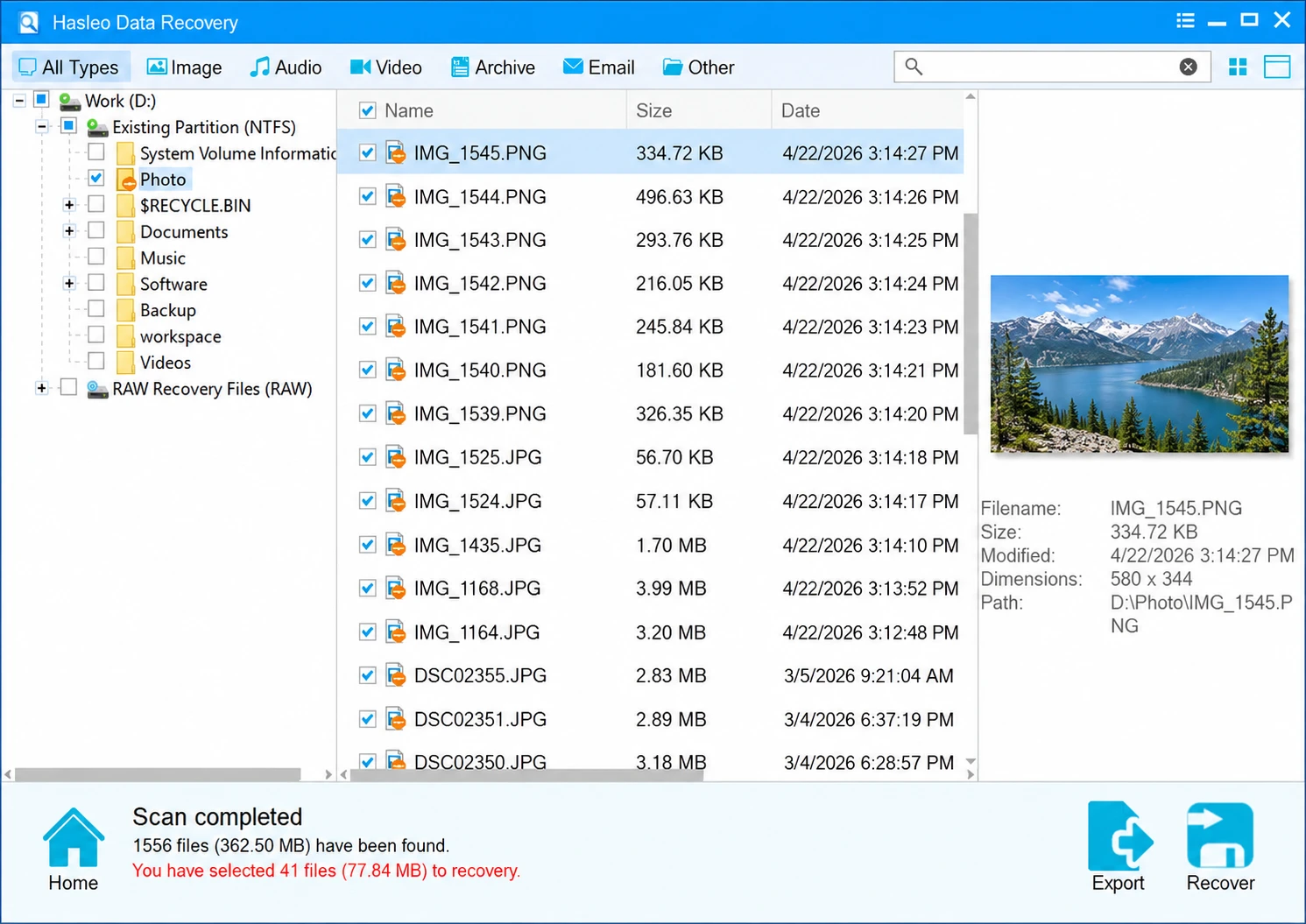
The official Hasleo product page identifies Hasleo Data Recovery version 6.8. Deleted File Recovery targets ordinary deletion, while Deep Scan Recovery searches more extensively after formatting, partition loss, or certain file-system problems. It supports common HDDs, USB storage, and memory cards and documents file previews and saved scan sessions.
The independent 2018 Remontka.pro test recovered 32 of 50 files after a FAT32-to-NTFS reformat. The reviewer could use the recovered images and PSD but did not retrieve the original documents or videos. This offers a concrete historical example of uneven recovery by file type, not a benchmark of today’s release.
Strengths: Clear 2 GB default free allowance, two task-specific scan modes, previews, and saved scan results. Limitations: The free edition excludes WinPE boot media and BitLocker recovery; an old cross-format result cannot establish contemporary recovery performance. SSD TRIM and physical damage may eliminate software recovery options entirely.
Is Hasleo Data Recovery Really Free?
Yes. According to Hasleo’s edition comparison, Free permits 2 GB by default. A separate promotion may grant eligible Windows Home users a one-year Home license after a qualifying public share. This is conditional, noncommercial use—not unconditional access to every paid feature.
Professional lists 49 for 1 PC, 169 for two PCs, and Technician $299 for unlimited PCs, excluding VAT. Professional adds WinPE boot media; BitLocker Data Recovery requires Ultimate or Technician and a valid password or 48-digit recovery key. The paid editions advertise lifetime upgrades.
Verdict: Hasleo Data Recovery is a sensible first GUI option for qualifying Windows users. The published test shows that a recovered photo can be usable even when other file types remain missing; it does not establish Hasleo as the most successful scanner overall.
2. Recuva vs Hasleo Data Recovery: Deleted-File Recovery
Best for: Home users who prefer a GUI for files deleted from a healthy HDD or removable disk.
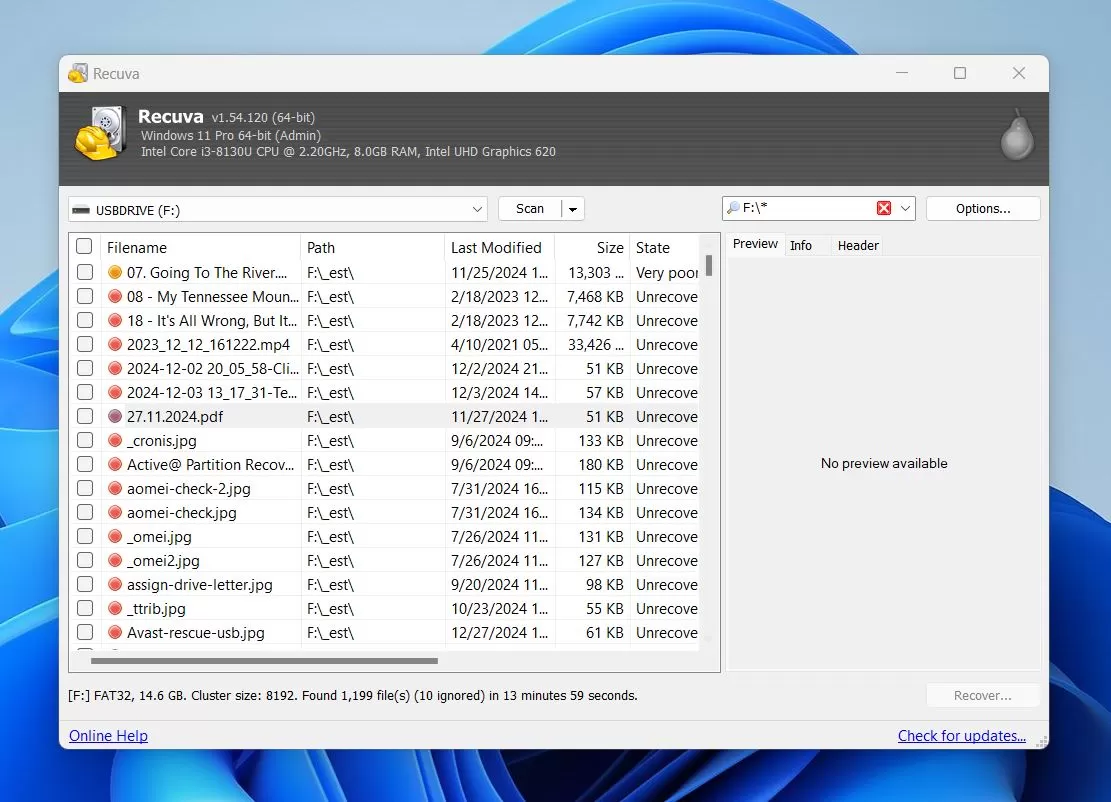
Recuva provides a free Windows edition and a paid Professional edition. It offers ordinary and deep scans, candidate-file status information, and supported previews.
In a 2024 Digital Trends review, the author used Recuva Professional on an external HDD. It restored all 163 files in the deletion test; after quick formatting, 158 of 163 returned. Nevertheless, some recovered files lost their original names. In that review, the tester also reported unsuccessful SSD recovery attempts. Those observations belong to that particular setup and should not be generalized to all SSDs.
Strengths: Free graphical edition, easy file filtering, and a published independent HDD test. Limitations: The reported result came from Professional rather than Free; filenames may be lost; virtual-hard-drive support and updates are paid extras.
Price and verdict: Recuva Professional displays $24.95, with a one-year subscription described in the Digital Trends review. Free is suitable to try first for basic deletion, while paid users should verify current checkout and device terms.
3. Windows File Recovery vs Hasleo Data Recovery
Best for: Users comfortable with Microsoft command-line tools and local Windows file systems.
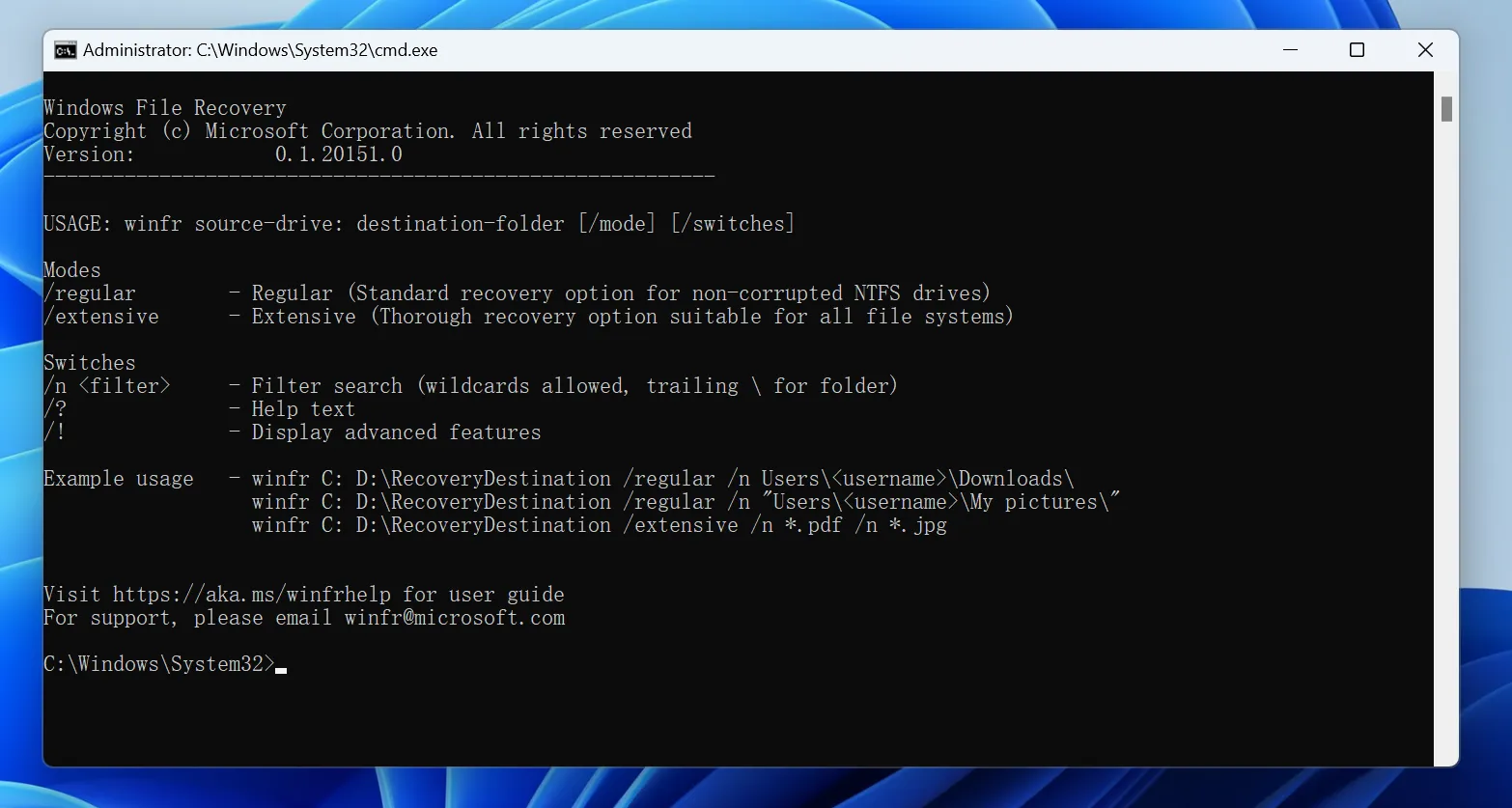
Windows File Recovery is free. Its Regular mode targets many recent NTFS deletions; Extensive mode addresses older deletion and certain formatting or other file-system situations. A typical command looks like winfr C: E: /regular /n *.pdf, with output written to a different drive.
A 2025 CleverFiles review reported a Windows 11 Pro 23H2 machine, 16 GB NTFS USB test drive, and 753 files. Regular mode returned 743/753 after deletion in approximately one minute. Separate format and corruption cases took about twelve minutes each and returned roughly 700 files, often without original names. The publisher develops competing recovery software, so its results should be treated as disclosed third-party claims rather than independent laboratory certification.
Strengths: No purchase, no stated GB cap, and powerful filename/path filters. Limitations: No GUI preview, command-line learning curve, and less control over recovered filenames in some modes.
Price and verdict: Free. Consider it if you are comfortable with commands and want a Microsoft tool before purchasing another recovery license.
4. Magic Data Recovery vs Hasleo Data Recovery
Best for: Users whose backups and initial recovery attempts failed but whose source drive remains physically stable and readable.
Magic Data Recovery from Amagicsoft scans Windows disks and removable storage. Its documented workflow covers drive selection, scanning, filtering, supported previews, and export to another physical drive.
Magic Data Recovery reportedly restored 35 deleted files from a 500 GB HDD, and all 35 opened normally. The scan took 37 minutes. This is a first-party test of a deletion scenario against Donemax, not a direct test against Hasleo Data Recovery. It also does not document byte-identical SHA-256 recovery for each file.
Strengths: GUI workflow, supported previews, and a real published file-open assessment. Limitations: Its 500 MB free allowance is smaller than Hasleo’s default 2 GB; the cited recovery test was run by its developer, not an independent lab; it cannot reverse overwriting or completed SSD TRIM.
Price and verdict: The Amagicsoft store advertises 49.95 for 1 year and 69.95 for Pro Perpetual, each covering one computer. Magic is worth evaluating as a second scanner, not because the unrelated 35-file test proves it outperforms Hasleo.

Hasleo Data Recovery Prices and License Comparison
Edition | Displayed USD price | Relevant conditions |
Hasleo Free | $0 | 2 GB default; home-use restrictions |
Hasleo Professional | $49 | 1 PC; unlimited exports; WinPE; no BitLocker mode |
Hasleo Ultimate | $169 | 2 PCs; adds BitLocker mode with required credentials |
Hasleo Technician | $299 | Unlimited PCs; service-provider rights |
Recuva Free | $0 | Home use; no published GB allowance |
Recuva Professional | $24.95 | Paid extras; verify subscription terms |
Windows File Recovery | $0 | Microsoft command-line utility |
Magic Data Recovery Free | $0 | 500 MB free recovery |
Magic Data Recovery Pro 1 Year | $49.95 | 1 PC; one year of upgrades |
Magic Data Recovery Pro Perpetual | $69.95 | 1 PC; lifetime upgrades |
Prices reviewed October 21, 2026. Hasleo store prices exclude VAT. Recuva and Amagicsoft offers can change; check taxes, renewal, refund, and device-transfer terms before buying.
Which Hasleo Data Recovery Alternative Fits Your Case?
Situation | Safer first action |
File remains in Recycle Bin | Restore it directly; skip paid software |
File History, OneDrive, or another backup contains an intact copy | Restore the backup first |
Permanently deleted files on a healthy HDD | Compare Hasleo, Recuva, or Windows File Recovery |
Quick-formatted HDD or RAW volume | Stop writes; scan only when the hardware is stable |
Hasleo finds files but the exports are corrupt | Verify content; consider another scanner if the source is healthy |
Unsaved Word or Excel document | Check AutoRecover or temporary files, not generic deleted-file scans |
Locked BitLocker volume | Obtain the recovery key; check licensed encryption support |
SSD deletion after TRIM | Check backups; software recovery may be impossible |
Clicking or repeatedly disconnecting drive | Stop DIY scanning; seek professional recovery |
When Hasleo Data Recovery is not the right fit, choose a method that matches the storage fault instead of relying on a different brand name. For device-specific instructions, see recovering deleted files from an HDD and recovering data from a formatted hard drive. If folders merely look missing, first investigate files disappearing from an external hard drive rather than assuming they were deleted.
When Hasleo Data Recovery or Any Scanner Is the Wrong Choice
If an intact backup exists, use it. If a file was never written to storage, disk scanning cannot reconstruct text that existed only in application memory. Autosave and AutoRecover may help, but neither is a permanent backup.
Similarly, do not repeatedly scan a clicking or disappearing HDD. Software cannot repair failed heads or electronics. On SSDs, TRIM may make deleted blocks inaccessible even without visible new user files. Avoid repair commands, formatting, or installing tools on the affected drive until important data is protected.
If a Hasleo Data Recovery preview looks correct, that is encouraging but still weaker than verifying the exported file. Finally, verify actual output before paying. Found files, previews, exported files, and intact content are different results, and no published recovery figure guarantees your own outcome.
Conclusion: Is Hasleo Data Recovery Worth Using?
Hasleo Data Recovery offers an accessible Windows workflow, a documented 2 GB default free allowance, and separate modes for deletion and more extensive scans. The historical independent test shows usable image recovery after one cross-file-system format, alongside failures for other file types. Recuva has a separate favorable HDD test, while Windows File Recovery offers a free command-line route. If initial methods fail on healthy storage, Magic Data Recovery is another GUI option, although its published test is first-party and not directly comparable.
Choose based on the actual data-loss scenario, license, and whether an exported file opens—not a cross-study percentage. For more device-specific Hasleo Data Recovery troubleshooting, return to the hard drive recovery solutions.
Supports Windows 7/8/10/11 and Windows Server
FAQ
Is Hasleo Data Recovery completely free?
What did independent tests find about Hasleo Data Recovery?
Is Hasleo Data Recovery better than Recuva?
Can Hasleo Data Recovery restore permanently deleted or formatted files?
Does the Hasleo Free edition recover BitLocker files?
Why might another recovery program find files Hasleo missed?
Should I pay for recovery software before testing the results?

Vasilii is a data recovery specialist with around 10 years of hands-on experience in the field. Throughout his career, he has successfully solved thousands of complex cases involving deleted files, formatted drives, lost partitions, and RAW file systems. His expertise covers both manual recovery methods using professional tools like hex editors and advanced automated solutions with recovery software. Vasilii's mission is to make reliable data recovery knowledge accessible to both IT professionals and everyday users, helping them safeguard their valuable digital assets.