
Recover Accidentally Formatted Hard Drive Guide
Accidentally formatting the wrong disk can make years of photos, work files, videos, and project folders disappear within seconds. However, formatting does not always destroy every file immediately. This formatted drive recovery guide explains how to recover accidentally formatted hard drive data safely, how to judge your recovery chances, and which mistakes to avoid. When no usable backup exists, Magic Data Recovery provides a practical Windows-based way to scan the formatted drive without requiring command-line skills.
Immediate answer: Stop using the drive, do not format it again, and recover files to a different disk. If you searched i accidentally formatted my hard drive how to recover, these three actions give you the best starting point.
Supports Windows 7/8/10/11 and Windows Server
Table of Contents
Can You Recover Accidentally Formatted Hard Drive Data?
Yes, you can often recover accidentally formatted hard drive files when the drive still works and new data has not overwritten the old sectors. A format creates a new file-system structure so Windows can store new files. After a quick format, much of the previous content may remain in the storage area even though File Explorer no longer shows it.
Recovery results depend on five main factors:
- Whether you used a quick or full format
- Whether the device is an HDD or SSD
- How much new data you wrote after formatting
- Whether Windows installation or another process overwrote the disk
- Whether the drive has physical damage, encryption, or file-system corruption
Therefore, no responsible recovery guide should promise a guaranteed result. The correct goal is to preserve the current disk state and test what remains recoverable.
Quick Format vs. Full Format
Microsoft states that a Windows quick format creates a new file table without fully overwriting or erasing the volume. By contrast, a normal format fully erases existing data, so the format type directly changes the recovery outlook.
Format type | What usually happens | General recovery outlook |
Quick format | Windows creates a new file table and marks the storage space as available | Often recoverable if you have not reused the drive |
Full format | Windows writes across the volume and fully erases existing data | Software recovery is generally not practical |
Reformat to another file system | New metadata replaces parts of the old structure | Files may remain, but original names and folders may be incomplete |
Windows installed after formatting | Setup writes operating-system files across the disk | Recovery becomes harder because of substantial overwriting |
To recover accidentally formatted hard drive content after a quick format, act before applications, updates, downloads, or temporary files occupy the released space.
HDD vs. SSD: Why the Device Type Matters
Traditional hard disk drives store data magnetically. After a quick format, a scanner may still locate old file records or identify files by their signatures.
SSDs behave differently because TRIM can tell the device that certain blocks are no longer needed and may be purged. As a result, SSD recovery can become difficult even when you stopped using the computer soon after the mistake.
Do not assume that every SSD case is hopeless. Instead, stop all activity immediately and perform a read-only scan or contact a specialist when the files are irreplaceable.
What to Do Immediately After Accidental Formatting
The first few actions often matter more than the recovery tool you choose. Follow this sequence before trying to recover accidentally formatted hard drive files.
Stop Writing Data to the Formatted Drive
Do not download files, create folders, install programs, copy backups, or continue normal work on the affected disk. Every write operation can replace part of the lost data.
For an external drive, safely disconnect it. If you formatted a system partition or installed Windows on the wrong drive, shut down the computer and connect that disk to another Windows PC as a secondary drive when possible.
Do Not Format, Initialize, or Repair the Drive Again
Avoid Disk Management prompts that ask you to initialize or format the disk. Do not run DiskPart, format, or CHKDSK before recovery.
These tools manage or repair the current disk structure. They do not restore the old formatted file system and may change metadata that recovery software could otherwise analyze.
For a deeper explanation, see Can You Recover Files from a Formatted Hard Drive?.
Prepare a Separate Destination Drive
You need a second healthy drive with enough free space for the recovered files. Never save restored data to the formatted source disk.
Otherwise, the recovery process may overwrite files that the scan has not yet found.
Check for Physical Failure Symptoms
Software can help with logical data loss, such as accidental formatting, deletion, RAW file systems, or damaged partition information.
Stop DIY recovery if the HDD:
- Clicks or produces unusual grinding sounds
- Disappears repeatedly
- Spins down unexpectedly
- Overheats
- Reports the wrong storage capacity
- Causes the computer to freeze
When Windows cannot reliably detect the disk, review this unrecognized hard drive recovery guide before continuing.
How to Recover Accidentally Formatted Hard Drive Files
Choose the least invasive method that fits your situation. Start with an existing backup. When no backup contains the missing data, use a recovery scanner while the formatted drive remains unchanged.
Method 1: Restore Files from a Backup
A backup provides the safest way to recover accidentally formatted hard drive data because it does not depend on the condition of the formatted disk.
Check these locations:
- File History on an external drive or network location
- Windows Backup or Backup and Restore
- OneDrive, Google Drive, Dropbox, or another cloud service
- NAS snapshots or company backup systems
- Manual copies on another computer, USB drive, or external disk
Windows File History stores copies of protected personal files on an external drive or network location when users enable it in advance. You can open Control Panel, select System and Security > File History, and choose Restore personal files.
A backup may not include recently created files. Therefore, compare backup dates carefully before concluding that everything is safe.
Method 2: Recover Accidentally Formatted Hard Drive with Magic Data Recovery
When you have no complete backup, Magic Data Recovery offers a straightforward solution for Windows users. It addresses accidental formatting, deletion, inaccessible partitions, RAW drives, and file-system errors through one scan-and-preview workflow.
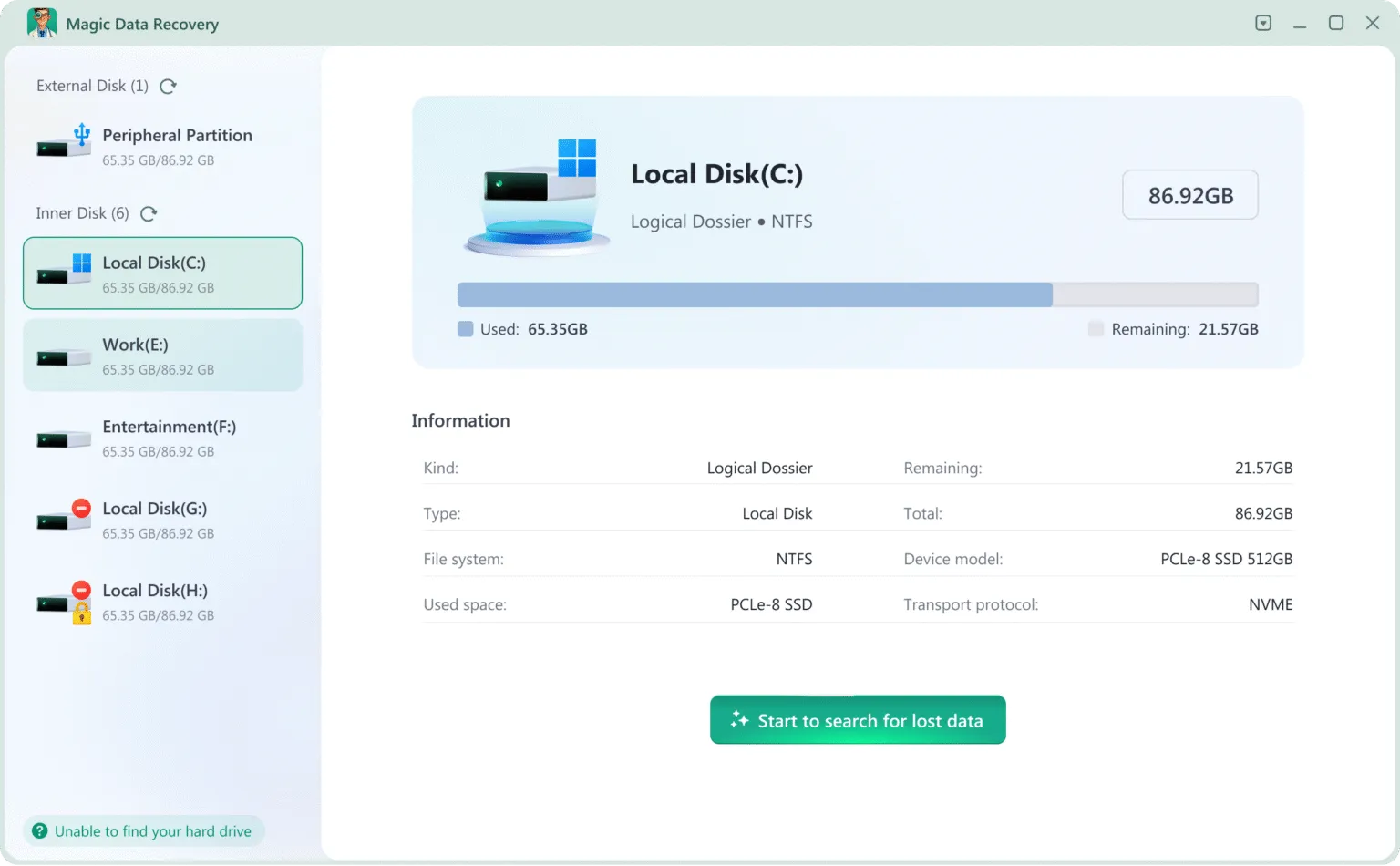
Magic Data Recovery fits this scenario because it:
- Scans formatted HDDs, SSDs, external drives, USB devices, and memory cards
- Supports more than 5,000 file formats, including documents, photos, videos, archives, and project files
- Lets you preview found files before recovery
- Provides filters and file-type categories to reduce search time
- Allows 500 MB of free recovery for testing
- Uses a graphical interface instead of command syntax
Amagicsoft’s product information lists support for more than 5,000 file formats and a 500 MB free recovery allowance. The formatted recovery page also describes a read-only scanning workflow and advises users to save recovered files elsewhere.
Step 1: Install the Software on a Safe Drive
Download Magic Data Recovery on a healthy Windows partition or another computer. Do not install it on the accidentally formatted drive.
Supports Windows 7/8/10/11 and Windows Server
For example, if you formatted drive D:, install the program on drive C: or an external system disk. If you formatted the only internal drive, remove it and connect it to another PC with a suitable enclosure or adapter.
Step 2: Select the Formatted Hard Drive
Launch the program and choose the correct physical disk or formatted partition. Confirm its capacity, drive letter, and label so you do not scan the wrong device.
Step 3: Scan for Lost Data
Start the scan and allow it to finish whenever the drive remains stable. A complete scan can locate surviving file-system records and files identified by recognizable signatures.
While scanning, avoid other activity on the source drive. This protects the remaining data and gives the software a consistent disk state to examine.
Step 4: Filter and Preview the Results
Use file type, path, size, date, and name filters to locate important files. Preview representative documents, photos, and videos before selecting a large recovery batch.
A successful preview offers stronger evidence that a file is intact. However, some specialized formats may not support preview even when the file remains recoverable.
Step 5: Recover Files to Another Drive
Select the required items and save them to the separate destination drive you prepared earlier. After recovery, open a sample from every important folder and verify file sizes, names, and content.
This workflow makes Magic Data Recovery more practical than command-line tools for ordinary users who need to recover accidentally formatted hard drive files selectively. You can inspect results before committing storage space and avoid guessing complex filters.
Method 3: Try Windows File Recovery
Microsoft provides Windows File Recovery as a command-line application from the Microsoft Store. It can recover lost files from internal drives, external drives, and USB devices. Microsoft requires the source and destination to be different drives.
For a formatted NTFS partition, an Extensive mode command may look like this:
winfr D: E: /extensive /n *.docx /n *.xlsx /n *.jpg /n *.mp4
In this example:
- D: is the accidentally formatted source
- E: is a separate recovery destination
- /extensive performs a broader search
- /n limits results to selected file patterns
Windows File Recovery can help users who want a free option and feel comfortable with Command Prompt. However, it has no graphical preview, and broad scans may return files with altered names or incomplete folder structures.
Therefore, it is less convenient when you need to identify hundreds of specific files.
Method 4: Use a Professional Data Recovery Service
A laboratory service becomes the safer choice when:
- The drive clicks, grinds, or fails to spin normally
- BIOS or Disk Management cannot detect the correct capacity
- The disk disconnects during every scan
- The files have high business, legal, or personal value
- The drive uses damaged encryption or has suffered fire, water, or impact
- A previous Windows installation heavily overwrote the formatted disk
Repeated DIY scans can stress a failing HDD. Stop when the device behaves abnormally and request an evaluation from a qualified provider.
You can also review when to choose a hard drive recovery service instead of software.
Accidentally Formatted Hard Drive Recovery Chances
Use the following guide to set realistic expectations before you recover accidentally formatted hard drive files.
Scenario | Expected difficulty | Recommended first action |
Quick-formatted HDD with no reuse | Lower | Scan promptly and save results elsewhere |
Quick-formatted external HDD used briefly | Moderate | Stop using it and run a complete scan |
Full-formatted HDD | Very high | Confirm the format type and consult a specialist |
SSD formatted with TRIM active | High | Power down and assess carefully |
Windows installed on the formatted disk | High | Stop booting from it and scan from another PC |
Encrypted drive reformatted without keys | Very high | Locate recovery keys and consult a specialist |
Clicking or unstable hard drive | Critical | Do not scan; use a professional service |
These labels describe relative difficulty, not guaranteed outcomes. File condition can vary across the same disk because some sectors may remain untouched while others have already been overwritten.
Common Mistakes That Reduce Recovery Success
Avoid these errors when trying to recover accidentally formatted hard drive data.
Continuing to Use the Computer
Browsers, Windows updates, indexing services, and applications can write temporary data automatically, even when you are not intentionally saving files.
Installing Recovery Software on the Source Drive
The installer may occupy sectors that previously contained lost files. Always use another partition, external drive, or computer.
Recovering Files Back to the Same Disk
Restored files can overwrite unrecovered content. Select a completely separate physical device whenever possible.
Running CHKDSK First
CHKDSK repairs the current file system. It does not reconstruct the file-system structure that existed before formatting.
Formatting Again to Make the Drive Readable
A second format creates additional metadata changes and may make recover accidentally formatted hard drive operations more difficult.
Scanning a Physically Failing Drive Repeatedly
Repeated reads can place additional stress on unstable hardware. Unusual sounds, disconnections, or slow responses indicate that you should stop.
Trusting Filenames Alone
A correct filename does not prove that the file content remains intact. Always preview or open recovered files before deleting other copies.
How to Verify and Protect Recovered Data
The recover accidentally formatted hard drive process does not end when files appear in a destination folder. Complete these checks:
- Open several files from every critical category
- Compare recovered file sizes with known originals
- Play videos past the first few seconds
- Check archives with an integrity test
- Confirm that project files load in their original applications
- Remove duplicates only after verification
- Create two independent backups of the recovered data
After confirming the files, replace or reformat the original drive only if hardware diagnostics show that it remains healthy. For future protection, keep at least one local backup and one separate or cloud copy.
Conclusion
To recover accidentally formatted hard drive files, stop using the disk, avoid repair or formatting commands, and restore data to another device. Backups offer the safest recovery path, while Windows File Recovery provides a free but technical option.
For a healthy, Windows-detected drive without a complete backup, Magic Data Recovery offers a clearer process through complete scanning, filters, previews, and support for formatted, deleted, RAW, and file-system error scenarios.
If your search is still i accidentally formatted my hard drive how to recover, begin with Amagicsoft’s formatted drive recovery solution and scan the affected disk before new data replaces the files you need.
Supports Windows 7/8/10/11 and Windows Server
FAQs
Can I recover an accidentally formatted hard drive?
You can often recover accidentally formatted hard drive data after a quick format when the disk remains healthy and has not received much new data. Stop using the drive immediately, connect it as a secondary disk if necessary, and scan it with recovery software. A full format, SSD TRIM, encryption, or substantial overwriting can sharply reduce the available recovery options.
I accidentally formatted my hard drive—how do I recover it?
If your question is i accidentally formatted my hard drive how to recover, first disconnect or stop using the disk. Check File History, cloud storage, and other backups. If they do not contain the missing files, install Magic Data Recovery on another drive, scan the formatted disk, preview the results, and restore selected files to a separate healthy storage device.
Can I recover a formatted hard drive without software?
You can recover files without scanning software only when another copy already exists. Check File History, Windows Backup, OneDrive, other cloud services, NAS snapshots, and external backup disks. Built-in restore tools cannot recreate files that were never backed up. Without a backup, you normally need recovery software or a professional data recovery service to examine the formatted disk.
Can CMD recover files from a formatted hard drive?
Standard commands such as CHKDSK, DiskPart, and Format cannot reverse an accidental format. Microsoft’s Windows File Recovery runs through Command Prompt and can extract some surviving files with Regular or Extensive mode. However, it requires a different destination drive, offers no graphical preview, and may not preserve original filenames or folder structures in difficult formatted-drive cases.
Can data be recovered after a full format?
A completed Windows full format usually prevents software recovery because the normal format process fully erases existing data on the volume. If you are unsure whether the operation was quick or full, stop using the drive and perform a non-destructive assessment. Consult a specialist when the missing data has high business, legal, or personal value.
Is recovery possible after formatting and reinstalling Windows?
It may be possible, but reinstalling Windows writes operating-system files, updates, applications, and temporary data across the disk. Those writes can overwrite part of the previous content. Stop booting from the affected drive, attach it to another computer, and scan it as a secondary device. Expect incomplete folders or damaged files when the installation used substantial disk space.
Should I run CHKDSK on an accidentally formatted drive?
No. CHKDSK checks and repairs the current file system; it does not restore the file system that existed before formatting. Because it can modify metadata and directory records, running it before recovery may complicate the scan. Recover important files first. After verification and backup, you can diagnose or repair the drive if you still plan to use it.
When should I stop DIY recovery and contact a professional?
Stop DIY recovery when the drive clicks, grinds, overheats, disconnects, reports an incorrect capacity, or disappears from BIOS or Disk Management. You should also seek professional help for fire, water, impact, severe encryption problems, or irreplaceable business data. Repeated scans can stress unstable hardware, so preserving the drive often matters more than trying another software tool.

Jason has over 15 years of hands-on experience in the computer data security industry. He specializes in data recovery, backup and restoration, and file repair technologies, and has helped millions of users worldwide resolve complex data loss and security issues.