
How to Recover Data from an NVMe or M.2 SSD
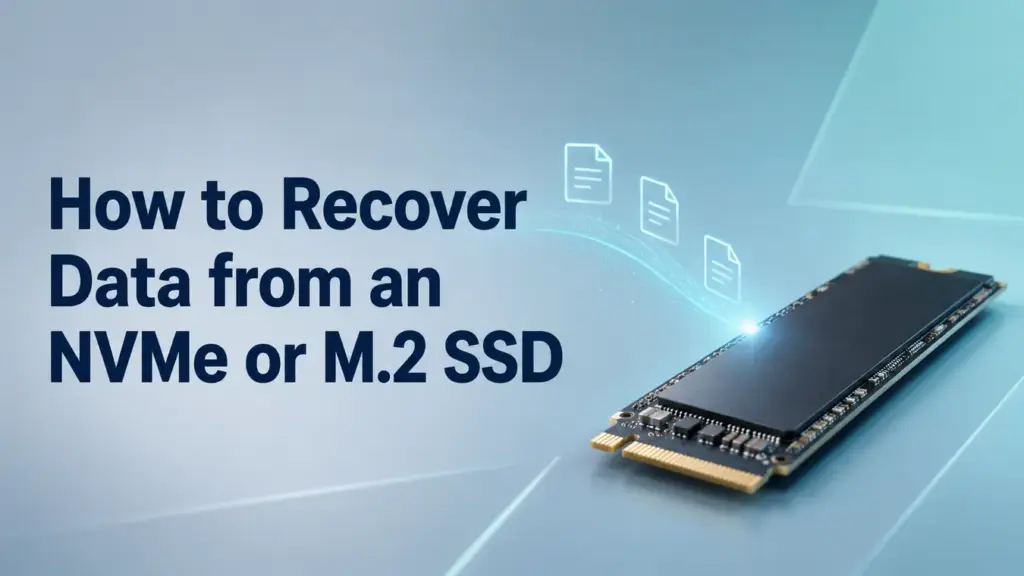
An NVMe drive can fail without much warning. One moment Windows starts normally; the next, a project folder is missing, the partition appears as RAW, or the PC no longer boots. If you need to recover data from an NVMe SSD, stop using the affected drive before trying to repair it. SSD background processes can clear deleted blocks faster than they would on a mechanical hard drive.
This guide explains what you can safely try, when software can help, and when a hardware lab is the better choice. If the loss followed a quick format, the broader formatted drive recovery guide explains why timing and new writes matter. For a Windows-readable drive, Magic Data Recovery offers a practical scan, preview, and recovery workflow for deleted, formatted, RAW, and file-system-loss cases.
Quick answer: You may be able to recover data from an NVMe SSD when Windows or another healthy computer still detects the device with the correct capacity. Check backups first. If no copy exists, scan the drive without writing to it and save recovered files elsewhere. If the SSD is missing from BIOS, reports 0 MB, overheats, or repeatedly disconnects, power it down and contact a specialist.
Supports Windows 7/8/10/11 and Windows Server
Table of Contents
Can You Recover Data from an NVMe or M.2 SSD?
Yes, but the cause of loss matters more than the label on the drive. Recovery software may find files after accidental deletion, a quick format, a lost partition, or file system corruption, provided the SSD remains readable and its controller has not erased or overwritten the relevant blocks.
Physical and electronic failures require a different response. Software cannot scan an SSD that the computer cannot communicate with. No tool can reconstruct blocks that TRIM and garbage collection have already cleared, and a BitLocker-protected drive normally requires its password or recovery key. Recovery chances improve when firmware shows the correct capacity, the loss is recent, and little new data has been written.
NVMe vs. M.2: Know Which Drive You Have
M.2 describes a physical form factor. NVMe describes a storage protocol that normally communicates over PCIe. Therefore, many NVMe drives use an M.2 card, but some M.2 drives use SATA instead. Kingston’s SSD overview also notes that not every M.2 SSD is NVMe.
That distinction matters when you remove a drive from a failed laptop. An NVMe-only USB enclosure will not read an M.2 SATA device, and a SATA-only adapter will not read an NVMe model. Check the SSD label, laptop specification, keying, and enclosure compatibility. If the device cannot initialize or disappears from firmware, DIY software is not the right tool.
Why NVMe SSD Data Recovery Is More Difficult Than HDD Recovery
Traditional hard drives often leave deleted data in place until another file overwrites the same sectors. SSDs manage flash memory differently.
TRIM can remove deleted blocks
Windows may send a TRIM command after deleting files or formatting a supported volume. The controller can then erase those blocks during garbage collection. Turning TRIM off afterward cannot restore cleared blocks. Since changing settings, rebooting, or installing a tool on the affected system SSD also creates writes, shutting down promptly is safer than experimenting with commands.
Wear leveling changes physical locations
An SSD controller spreads writes across NAND cells. It maps the operating system’s logical addresses to changing physical locations, making low-level recovery dependent on controller metadata.
Encryption may block an otherwise readable drive
Many Windows laptops enable device encryption or BitLocker. A recovery scan cannot bypass it. Keep the recovery key and any corporate recovery information available; formatting or initializing the disk only risks further loss.
What to Do Before You Try to Recover Data from an NVMe SSD
Your first few decisions can matter more than the software you choose.
1. Stop normal use. Do not download files, install updates, copy data to the SSD, or continue gaming and browsing on it.
2. Do not format or initialize the disk. If Disk Management asks, cancel. A second format does not make the drive easier to scan.
3. Avoid CHKDSK and repair tools for now. They modify file-system metadata and can remove records that recovery software might otherwise use.
4. Check for another copy. Look in OneDrive, File History, another computer, an external backup, and application-specific autosave folders.
5. Prepare a separate destination. Recovered files must go to another physical drive with enough free space.
6. Identify encryption and RAID. Record the BitLocker key and storage-controller configuration before removing the SSD.
Use this quick diagnosis before choosing a method:
What you see | Likely situation | Safest next step |
SSD appears normally and files alone are missing | Deletion or logical loss | Check backups, then run a read-only recovery scan |
Disk Management shows the correct capacity but the volume is RAW or unallocated | File system or partition damage | Do not format; scan the physical disk or lost partition |
Windows will not boot, but BIOS shows the SSD correctly | OS or file-system failure | Stop booting from it; connect it to a healthy Windows PC with a compatible enclosure |
SSD disconnects, becomes extremely hot, freezes the PC, or shows the wrong capacity | Controller, firmware, or NAND instability | Power down and use a professional service |
SSD is absent from BIOS/UEFI or reports 0 MB | Hardware or firmware failure | Software cannot access it; seek specialist evaluation |
Volume is BitLocker-locked | Encryption is preventing access | Locate the password or recovery key before scanning decrypted content |
Method 1: Restore the Files from a Backup
A backup avoids TRIM and damaged-drive risks, so check it first.
Restore from the Recycle Bin or OneDrive
Search the Windows Recycle Bin by name, type, or deletion date. If the folder synced with OneDrive, inspect its online Recycle Bin and version history.
Restore with File History
If you enabled File History, connect its backup drive. Open the original folder, right-click it, choose Restore previous versions, and select a dated copy. Microsoft’s File History instructions provide the full process.
Backups are the best answer when you need to recover data from an M.2 SSD that has already been heavily used since the deletion.
Method 2: Recover Data from an NVMe SSD with Magic Data Recovery
If no backup contains the files and the SSD remains stable, recovery software is the next logical step. Magic Data Recovery runs on Windows and supports SSDs as well as more than 5,000 file types. Its Quick Scan and Deep Scan workflow covers accidental deletion, quick formatting, lost partitions, RAW volumes, and file system errors. Previewing found files before recovery also helps you confirm whether a document, photo, or video is intact.
Unlike CHKDSK, the program searches for data instead of repairing the source volume. Still, no recovery application can reverse completed TRIM operations or fix a dead controller.
Step 1: Connect the SSD safely
If Windows recognizes a secondary SSD, leave it connected but do not modify it. For a system NVMe, shut down and, when practical, attach it to a healthy Windows computer through a compatible enclosure or motherboard slot. Confirm that the enclosure supports the actual NVMe or SATA interface.
Step 2: Install Magic Data Recovery elsewhere
Download and install the program on the healthy computer’s internal drive or another physical disk. Never install it on the SSD that contains the lost files. If your PC has only one internal NVMe, use another Windows machine rather than writing the installer to the source drive.
Supports Windows 7/8/10/11 and Windows Server
Step 3: Select the affected drive
Open Magic Data Recovery and identify the SSD by capacity and partition details. If a formatted partition is missing, choose the corresponding physical disk or detected lost partition.
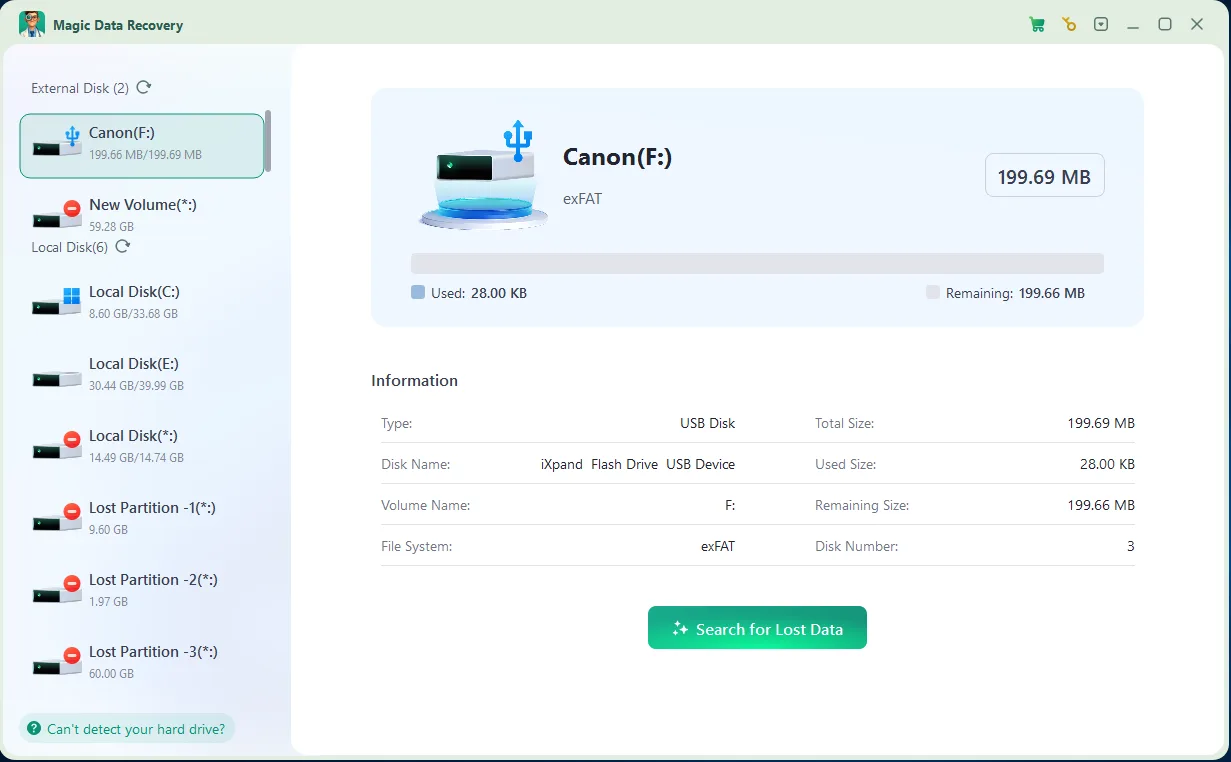
Step 4: Scan for lost data
Start the scan. Quick Scan looks for recently lost file-system records, while Deep Scan searches more broadly. Let the deeper scan finish after formatting, a RAW state, or partition loss. Use filename search, file-type filters, and dates to narrow the results.
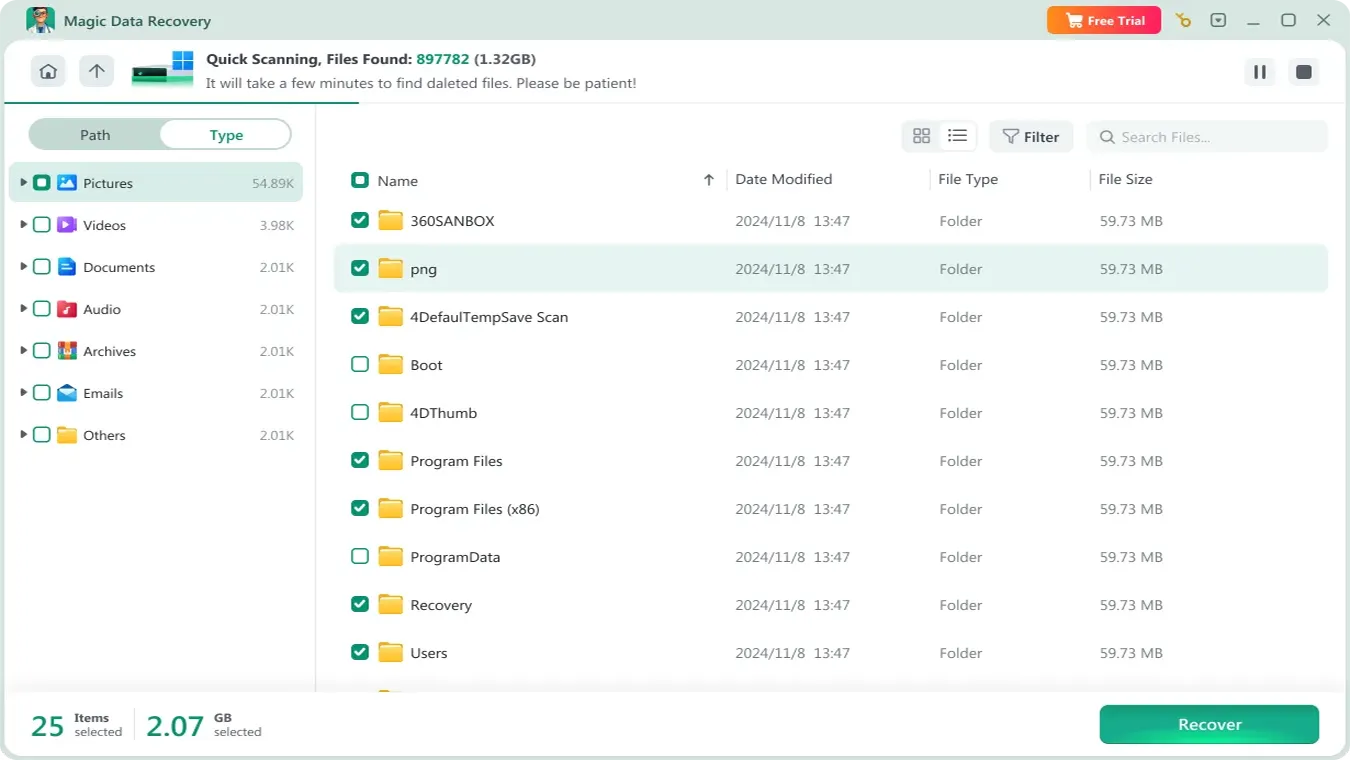
Step 5: Preview and recover to another drive
Preview important files where supported, select the required items, click Recover, and choose a different physical disk. Verify several recovered documents, archives, photos, and videos before reformatting the original SSD. The Magic Data Recovery user guide provides interface details.

Method 3: Try Windows File Recovery
Windows File Recovery is a free Microsoft command-line option for a stable, detected SSD. It suits users who are comfortable with Terminal and know the original drive letter or file type. For example, this command searches drive C for DOCX files and writes the results to drive E:
- winfr C: E: /extensive /n *.docx
Replace the letters with your actual source and destination drives. They must be different. Microsoft’s Windows File Recovery documentation explains the available modes and filters.
This option lacks a guided preview workflow, and success still depends on whether TRIM has cleared the blocks. Do not repeatedly scan a drive that disconnects or freezes.
Method 4: Use a Professional NVMe Recovery Service
Stop DIY work if the SSD is absent from BIOS, reports an incorrect capacity, repeatedly drops offline, overheats, or contains irreplaceable business data. A specialist may use controller-specific hardware, firmware access, and imaging procedures that consumer software cannot provide.
Controller translation, encryption, and model-specific firmware can defeat simple chip-level work. Ask the provider about NVMe experience, evaluation fees, confidentiality, return shipping, and charges when no usable data is recovered.
Do not bake, freeze, reflow, open, or repeatedly power-cycle the SSD. Those internet fixes can turn an intermittent failure into permanent damage.
How to Recover Data from a Formatted M.2 SSD
After an accidental quick format, stop immediately and do not create a new volume. The format rebuilds file-system structures and may trigger TRIM, although results vary by system, enclosure, controller, and file system.
To recover data from an M.2 SSD after formatting, first check whether Disk Management shows the correct capacity. If it does and the device remains stable, scan it with Magic Data Recovery and save the results to another disk. If the format was interrupted or the partition now appears as RAW, select the physical disk rather than formatting it again.
A full format, secure erase, sanitize command, or completed TRIM operation can make recovery impossible. Be skeptical of any service or product that promises otherwise without examining the device.
Tips That Improve Your Chance of NVMe SSD Recovery
- Act promptly, but do not rush into repair commands.
- Minimize power-on time and use the correct M.2 enclosure.
- Keep the source unchanged and recover to another physical disk.
- Preserve BitLocker keys and RAID or Intel VMD details.
- Replace a failing SSD after recovery.
- Adopt a 3-2-1 backup plan: three copies, two storage types, and one off-site copy.
Conclusion
The safest way to recover data from an NVMe SSD depends on what the computer detects. Start with backups. If Windows sees the correct capacity and the issue is deletion, formatting, a RAW volume, or file-system damage, a non-destructive scan is reasonable. If firmware cannot see the device, contact a specialist.
For quick formats, the formatted drive recovery adds context. We recommend Magic Data Recovery for logical loss because it combines Quick Scan, Deep Scan, previews, broad file-type support, and a clear Windows workflow. It cannot undo TRIM or repair hardware, but it offers a practical way to restore readable data without modifying the source.
If you are looking for an efficient solution, try Magic Data Recovery on a healthy Windows computer and save every recovered file to a different drive.
Supports Windows 7/8/10/11 and Windows Server
FAQs
Can data be recovered from an NVMe SSD?
Yes, when the SSD is detected and the lost blocks remain readable. Recovery may work after deletion, quick formatting, partition loss, or file system corruption. Completed TRIM, overwriting, controller failure, secure erase, and missing encryption keys can reduce or eliminate the chance of success.
How do I recover data from an M.2 SSD that will not boot?
Stop booting from the affected drive. If BIOS still detects it correctly, connect it to a healthy Windows PC with an enclosure that matches its NVMe or SATA interface. Check backups, then scan the SSD and save recovered files to a separate physical disk.
Can I recover files from a dead NVMe SSD?
Consumer software cannot recover files from an NVMe SSD that BIOS cannot detect. A professional lab may help with controller, power, firmware, or NAND faults, but results depend on the model and damage. Avoid repeated power cycles and home reflow attempts.
Does TRIM make NVMe data recovery impossible?
TRIM can make deleted data unrecoverable after the controller clears the relevant flash blocks. However, timing and implementation vary, so a readable SSD may still contain recoverable records. Disabling TRIM afterward cannot restore data that garbage collection has already erased.
Can I recover data from a formatted M.2 SSD?
Recovery may be possible after a quick format if the SSD remains readable and TRIM or new writes have not cleared the needed blocks. Do not reformat or initialize it again. Scan the device once and restore found files to another drive.
Why is my M.2 SSD not detected by an external enclosure?
The enclosure may support the wrong interface. M.2 drives can use either SATA or PCIe NVMe, and many adapters accept only one type. Check the drive model, connector key, and enclosure specification. Also test a known-good cable and port without repeatedly power-cycling an unstable SSD.
Can Magic Data Recovery recover data from an NVMe SSD?
Magic Data Recovery can scan a stable NVMe SSD that Windows recognizes. It targets logical losses such as deletion, formatting, RAW volumes, lost partitions, and file system errors. It cannot access a drive missing from BIOS or restore blocks already erased by TRIM.
Where should I save files recovered from an NVMe SSD?
Save them to a different physical drive, such as an external HDD, another SSD, or a large USB device. Writing recovered files back to the source NVMe can overwrite other lost data. Verify the recovered copies before repairing, formatting, or replacing the original SSD.

Jason has over 15 years of hands-on experience in the computer data security industry. He specializes in data recovery, backup and restoration, and file repair technologies, and has helped millions of users worldwide resolve complex data loss and security issues.