
AOMEI Partition Recovery: Safer Data Fix

When a partition disappears, Windows shows a drive as RAW, or important files vanish after formatting, many users search for aomei partition recovery to fix the problem quickly. AOMEI offers two main recovery paths: scanning the drive to recover files, or restoring the lost partition directly. Both can help in the right situation. However, they do not carry the same level of risk.
This guide explains how aomei partition recovery works, when an aomei recovery partition method makes sense, and why a safer file-first workflow is often better before you try direct partition restoration. It also introduces Magic Data Recovery as a more reliable partition recovery option for recovering deleted, formatted, RAW, file-system-error, and system-reinstallation data without rushing into risky disk changes.
Supports Windows 7/8/10/11 and Windows Server
Table of Contents
What Can AOMEI Partition Recovery Do?
Aomei partition recovery usually refers to recovering a deleted, missing, or damaged partition with AOMEI Partition Assistant. A partition is a logical section of a storage device. Windows uses it to organize file systems, drive letters, and data access.
When the partition table becomes damaged or a user deletes a partition by mistake, the files may still exist on the disk. The problem is that Windows can no longer locate them normally. In this case, users often search for aomei recovery tools to bring the lost volume back.
Common symptoms include:
- A drive letter suddenly disappears.
- Disk Management shows unallocated space.
- A partition becomes RAW.
- Windows asks you to format the drive.
- A recovery partition is missing after resizing or reinstalling Windows.
- Files disappear after repartitioning or mistaken deletion.
Before you click any repair button, stop using the affected drive. New data, formatting, partition creation, or repair attempts may overwrite recoverable files.
AOMEI Provides Two Recovery Solutions
AOMEI mainly gives users two ways to handle data loss and partition loss. The first method scans for lost files. The second method tries to restore the lost partition itself.
Solution 1: Use AOMEI Data Recovery to Scan and Recover Files
The first aomei recovery solution is file recovery. In this workflow, you select the affected drive or partition, scan it, preview recoverable files, and save them to another safe location.
This approach is usually safer because it focuses on copying recoverable files out of the damaged or missing partition. It does not require you to rebuild the partition table first.
Use this method when:
- You deleted important files.
- You formatted a drive by mistake.
- A partition becomes RAW but still appears in Windows.
- The disk has file system errors.
- You need documents, photos, videos, or work files back quickly.
- You do not fully understand the partition structure.
The downside is capability. AOMEI’s data recovery workflow is simple, but users who need deeper scanning, better preview control, and broader lost-partition recovery may need a more specialized tool. This is where Magic Data Recovery becomes a stronger recommendation.
Solution 2: Use AOMEI Partition Assistant to Recover the Lost Partition
The second aomei partition recovery method uses AOMEI Partition Assistant’s Partition Recovery feature. It scans the disk for deleted or lost partitions and attempts to restore the partition entry.
This can work when the partition was deleted recently and the disk has not been overwritten. However, it also carries more risk because it changes disk structure. If the wrong partition is restored, if the partition table has complex damage, or if the disk contains overlapping partitions, the operation may cause secondary data damage.
Use direct partition recovery only when:
- You clearly know which partition was lost.
- The disk has not been formatted again.
- You have not created new partitions on the same space.
- You already recovered or backed up critical files.
- You understand the risk of modifying partition metadata.
For most ordinary users, recovering files first is the safer path.
AOMEI Partition Recovery vs Magic Data Recovery
The main difference is the recovery strategy. Aomei partition recovery often focuses on bringing the partition back. Magic Data Recovery focuses on retrieving files safely before you make disk-level changes.
Recovery Need | AOMEI Data Recovery | AOMEI Partition Recovery | Magic Data Recovery |
Recover deleted files | Yes | Not the main purpose | Yes |
Recover formatted drive data | Basic option | Risky if used incorrectly | Yes |
Recover RAW drive files | Limited depending on condition | May require partition repair | Yes |
Recover lost partition files | Possible | Restores partition directly | Yes, with safer file-first recovery |
Modify partition structure | No | Yes | No direct structure rebuild required |
Risk level | Lower | Higher | Lower |
Best for beginners | Acceptable | Not ideal without backup | Strong choice |
Magic Data Recovery is better suited when the priority is data safety. It can scan deleted, formatted, inaccessible, and lost partitions, then help users preview and recover files to another drive. This workflow reduces the chance of making the original disk worse.
Why Direct Partition Recovery Can Be Risky
Many users assume that restoring a lost partition is the fastest fix. Sometimes it is. Yet direct aomei partition recovery can become risky because partition recovery changes how the disk describes itself to Windows.
A partition table works like a map. If the map is wrong, Windows may point to the wrong area of the disk. If a recovery tool writes an incorrect partition entry, the system may read the wrong file system, trigger formatting prompts, or make further recovery harder.
The risk increases when:
- The disk was repartitioned after data loss.
- The partition was formatted.
- The file system changed from NTFS to exFAT or FAT32.
- The disk has bad sectors.
- The drive was used after the partition disappeared.
- A system reinstall wrote new files to the same disk.
That is why professionals usually recover important files first. After the data is safe, you can recreate, format, or repair the partition with less pressure.
Why Magic Data Recovery Is the Safer Recommendation
Magic Data Recovery solves the core problem: users want their files back, not just a drive letter. Instead of immediately repairing or rewriting partition structures, it scans the affected disk and helps recover files to a safe location.
This is useful for many real-world cases:
- You deleted a partition while managing disk space.
- A USB drive shows as RAW.
- A hard drive becomes inaccessible after a power failure.
- You formatted the wrong partition.
- Windows was reinstalled and old files disappeared.
- A file system error prevents normal access.
- An external hard drive loses its partition after unsafe removal.
Magic Data Recovery stands out because it offers a practical file-first workflow. You select the disk, scan it, preview recoverable files, and save them to another storage device. This is easier for non-technical users and safer than trying to rebuild a partition before you know whether the files are intact.
If you are comparing aomei recovery with Magic Data Recovery, the key point is risk control. AOMEI can help with partition management, but Magic Data Recovery is the better fit when the goal is careful recovery from deleted, formatted, RAW, file system error, and reinstalled-system data loss scenarios.
How to Recover Lost Partition Files Safely with Magic Data Recovery
Follow these steps before trying direct aomei partition recovery or any partition repair operation.
Step 1: Stop Using the Affected Drive
Do not copy new files to the disk. Do not format it. Do not create a new partition. Also, avoid installing recovery software on the same drive because installation may overwrite deleted data.
Step 2: Install Magic Data Recovery on a Healthy Drive
Download and install Magic Data Recovery on a different drive or computer. This reduces the chance of overwriting files on the affected disk.
Supports Windows 7/8/10/11 and Windows Server
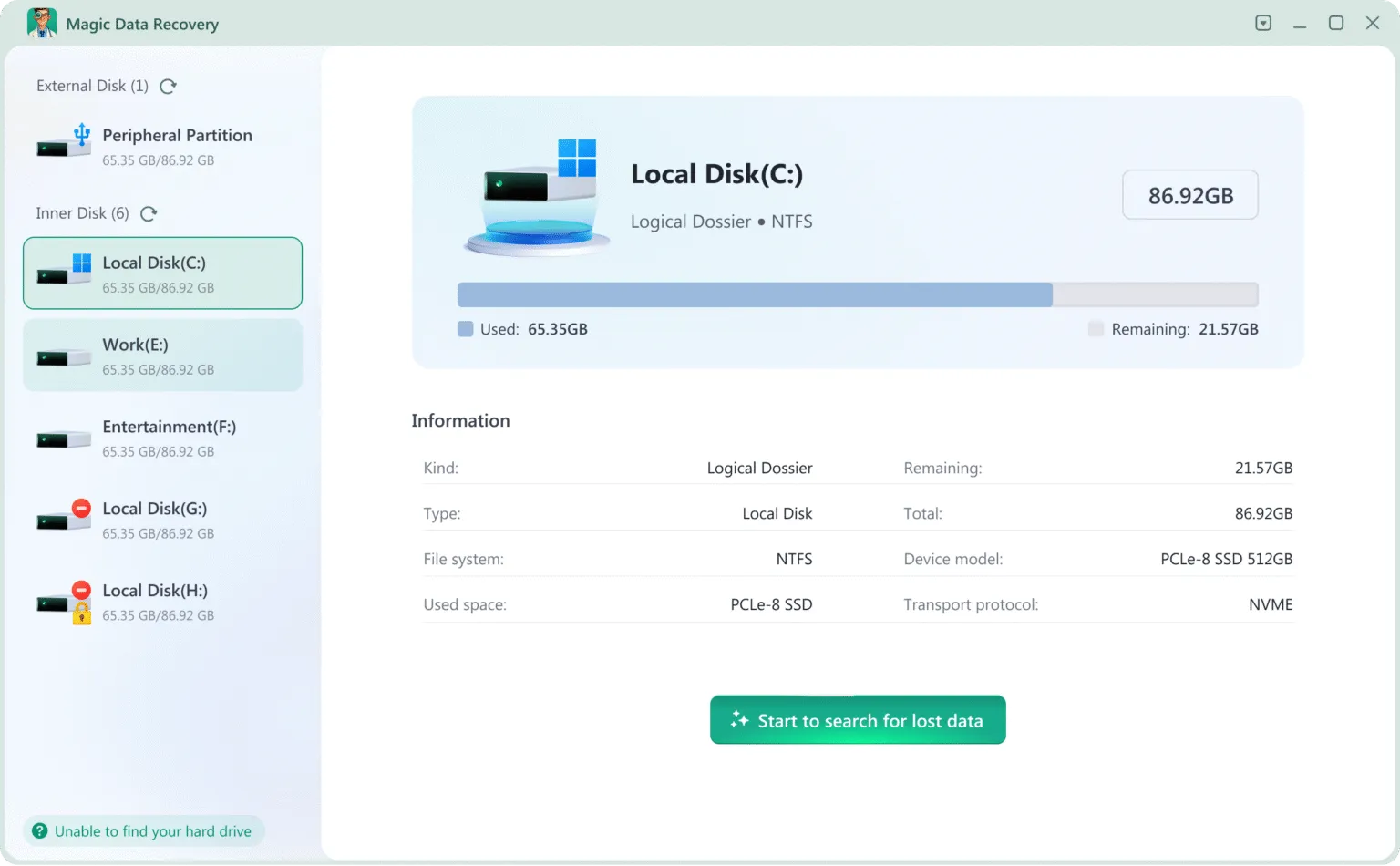
Step 3: Select the Lost, RAW, or Formatted Partition
Open the software and choose the storage device where the files were lost. If the original partition is missing, select the whole disk so the software can scan for recoverable data.
Step 4: Run a Deep Scan
Start scanning. A quick scan may find recently deleted files, while a deeper scan can help locate data from formatted, damaged, or lost partitions.
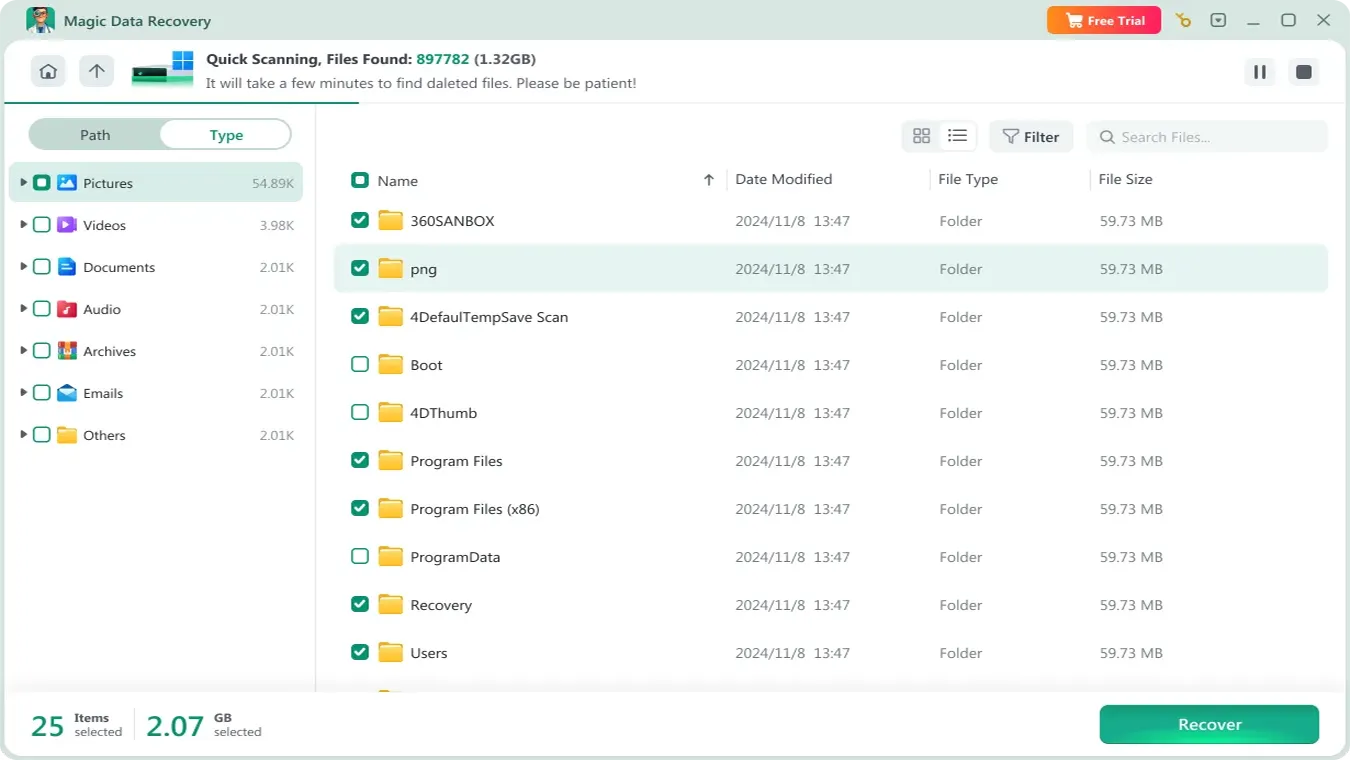
Step 5: Preview the Recoverable Files
Preview documents, photos, videos, and other files before recovery. This step helps you confirm whether the data is usable.

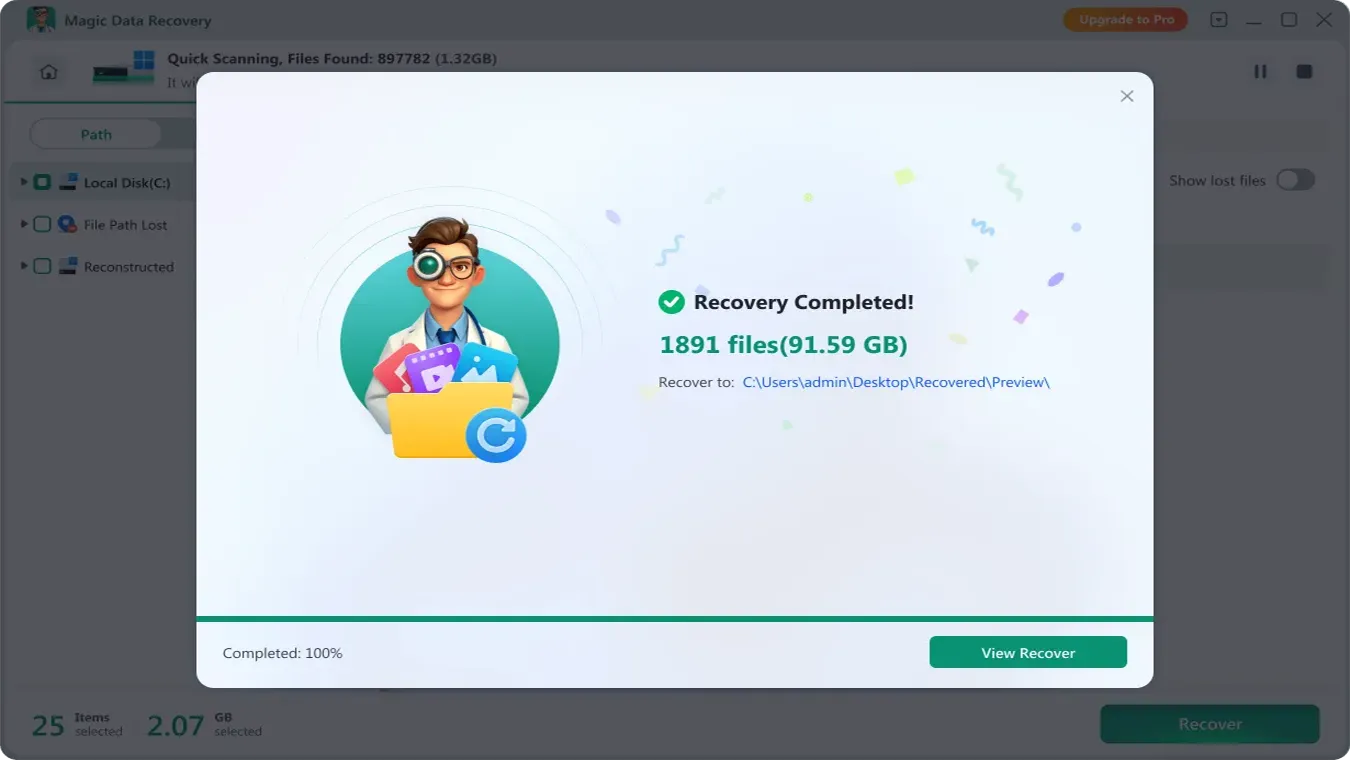
Step 6: Recover Files to Another Drive
Save recovered files to a different disk, USB drive, or external hard drive. After your data is safe, you can decide whether to recreate the partition, format the drive, or use a partition manager.
When Should You Still Use AOMEI Partition Recovery?
Aomei partition recovery can still be useful in specific cases. For example, if you accidentally deleted a partition and immediately noticed the mistake, AOMEI Partition Assistant may detect and restore it.
Consider AOMEI’s partition restoration method when:
- The lost partition was deleted recently.
- No new data was written to the disk.
- You do not need to recover files selectively.
- You understand the partition layout.
- You already have a backup or recovered the key files first.
However, avoid direct partition restoration when the disk shows RAW, contains bad sectors, was formatted, or has been repartitioned several times. In these cases, file recovery should come first.
What About an AOMEI Recovery Partition?
The phrase aomei recovery partition can mean two different things. Some users mean a lost Windows recovery partition. Others mean a partition recovered by AOMEI software.
A Windows recovery partition stores boot and recovery tools. If it disappears, Windows may still run, but recovery features may fail. If you lost personal files along with the partition, focus on data recovery first. Do not recreate or resize partitions until you recover important files.
If you mean a partition restored by AOMEI, check whether all files open correctly after recovery. If anything looks missing, stop using the drive and scan it with Magic Data Recovery.
Best Practices Before Any Recovery Attempt
Good recovery habits matter more than the tool name. Whether you try aomei recovery, Magic Data Recovery, or another solution, follow these rules:
- Stop using the disk immediately.
- Do not format a RAW drive.
- Do not run CHKDSK before recovering important files.
- Do not install software on the affected partition.
- Do not save recovered files back to the same drive.
- Recover files before rebuilding partitions.
- Use an external drive for recovered data.
- Create a disk image first if the drive makes noises or shows hardware failure.
These steps improve your chance of getting data back and reduce unnecessary disk changes.
Conclusion: Which Recovery Method Should You Choose?
If your main goal is to restore a recently deleted partition and you already have a backup, aomei partition recovery may be enough. If your main goal is to recover important files from a deleted, formatted, RAW, inaccessible, or reinstalled-system drive, Magic Data Recovery is the safer choice.
AOMEI gives users two paths: scan files or restore the partition. The file scanning path has lower risk, while direct partition restoration can be more dangerous because it changes disk structure. Magic Data Recovery offers a more reliable balance for ordinary users because it focuses on recovering files first and avoiding unnecessary writes to the damaged partition.
If you are looking for a safer and more efficient solution, try Magic Data Recovery before attempting direct partition repair. It helps you recover the data that matters most before you make any permanent disk changes.
Supports Windows 7/8/10/11 and Windows Server
FAQs
Is AOMEI partition recovery safe to use?
Aomei partition recovery can be safe when the partition was deleted recently and the disk has not been overwritten. However, direct partition restoration changes disk structure, so it carries risk. If the lost files are important, recover them first with file recovery software such as Magic Data Recovery before repairing the partition.
Should I recover files or restore the lost partition first?
Recover files first in most cases. File recovery usually copies data out without rebuilding the partition table, so it reduces the risk of secondary damage. After you save important files to another drive, you can safely recreate, format, or repair the lost partition with fewer consequences.
What is the difference between AOMEI data recovery and AOMEI partition recovery?
AOMEI data recovery scans a drive and helps restore lost files. Aomei partition recovery tries to restore the missing partition itself. The first method usually has lower risk because it focuses on files. The second method can be useful, but it may cause problems if the partition table is badly damaged.
Can Magic Data Recovery recover files from a lost partition?
Yes. Magic Data Recovery can scan storage devices where partitions are lost, deleted, formatted, or inaccessible. It helps locate recoverable files and lets you save them to another drive. This file-first method is safer than restoring a damaged partition before confirming whether your important data is intact.
Is an AOMEI recovery partition the same as a Windows recovery partition?
Not always. An aomei recovery partition may refer to a partition recovered through AOMEI software, while a Windows recovery partition stores system repair tools. If the missing partition contains personal files, focus on data recovery first. Rebuilding or resizing partitions too early may overwrite recoverable data.
Can I recover data after formatting a partition?
In many cases, yes, especially after a quick format. Formatting often removes file system references rather than immediately erasing every file. However, new data can overwrite old files. Stop using the drive, avoid installing software on it, and scan it with Magic Data Recovery as soon as possible.
Why is direct partition recovery risky?
Direct partition recovery writes or restores partition information. If the recovered partition entry is wrong, Windows may read the disk incorrectly or make future recovery harder. The risk becomes higher after repartitioning, formatting, file system corruption, or system reinstallation. Recovering files first is usually the safer strategy.
Which tool should I choose instead of AOMEI recovery?
Choose Magic Data Recovery when your priority is safe file recovery from deleted, formatted, RAW, inaccessible, or lost partitions. AOMEI tools can help with partition management, but Magic Data Recovery offers a clearer file-first workflow. It helps users preview and recover important files before making disk-level changes.

Jason is a data recovery and technical support specialist with over 15 years of hands-on experience. He has worked extensively with frontline users, troubleshooting difficult data loss cases and providing practical recovery solutions for accidental deletion, formatted drives, damaged file systems, lost partitions, system failures, and other recovery emergencies. His expertise also includes backup and restoration, file repair, and disaster recovery, with a strong emphasis on safe, reliable, and technically accurate guidance.