
Linux Data Recovery Guide
Losing important files on Linux can feel stressful, especially when the missing data comes from an EXT4 partition, an accidentally formatted drive, a failed mount, or a damaged external disk. The good news is that linux data recovery is often possible if you act quickly and avoid writing new data to the affected drive.
This guide explains the most practical linux file recovery methods for common situations. You will learn how to recover files from Trash, backups, terminal tools, Live USB environments, open-source recovery utilities, and professional recovery software.
However, not every Linux recovery case works well inside Linux itself. When the partition table is damaged, the file system has errors, or free tools cannot locate the lost files clearly, you may need a more guided hdd recovery solution. In those cases, Magic Data Recovery can help by scanning Linux disks connected to a Windows computer. It supports EXT2, EXT3, and EXT4 file systems and can recover data lost because of deletion, formatting, file system errors, and other common storage problems.
Supports Windows 7/8/10/11 and Windows Server
Table of Contents
What Is Linux Data Recovery?
Linux data recovery means restoring lost, deleted, inaccessible, or formatted files from a Linux storage device. The device may be an internal hard drive, SSD, USB drive, SD card, external hard drive, or server disk.
Most Linux users work with file systems such as EXT2, EXT3, EXT4, XFS, Btrfs, FAT32, or exFAT. Among them, EXT4 is one of the most common file systems on modern Linux distributions. It is stable and fast, but deleted file recovery can still become difficult because Linux may quickly reuse free space.
Common Linux data loss cases include:
- Accidental file deletion
- Emptying Trash by mistake
- Formatting the wrong partition
- Partition table corruption
- File system errors
- Failed Linux installation or upgrade
- External drive not mounting
- Dual-boot partition mistakes
- Disk errors after power loss
In many cases, successful linux file recovery depends on one rule: stop using the affected disk immediately.
Before You Start Linux File Recovery
Before trying any recovery method, follow these steps. They can improve your chance of success.
Stop Writing New Data to the Drive
When you delete a file, Linux usually removes the file reference first. The actual file content may still exist until new data overwrites the same space. Therefore, do not download files, install software, copy data, or run updates on the affected partition.
If the lost files were on your system partition, shut down the computer and use another device or a Live USB to continue.
Do Not Save Recovered Files to the Same Partition
Always recover files to another disk. For example, if you lost files from /dev/sda2, save recovered files to an external USB drive, another internal disk, or a different computer.
Saving recovered files to the same partition may overwrite the very data you want to restore.
Check Whether the Drive Has Physical Problems
If the disk clicks, disconnects often, shows many I/O errors, or becomes extremely slow, avoid repeated scanning. A failing disk can get worse with every read attempt. In severe cases, contact a professional data recovery lab.
Software-based linux data recovery works best when the drive still appears in the system and does not have serious physical damage.
Method 1: Recover Deleted Linux Files from Trash
The simplest linux file recovery method is checking the Trash folder. Many desktop environments, such as GNOME, KDE, and Cinnamon, move deleted files to Trash instead of deleting them immediately.
How to Check Trash in Linux
Open the file manager and click Trash or Deleted Files. If you find the missing files, right-click them and choose Restore.
You can also check Trash from the terminal:
ls ~/.local/share/Trash/files
If the files appear there, copy them to a safe location:
cp -r ~/.local/share/Trash/files/filename /media/backup/
This method only works if you deleted files through the file manager. Files deleted with rm, scripts, or some applications usually bypass Trash.
Method 2: Restore Linux Files from Backups
Backups offer the safest recovery path. Before using advanced tools, check whether you have a recent backup.
Common Linux backup sources include:
- Timeshift snapshots
- Deja Dup backups
- rsync backup folders
- external drive backups
- NAS backups
- cloud storage sync history
- server snapshots
- virtual machine snapshots
For personal Linux computers, Timeshift helps restore system files and settings. For documents, photos, projects, and downloads, tools like rsync, Deja Dup, or cloud sync may provide better file-level recovery.
This method works best when the backup exists before the loss happened. If no backup exists, continue with other linux data recovery methods.
Method 3: Recover Open Deleted Files from /proc
Sometimes Linux can recover a deleted file if a process still keeps it open. This usually happens with log files, database files, or documents opened by an application.
First, find deleted files still held by running processes:
sudo lsof | grep deleted
If you find a useful result, check the process ID and file descriptor. Then copy the file from /proc:
sudo cp /proc/PID/fd/FD /media/backup/recovered-file
Replace PID and FD with the actual numbers.
This is a practical linux file recovery trick, but it only works while the related process still runs. Once the process closes, this recovery path disappears.
Method 4: Use extundelete for EXT3/EXT4 File Recovery
If the lost files were on an EXT3 or EXT4 partition, extundelete may help. It tries to recover deleted files by reading file system metadata and journal information.
Basic extundelete Steps
First, unmount the affected partition:
sudo umount /dev/sdX1
Then restore all possible files:
sudo extundelete /dev/sdX1 –restore-all
Recovered files usually appear in a folder named RECOVERED_FILES.
When extundelete Works Best
extundelete works best when you act quickly after deletion. It may recover recently deleted files from EXT3 or EXT4 partitions if the metadata still exists.
However, it has limits. It may fail if the partition stayed active for a long time, the system wrote new data, the file system journal changed, or the deleted files were partially overwritten. For formatted drives or serious partition damage, you may need another linux data recovery approach.
Method 5: Try TestDisk for Lost Linux Partitions
TestDisk is one of the most widely used open-source recovery tools. It focuses on lost partitions, damaged partition tables, and boot problems. If a Linux partition disappeared after formatting, repartitioning, or a failed installation, TestDisk may help locate it.
When to Use TestDisk
Use TestDisk when:
- a Linux partition no longer appears
- the disk shows as unallocated
- the partition table looks damaged
- the system cannot boot because of partition issues
- a drive shows the wrong size or layout
Basic TestDisk Workflow
Install TestDisk:
sudo apt install testdisk
Run it with administrator rights:
sudo testdisk
Then choose the affected disk, select the partition table type, run an analysis, and review the found partitions. If TestDisk detects the correct partition structure, you can list files or write the recovered partition table.
TestDisk is powerful, but users should read every prompt carefully. Writing the wrong partition structure can make the situation worse. If you feel unsure, scan the disk first and avoid writing changes until you understand the result.
Method 6: Use PhotoRec for Raw Linux File Recovery
PhotoRec comes from the same project as TestDisk, but it works differently. Instead of relying heavily on file system metadata, it scans raw disk space for known file signatures.
This approach helps when the file system is badly damaged or when deleted file metadata no longer exists.
Best Use Cases for PhotoRec
PhotoRec can help recover:
- photos
- videos
- documents
- archives
- office files
- source code files
- files from formatted partitions
- files from corrupted file systems
However, PhotoRec often loses original file names and folder paths. It may recover many files with generic names, so you need time to sort the results.
For many users, this makes PhotoRec useful but not very convenient. It can save data, but the cleanup process can take hours when the disk is large.
Method 7: Boot from a Linux Live USB
If your system partition contains the lost files, do not keep using the installed Linux system. Instead, boot from a Linux Live USB.
A Live USB allows you to access the disk without writing unnecessary data to the affected partition. You can then copy remaining files, create a disk image, or run recovery tools from a safer environment.
Recommended Live USB Workflow
- Create a bootable Linux USB on another computer.
- Boot the affected computer from the USB.
- Do not mount the damaged partition in write mode.
- Connect a separate external drive for recovered files.
- Run recovery tools against the affected disk or a disk image.
- Save all recovered files to the external drive.
This method gives you more control and reduces the risk of overwriting deleted data.
Method 8: Create a Disk Image Before Deep Recovery
For serious cases, create a disk image before scanning. A disk image is a sector-by-sector copy of the affected disk or partition. You can then run recovery tools against the image instead of the original drive.
This approach protects the source disk from repeated scans. It also helps when the disk has early signs of failure.
A common Linux imaging command is:
sudo dd if=/dev/sdX of=/media/backup/linux-disk.img bs=4M status=progress
For unstable disks, ddrescue often works better because it handles read errors more carefully:
sudo ddrescue -f -n /dev/sdX /media/backup/linux-disk.img /media/backup/linux-disk.log
After creating the image, use recovery tools on the image file. This is a safer and more professional linux data recovery workflow.
When Linux Recovery Tools May Not Be Enough
Linux offers many strong recovery options, but some situations remain difficult for ordinary users.
You may need a different solution when:
- free tools cannot find the lost files
- the EXT partition shows file system errors
- the drive was formatted
- the partition table is damaged
- PhotoRec recovers files without useful names
- command-line tools feel too complex
- you need a clearer preview before recovery
- you want to scan an EXT2, EXT3, or EXT4 disk from a Windows computer
This is where Magic Data Recovery can become useful.
Recover Linux Data with Magic Data Recovery on Windows
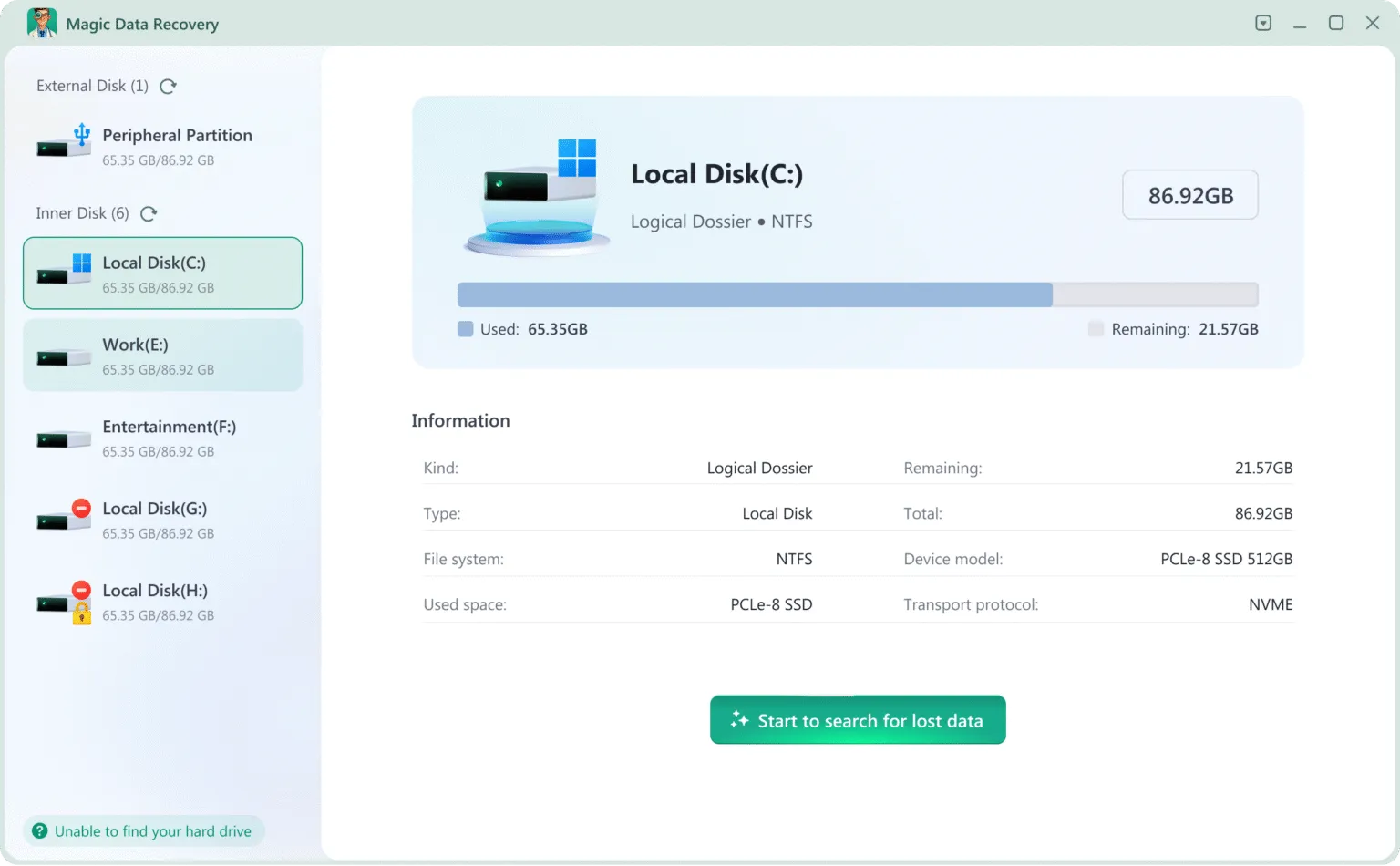
Magic Data Recovery does not run directly on Linux. It runs on Windows. To recover Linux files with it, you need to connect the Linux disk to a Windows computer. You can use a SATA-to-USB adapter, external drive enclosure, docking station, or direct internal connection.
Once Windows detects the physical disk, Magic Data Recovery can scan supported Linux file systems, including EXT2, EXT3, and EXT4.
What Problems Can Magic Data Recovery Solve?
Magic Data Recovery helps in several common linux data recovery scenarios:
- deleted Linux files
- formatted EXT partitions
- inaccessible Linux disks
- file system errors
- lost files from external Linux drives
- data loss after repartitioning
- files missing from EXT2, EXT3, or EXT4 partitions
This makes it useful when Linux command-line methods do not give a clear result.
Why Use Magic Data Recovery Instead of Only Free Linux Tools?
Free Linux tools can work well, but many of them require technical knowledge. Some tools focus on partitions. Others recover raw files but lose names and folder structures. In contrast, Magic Data Recovery provides a more guided recovery workflow.
Key advantages include:
- support for EXT2, EXT3, and EXT4 file systems
- recovery from deletion, formatting, and file system errors
- clearer scan results for ordinary users
- easier file preview and selection
- support for different storage devices
- no need to run complex Linux commands during recovery
For example, if an Ubuntu EXT4 external drive no longer mounts correctly, you can connect it to a Windows PC, scan it with Magic Data Recovery, preview recoverable files, and save them to another safe drive.
Supports Windows 7/8/10/11 and Windows Server
How to Use Magic Data Recovery for Linux File Recovery
Follow these steps:
- Shut down the Linux computer or disconnect the Linux external drive.
- Connect the Linux disk to a Windows computer.
- Install and launch Magic Data Recovery on Windows.
- Select the Linux disk or EXT partition.
- Run a scan to search for lost files.
- Preview the recoverable files when possible.
- Select the files you need.
- Recover them to another drive, not the original Linux disk.
This workflow helps users who want a simpler linux file recovery solution without relying only on terminal commands.
Linux Data Recovery Method Comparison
Method | Best For | Difficulty | Main Limitation |
Trash | Recently deleted desktop files | Easy | Does not work for rm deletion |
Backups | Files saved before data loss | Easy | Requires existing backup |
/proc recovery | Open deleted files | Medium | Works only while process runs |
extundelete | Recent EXT3/EXT4 deletion | Medium | Limited after overwriting or formatting |
TestDisk | Lost partitions | Medium/Hard | Requires careful decisions |
PhotoRec | Raw recovery from damaged disks | Medium | Often loses names and folders |
Live USB | Safer system partition recovery | Medium | Needs bootable USB |
Disk image | Serious recovery cases | Hard | Needs enough storage space |
Magic Data Recovery | EXT2/3/4 deletion, formatting, errors via Windows | Easy/Medium | Requires connecting Linux disk to Windows |
Best Practices to Improve Linux File Recovery Success
To improve your recovery results, follow these practical tips:
- Stop using the affected disk immediately.
- Do not install recovery software on the damaged partition.
- Save recovered files to another drive.
- Create a disk image for important or unstable disks.
- Try backup recovery before deep scanning.
- Use TestDisk for partition problems.
- Use PhotoRec when the file system is badly damaged.
- Use Magic Data Recovery when you need a clearer Windows-based recovery workflow for EXT2/3/4 disks.
- Contact a professional lab if the drive has physical damage.
These steps reduce risk and help you choose the right tool for the right problem.
Conclusion
Linux data recovery can be simple or complex depending on how the data was lost. If you deleted files through the desktop, Trash may solve the problem. If you have backups, restore from them first. For recent EXT4 deletion, extundelete may help. For lost partitions, TestDisk is worth trying. For damaged file systems, PhotoRec can recover files by signature.
However, Linux recovery tools are not always easy for regular users. Some require command-line experience, while others recover files without original names or folder paths. If you need a more guided solution for an EXT2, EXT3, or EXT4 disk, Magic Data Recovery is a practical option. It runs on Windows, so you need to connect the Linux disk to a Windows computer, but it can handle deletion, formatting, and file system error scenarios with a clearer recovery workflow.
If you are looking for a more efficient linux file recovery solution after free methods fail, you can try Magic Data Recovery and scan your Linux disk from a Windows PC.
Supports Windows 7/8/10/11 and Windows Server
FAQs About Linux Data Recovery
Can I recover deleted files in Linux?
Yes, you can often recover deleted files in Linux if the deleted data has not been overwritten. Start by checking Trash and backups. If the file was deleted with rm, try tools such as extundelete, PhotoRec, or a disk image workflow. Stop using the affected partition immediately to improve recovery chances.
What is the best Linux data recovery method?
The best linux data recovery method depends on the data loss situation. Use Trash or backups for simple deletion, extundelete for recent EXT3/EXT4 deletion, TestDisk for lost partitions, and PhotoRec for raw file recovery. If free tools fail, Magic Data Recovery can scan EXT2/3/4 disks connected to a Windows computer.
Can Linux recover files deleted with rm?
Files deleted with rm usually bypass Trash, so recovery becomes harder. Still, recovery may be possible if the data blocks remain intact. You can try extundelete for EXT3/EXT4 partitions or PhotoRec for raw file recovery. Avoid writing new files to the same partition before recovery.
Does TestDisk recover Linux files?
TestDisk can help recover lost Linux partitions and may allow file listing in some cases. It works best when the partition table is damaged or a partition disappears. For deleted files on EXT4, PhotoRec or other file recovery tools may work better because TestDisk focuses more on partition recovery.
Can PhotoRec recover files from EXT4?
Yes, PhotoRec can recover files from EXT4 and many other file systems by scanning for file signatures. It works even when file system metadata is damaged. However, it often cannot restore original file names or folder structures, so you may need to spend time sorting recovered files manually.
Can Magic Data Recovery recover Linux files?
Yes, Magic Data Recovery can recover Linux files from supported EXT2, EXT3, and EXT4 file systems. However, it runs on Windows, not Linux. You need to connect the Linux disk to a Windows computer, scan the disk, preview recoverable files, and save recovered data to another safe drive.
Is Linux data recovery possible after formatting?
Yes, linux data recovery may still work after formatting if new data has not overwritten the old files. Tools such as PhotoRec can scan raw disk space, while Magic Data Recovery can scan formatted EXT2/3/4 partitions from Windows. For best results, stop using the formatted drive immediately.
Where should I save recovered Linux files?
Always save recovered Linux files to a different storage device. Do not save them back to the same partition or disk you are recovering from. Use an external drive, another internal disk, or a separate computer. This prevents overwriting remaining recoverable data and improves your overall recovery success.

Jason is a data recovery and technical support specialist with over 15 years of hands-on experience. He has worked extensively with frontline users, troubleshooting difficult data loss cases and providing practical recovery solutions for accidental deletion, formatted drives, damaged file systems, lost partitions, system failures, and other recovery emergencies. His expertise also includes backup and restoration, file repair, and disaster recovery, with a strong emphasis on safe, reliable, and technically accurate guidance.