
How to Recover Data from Quick Formatted Drive
Accidentally selecting Quick Format can make years of photos, work files, or backups disappear in seconds. The encouraging news is that you may still be able to recover data from a quick formatted drive, especially if it is an HDD and you have not written anything new to it. This guide explains what the format changed, what to do immediately, and how to use Magic Data Recovery or other practical formatted drive recovery options without making the situation worse.
Quick answer: Stop using the drive. Do not format it again, run CHKDSK, or save anything to it. Install recovery software on another disk, scan the entire formatted device, and restore found files to a separate destination.
Supports Windows 7/8/10/11 and Windows Server
Table of Contents
Can You Recover Data from a Quick Formatted Drive?
In many cases, yes. A quick format creates fresh file-system structures and marks the volume as available for new data. It does not perform the same full-volume zero-writing process as a modern Windows full format. Consequently, much of the old file content may remain in the storage sectors until another file overwrites it.
That does not mean every old byte or folder record remains untouched. New file-system metadata can replace parts of the previous records. A recovery tool may therefore find some files with their original paths, while others appear under generic names reconstructed from file signatures.
Your chance to recover quick formatted drive data depends mainly on what happened next:
Factor | Better recovery outlook | Worse recovery outlook |
Storage type | Mechanical HDD | SSD with TRIM enabled |
Activity after formatting | Drive disconnected immediately | Windows, apps, or files written to it |
Format type | Quick format | Full format or secure erase |
Drive health | Stable and detected normally | Clicking, disconnecting, or not detected |
Encryption | Unencrypted, or key available | BitLocker key unavailable |
Recovery approach | Full scan and separate save drive | Reformatting, repair commands, or same-drive saving |
Acting quickly means stopping writes, not rushing into the first fix you see. A powered-off HDD will not gradually erase itself.
What Quick Format Actually Does
Windows offers Quick Format because it prepares a volume much faster than a full format. The process writes a new file-system framework—such as NTFS, exFAT, or FAT32—so the operating system sees an empty, usable volume. You can read a more detailed explanation in this guide to how quick format works.
The practical distinction is simple:
- A quick format primarily replaces file-system structures and frees the volume for reuse.
- A full format in current Windows versions also writes zeros across the volume, making software recovery far less realistic.
- A secure erase or deliberate overwrite destroys the old content rather than merely removing its references.
This is why quick format recover software scans for both surviving metadata and recognizable file signatures. It may rebuild original paths when records survive, or identify JPEG, DOCX, PDF, MP4, and ZIP files by structure when they do not.
HDD vs. SSD: A Crucial Difference
On a mechanical hard drive, old content commonly remains until new writes occupy the same sectors. That makes a stopped, healthy HDD a good candidate for recover quick format hard drive scanning.
An SSD is less predictable. TRIM can tell its controller that freed blocks are no longer needed, allowing the device to clear them internally before a scanner reads them. Disconnect an accidentally formatted SSD immediately.
Before You Try Quick Format Recovery
A careful first five minutes can matter more than the brand of recovery software you choose. Follow these rules before you attempt to recover quick format data:
- Stop all use of the affected volume. Cancel downloads, file transfers, and installations.
- Disconnect an external drive safely. If it is an internal secondary disk, shut down the computer before removing it.
- Do not format, initialize, repartition, or convert the drive. These actions add more changes.
- Avoid CHKDSK and file-system repair tools for now. They aim to repair a working structure, not retrieve lost files, and may alter useful metadata.
- Prepare another drive. It needs enough free space for the recovered data.
- Check for physical symptoms. Clicking, repeated disconnections, or failure to appear in Disk Management calls for a professional lab.
If you formatted the Windows partition and then reinstalled the OS, stop using that computer. Updates, logs, and temporary files create continuous writes. Connect the disk as a secondary drive to another Windows PC if possible.
How to Recover Data from a Quick Formatted Hard Drive
Start with the least invasive source: an existing backup. If no current copy exists and the drive remains physically healthy, run a read-focused recovery scan. The methods below cover both situations.
Method 1: Check Backups and Cloud Copies First
A backup preserves original names and folders, so check it first. Look in File History, Backup and Restore, OneDrive, Dropbox, Google Drive, a NAS, external disks, and application-specific storage.
Restore to another healthy disk, not the formatted source. If the backup is incomplete, continue with a sector-level scan.
Method 2: Recover the Quick Formatted Drive with Magic Data Recovery
Magic Data Recovery suits logical data-loss cases in which the device is detected and works normally but files disappeared after formatting, deletion, a file-system error, Windows reinstallation, or virus damage. It supports more than 5,000 file types and combines quick and deeper scanning with filters and previews.
Instead of repairing the volume first, you can scan it, inspect results, and copy selected files elsewhere. That visual workflow is easier to verify than a command line when sorting many photos or documents.
Step 1: Install the Software Somewhere Safe
Download Magic Data Recovery on a healthy Windows drive. Never install it on the formatted source. To recover data from quick formatted drive E:, for example, install it on another physical disk or use a second computer.
Supports Windows 7/8/10/11 and Windows Server
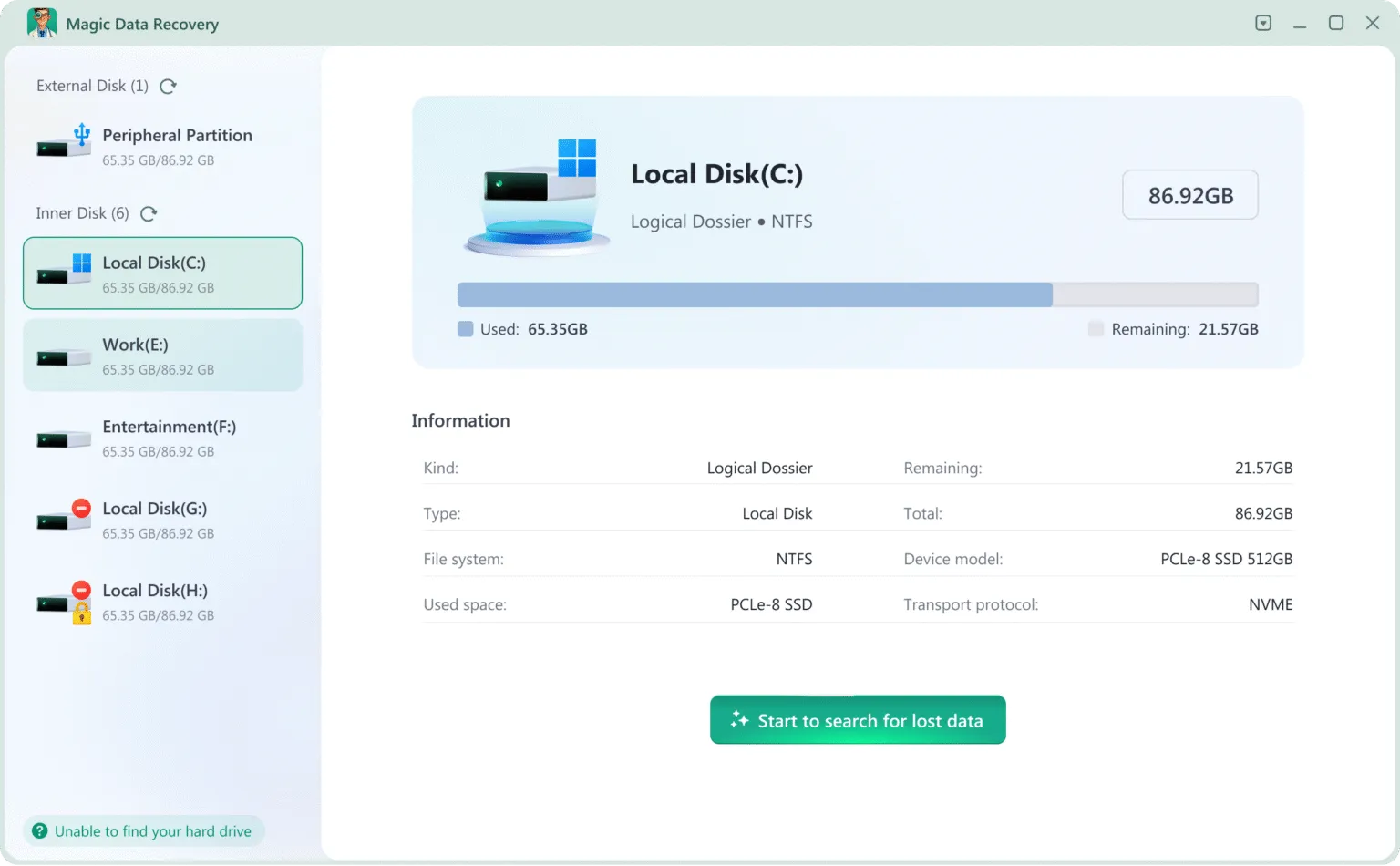
Step 2: Select the Correct Physical Drive or Volume
Identify the source by capacity, model, and partition size—not only its drive letter. Select the quick-formatted volume and start the search for lost data.
Step 3: Let the Scan Finish
Do not stop when a few familiar names appear. A deeper scan can locate files whose directory entries were replaced, so let it finish when the missing data matters.
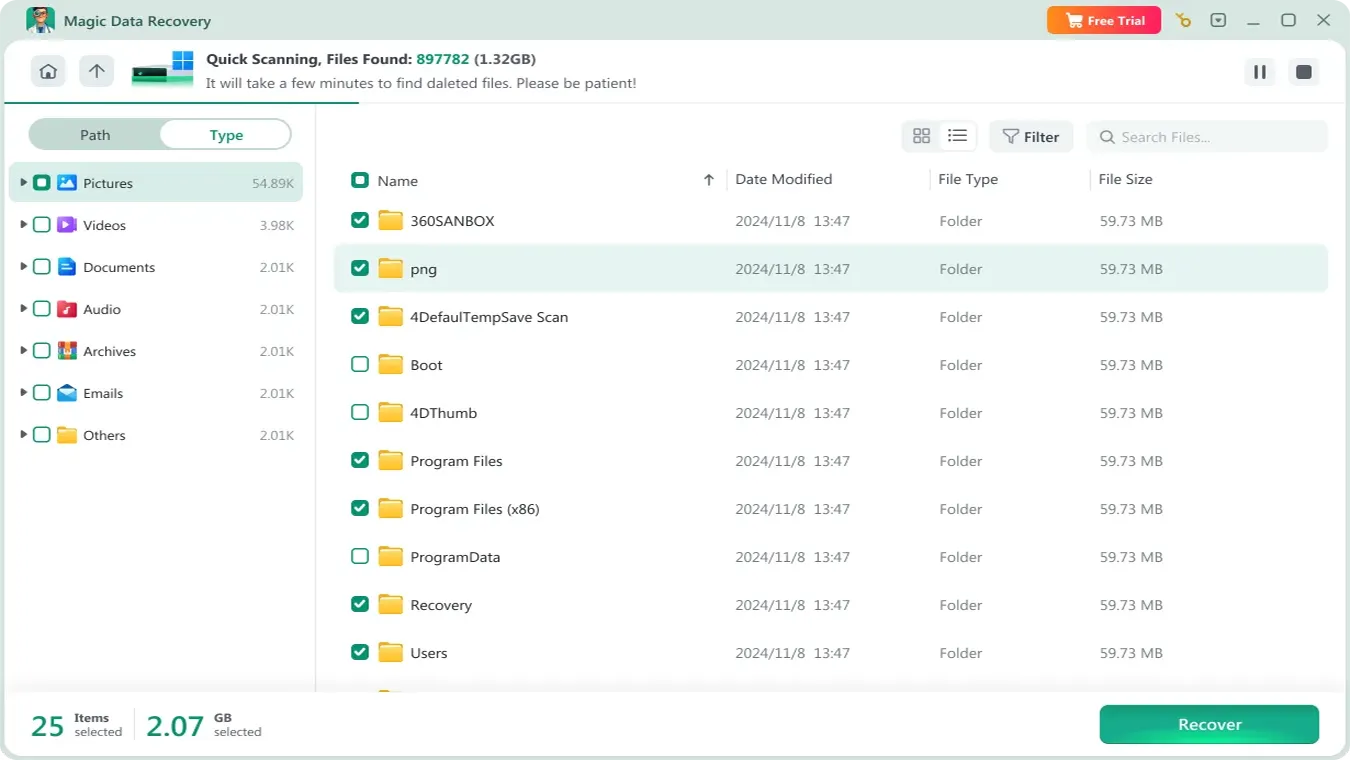
Step 4: Filter and Preview the Results
Filter by type, name, path, size, or date. Preview important documents, images, and videos. A working preview suggests that content is readable, but verify the recovered copy afterward.

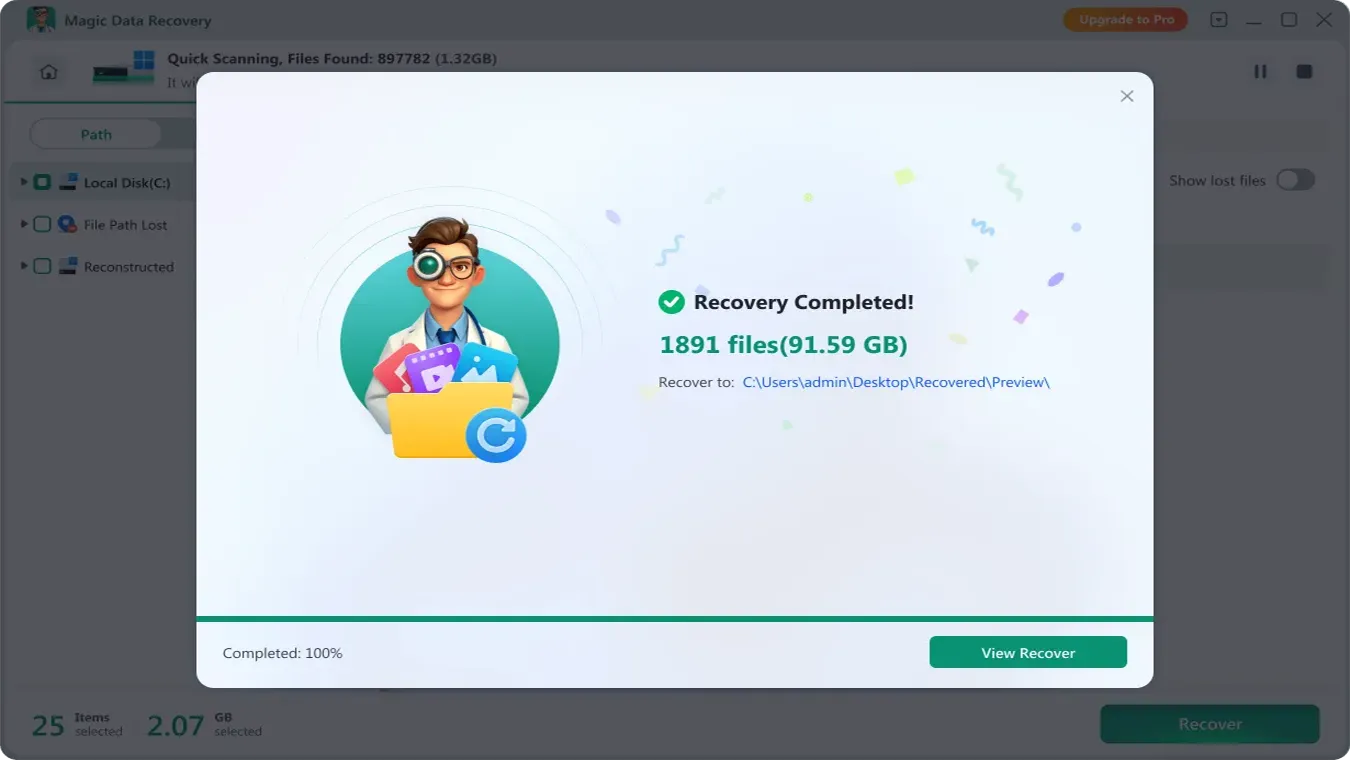
Step 5: Recover Files to Another Disk
Recover priority files first and choose another physical drive as the destination. A different partition on the same disk can still overwrite recoverable sectors. Afterward, open samples from every important file type.
For example, a photographer quick-formats a 2 TB external HDD instead of an SD card, then unplugs it without copying anything. Scanning it from another computer and saving found RAW photos to a separate disk is a sensible DIY case. A clicking HDD or an SSD holding the only copy of client work deserves a lab-first decision.
Method 3: Use Windows File Recovery if You Prefer Commands
Microsoft’s Windows File Recovery is a free command-line option for local storage. Microsoft recommends Extensive mode after formatting an NTFS disk and for FAT or exFAT recovery. You need two different drive letters: one for the formatted source and one for the destination.
For example, to search formatted drive E: for DOCX and JPG files and save the results to D:, open Windows File Recovery and run:
- winfr E: D: /extensive /n *.docx /n *.jpg
This method is free, but it has no graphical preview and requires careful syntax. See Microsoft’s Windows File Recovery instructions before changing the command.
Method 4: Choose a Professional Recovery Service When Needed
Stop DIY attempts if the disk clicks, spins down, vanishes during reads, shows the wrong capacity, or suffered water, fire, or impact damage. Repeatedly powering a failing drive can make the damage worse. A professional service can create a controlled image and work from the copy.
Software is practical for a stable recover quick formatted drive case; it is not a substitute for clean-room hardware work.
Why Magic Data Recovery Is a Practical Choice
No honest tool can promise that overwritten or TRIM-cleared data will return. Magic Data Recovery earns a recommendation because its strengths match the problem:
- It covers the right scenarios. It handles formatting, deletion, file-system errors, RAW volumes, lost partitions, Windows reinstallation, and virus-related loss.
- It searches beyond the fresh file system. Deeper scanning helps when quick formatting replaced original directory records.
- It supports broad file coverage. More than 5,000 file types cover documents, media, archives, and less common formats.
- It lets you inspect before saving. Preview and filtering help prioritize usable files rather than restoring a mass of unknown results.
- It keeps the workflow approachable. Select, scan, preview, and recover is easier than building multiple command filters.
- It sets a sensible boundary. It is intended for logical data loss on functioning storage, not physical repair or recovery of overwritten content.
It helps when no backup exists, adds a visual preview that Windows File Recovery lacks, and offers a direct DIY check for a stable disk. A lab remains better for hardware failure or uniquely valuable data.
If you need to recover quick formatted hard drive files without editing its structure first, Magic Data Recovery is worth scanning with. Judge it by files you can locate and preview, not an unrealistic percentage claim.
Common Mistakes That Reduce Recovery Chances
Most failed attempts begin with extra writes. Avoid these errors:
- Continuing to use the drive: Even a small download may occupy sectors that held an old file.
- Installing recovery software on the source: Program files and temporary data can overwrite what you want to restore.
- Reformatting with another file system: Changing NTFS to exFAT creates more metadata and does not bring files back.
- Running CHKDSK before recovery: Repairing a newly formatted file system cannot recreate the previous one and may change useful evidence.
- Recovering to the same physical disk: The first restored files can overwrite the next ones waiting to be found.
- Assuming every listed file is intact: Preview key items and test recovered documents, archives, and videos.
- Scanning a failing disk repeatedly: If the device disconnects or makes unusual noises, power it down and consult a specialist.
How to Check the Recovered Data
Finishing the scan is not the end of quick format recover data work. Test large videos, extract sample archives, and confirm that office documents are not truncated. Compare file counts and sizes with backups, cloud listings, or project records.
Keep the source unchanged until you verify two copies of recovered material. Then diagnose, repartition, format, and health-check the disk. Do not return a drive with recurring errors to backup duty.
Conclusion
The safest answer to how to recover quick formatted hard drive data is straightforward: stop writes, check the device, scan it from another disk, and save recovered files elsewhere. In other words, the search how to recover data from quick formatted hard drive leads to the same rule—protect the source before you attempt recovery. SSD TRIM, new writes, encryption, physical failure, and full formatting can sharply limit results.
Magic Data Recovery is recommended because it addresses the real pain points in this case: lost directory access, uncertainty about file integrity, and the need to search beyond the new file system. Its deeper scan, broad file support, filters, and preview make it a practical option for a functioning drive affected by logical data loss. If you need a broader recovery overview before starting, revisit Amagicsoft’s formatted drive recovery guide, then recover important files to a separate device before making any repairs.
Supports Windows 7/8/10/11 and Windows Server
FAQs About Quick Format Recovery
Can quick-formatted data be recovered?
Often, yes. A quick format creates new file-system structures but may leave much of the previous file content in place. Recovery becomes less likely after new writes, SSD TRIM, secure erasure, or physical damage. Stop using the drive before scanning it.
How soon should I scan a quick-formatted drive?
Scan it after you have a safe plan and a separate destination drive. Time alone does not overwrite a powered-off HDD; continued use does. Disconnect the device immediately, install recovery software elsewhere, and avoid repair commands before the scan.
Can I undo a quick format without software?
Windows has no simple Undo Format button. You can restore files from File History, cloud storage, or another backup without recovery software. If no backup exists, you generally need a recovery tool or professional service to locate the inaccessible data.
Does quick formatting permanently erase an HDD?
Not usually. On an HDD, quick formatting mainly creates fresh file-system information and marks space as available. Some old metadata may be overwritten immediately, while remaining content stays recoverable only until new data occupies the same sectors.
Can I recover data from a quick-formatted SSD?
Possibly, but SSD recovery is less predictable because TRIM can allow the controller to clear freed blocks internally. Disconnect the SSD immediately. If the files are uniquely valuable, consult a professional before running repeated scans or reconnecting it unnecessarily.
Should I run CHKDSK after accidentally quick-formatting a drive?
No. CHKDSK repairs the current file system; it does not restore the previous formatted structure. Because it can write changes to the volume, recover or image the data first. Use repair tools only after important files are safely stored elsewhere.
Where should I save files recovered from a formatted drive?
Save them to a different physical disk with enough free space. Another partition on the same disk is not the safest choice because recovery writes may overwrite unfound data. Verify the restored files before reusing or reformatting the source.
When should I use a recovery lab instead of software?
Choose a lab if the drive clicks, repeatedly disconnects, is not detected correctly, has physical damage, or contains irreplaceable high-value data. Software fits a stable, normally detected drive with logical loss; it cannot repair failed hardware or recover overwritten sectors.

Jason is a data recovery and technical support specialist with over 15 years of hands-on experience. He has worked extensively with frontline users, troubleshooting difficult data loss cases and providing practical recovery solutions for accidental deletion, formatted drives, damaged file systems, lost partitions, system failures, and other recovery emergencies. His expertise also includes backup and restoration, file repair, and disaster recovery, with a strong emphasis on safe, reliable, and technically accurate guidance.