
How to Recover Data from an Old Hard Drive
Finding an old computer drive can feel like opening a sealed time capsule—until the disk refuses to appear or Windows says you do not have permission to open it. If you need to recover data from an old hard drive, start with the drive’s physical condition, not with repair commands. This guide explains how to connect common SATA and IDE drives, copy accessible folders, solve basic access problems, and retrieve missing files. When the disk is detected but its data has been deleted, formatted, or made inaccessible by a file-system error, Magic Data Recovery offers a practical Windows-based data recovery option.
Table of Contents
Supports Windows 7/8/10/11 and Windows Server
Quick Answer: How to Get Files Off an Old Hard Drive
In most cases, you can recover files from an old hard drive with this sequence:
- Inspect the drive for physical damage and listen for abnormal sounds.
- Identify its connector, then attach it to a working computer with the correct powered adapter or enclosure.
- Check File Explorer and Disk Management without initializing or formatting the disk.
- Copy readable files to a healthy drive. If files are missing or the volume is RAW, scan it with data recovery software.
- Stop DIY attempts and contact a recovery laboratory if the drive clicks, grinds, repeatedly disconnects, or remains undetected.
The order matters. A harmless-looking “Initialize disk,” “Format,” or repair action may change the old drive before you have secured its files.
Can You Recover Data from an Old Hard Drive?
Often, yes. Age alone does not erase the information stored on a magnetic hard disk. What matters is the drive’s present condition and what has happened to the data since it was last used.
What you see | Likely situation | Best next step |
The drive opens and folders look normal | The data is still accessible | Copy important folders immediately |
The drive appears, but Windows says “Access denied” | Old account permissions or encryption | Check BitLocker first; then address permissions |
The drive appears in Disk Management but not File Explorer | Missing drive letter, lost partition, or damaged file system | Diagnose without initializing or formatting |
The volume shows as RAW or Unallocated | Logical damage | Recover files before attempting repairs |
Files were deleted or the drive was quick-formatted | File records may remain until overwritten | Run a read-only recovery scan |
The drive clicks, grinds, smells burnt, or vanishes repeatedly | Possible physical or electrical failure | Disconnect it and use a professional service |
The chances of recovering data from an old hard drive decrease after overwriting, severe platter damage, or repeated operation of a failing mechanism. By contrast, an intact drive that has simply sat unused for years may still open normally once connected correctly.
Before You Recover Files from an Old Hard Drive
A few precautions can prevent a recoverable case from becoming a permanent loss.
- Do not format or initialize the disk. Windows may label an unfamiliar or damaged volume as RAW, Unallocated, Unknown, or Not Initialized. Those labels do not prove that the disk is empty.
- Keep software off the old drive. New writes can overwrite deleted file content and metadata.
- Choose another recovery destination. Use a healthy internal disk, external drive, or network location.
- Delay CHKDSK until the files are safe. CHKDSK repairs file-system structures; it does not serve as a file recovery tool. Repair changes may complicate later recovery.
- Do not open the metal hard-disk casing. Dust can contaminate the platters. A data recovery lab opens a mechanical drive only in a controlled environment.
- Skip internet “freezer tricks.” Moisture and thermal stress can cause further damage.
Most importantly, listen to the drive. Seagate’s guidance notes that persistent hard clicking, repeated clunking, or grinding can indicate a physical problem. If the files are irreplaceable, disconnect the disk rather than testing it repeatedly.
Step 1: Identify the Old Hard Drive and Its Connector
Before buying an adapter, read the label and examine the connector. A model-number search can also confirm the interface and power requirements.
Drive type | Common source | What you need |
2.5-inch SATA HDD | Older laptop | SATA-to-USB cable or 2.5-inch SATA enclosure |
3.5-inch SATA HDD | Desktop computer | Powered SATA-to-USB adapter, dock, or enclosure |
2.5-inch IDE/PATA HDD | Very old laptop | 2.5-inch IDE-to-USB adapter with the correct pin layout |
3.5-inch IDE/PATA HDD | Very old desktop | Powered 40-pin IDE-to-USB adapter; check the jumper setting |
SATA connectors have two flat, L-shaped sections for data and power. Desktop IDE drives have a wide two-row pin connector, usually alongside a four-pin Molex power socket. Handle exposed drives by the sides and avoid touching the circuit board.
Power deserves special attention. A simple USB cable can often power a 2.5-inch SATA laptop disk. A 3.5-inch desktop HDD normally needs a separate power supply. If it receives too little power, it may fail to spin or repeatedly disconnect even when the disk itself remains healthy.
Step 2: Connect the Drive to a Working Computer
Using a USB adapter or enclosure is usually easier than installing the old disk inside a desktop PC.
- Shut down or disconnect power from the adapter.
- Attach the SATA or IDE connector without forcing it.
- Connect the external power supply if the drive requires one.
- Turn on the adapter, then connect its USB cable directly to the computer rather than through an unpowered hub.
- Wait a minute and check File Explorer.
If the drive does not appear, try one known-good cable, another USB port, and another computer. For an IDE disk, verify that the adapter supports its size and check whether the jumper should be set to Master. Repeatedly power-cycling an unstable disk, however, adds risk.
Check Disk Management Without Changing the Disk
Press Win + X and choose Disk Management. Identify the old disk by capacity, not only by its disk number.
- If the partition is Healthy but has no letter, you can assign one through Change Drive Letter and Paths. Microsoft documents the same procedure in its drive-letter guide.
- If it shows RAW, Unallocated, Unknown, or Not Initialized, cancel any prompt to modify it. See this unrecognized HDD recovery guide before taking the next step.
- If the disk reports the wrong capacity, freezes Disk Management, or disappears, stop. These signs may point to an adapter problem, bad sectors, firmware trouble, or physical failure.
Step 3: Copy Accessible Files First
When the drive opens normally, you do not need recovery software. Create a folder on a healthy destination disk and copy the most valuable data first. Old Windows user files usually sit under:
X:\Users\OldUserName\
Check Desktop, Documents, Downloads, Pictures, Videos, and any folders created outside the user profile. Also search by file extension—such as .jpg, .docx, .xlsx, .pdf, or .mp4—if the original folder arrangement is unclear.
Copy in smaller batches if the disk is slow. Start with unique documents and family photos rather than replaceable applications. If a particular folder causes the drive to hang, skip it temporarily and secure readable data elsewhere.
What to Do When Windows Says “Access Denied”
An old Windows installation may still associate a user folder with an account security identifier from the previous computer. If the drive is healthy and unencrypted, sign in with an administrator account, right-click the folder, and open Properties > Security > Advanced to change its owner to your current account. Apply permissions only to the folder you need.
First, look for a padlock icon or a BitLocker prompt. Permission changes cannot decrypt an encrypted volume. Microsoft explains that BitLocker may require its unique 48-digit recovery key. Without the password or recovery key, neither ownership changes nor ordinary data recovery software can decrypt the files.
Step 4: Recover Missing, Deleted, or Inaccessible Files
Direct copying solves an access problem, but it cannot restore content that the file system no longer lists. Consider a recovery scan when:
- files or folders have disappeared;
- the Recycle Bin was emptied before the computer was retired;
- Windows asks to format the disk;
- the drive or partition appears RAW;
- a quick format, partition loss, or file-system error occurred; or
- you can open the drive, but some files return corruption errors.
This is the point at which dedicated software can recover data from an old hard drive more effectively than File Explorer. It reads the detected storage device for surviving file-system records and recognizable file signatures. It cannot repair a broken motor, damaged heads, or a drive that the computer cannot detect.
How to Recover Data from an Old Hard Drive with Magic Data Recovery
Magic Data Recovery is useful when the old HDD still appears in Windows but logical data loss prevents a normal copy. It supports deleted, formatted, RAW, corrupted, and inaccessible storage scenarios, along with more than 5,000 file types. It can also scan NTFS, FAT32, exFAT, and EXT2/3/4 volumes attached to a Windows computer.
Its practical advantage is control: you can scan and preview found photos, documents, videos, and other files before choosing what to restore. This makes it easier to verify results without relying on a repair command that changes the original file system.
Step 1: Install the Software on a Healthy Drive
Download and install the program on the working computer’s system disk or another healthy device. Never place it on the old HDD you plan to scan.
Supports Windows 7/8/10/11 and Windows Server
Step 2: Select the Old Hard Drive
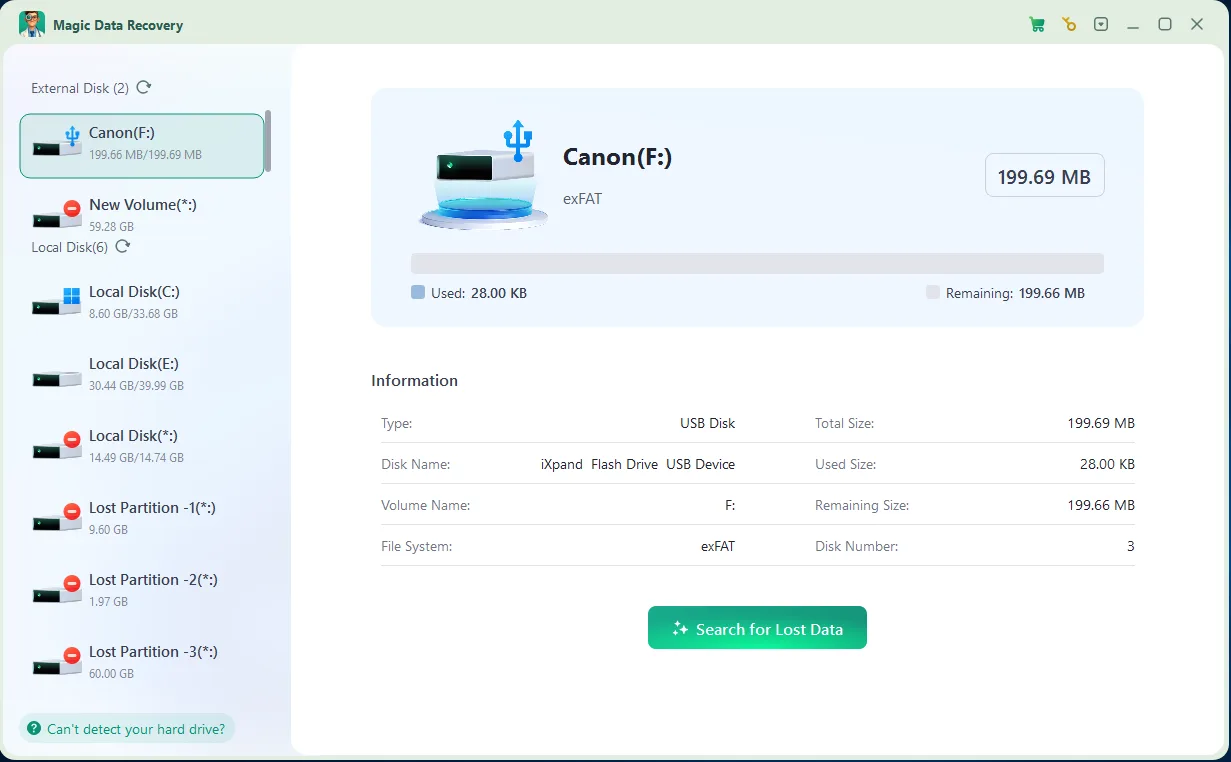
Launch the software and identify the drive by its capacity and partition information. Select the affected HDD or volume, then start the scan. If Windows can see the physical disk but not its old partition, allow the deeper scan to search for lost file records and signatures.
Step 3: Filter and Preview the Results
Search by filename or filter by file type, size, and date when available. Preview important files instead of assuming that every listed item remains intact. A correct filename does not always mean the file content survived overwriting.

Step 4: Recover to a Different Device
Select the files you need and choose a healthy destination with enough free space. Do not restore them to the source disk. Open a sample of the recovered documents, photos, and videos afterward to confirm that they work.
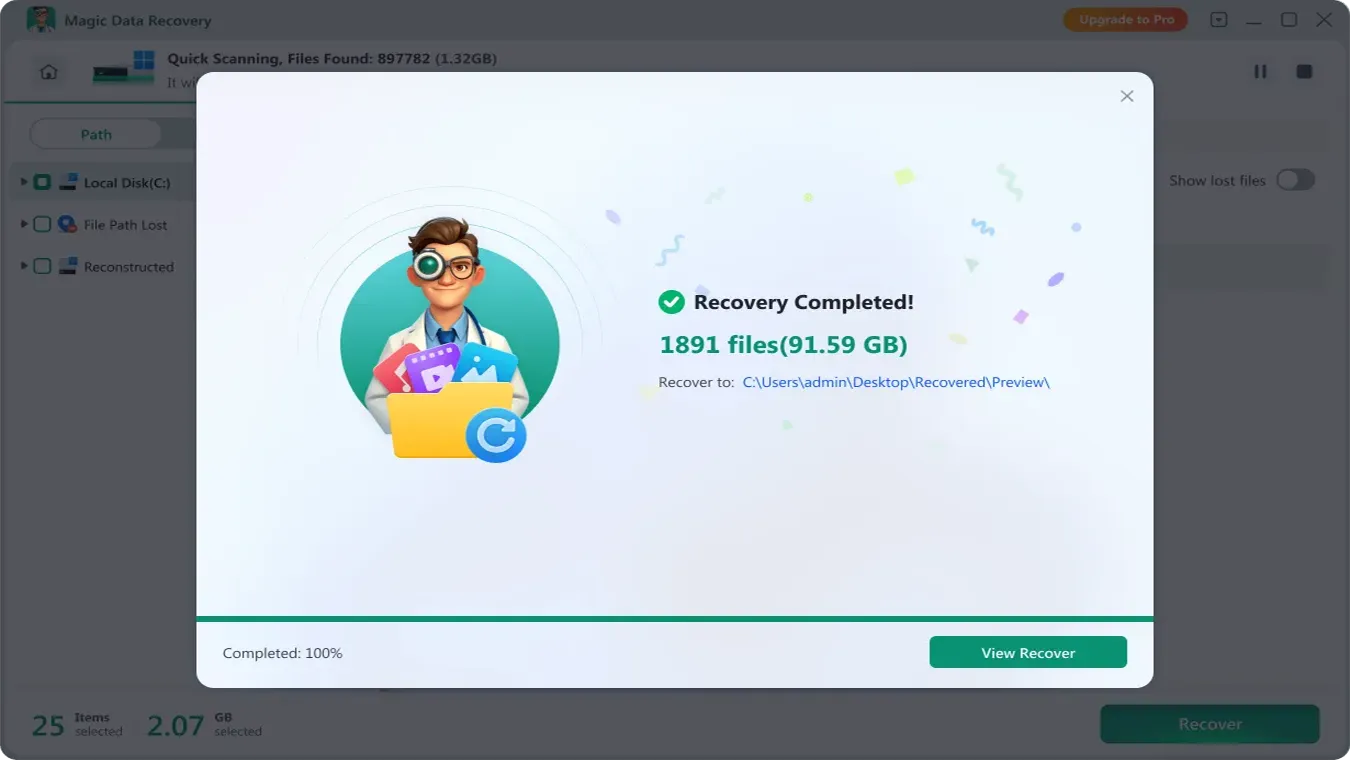
For more detail on logical symptoms and the recover-first approach, see how HDD logical failure works. If you want an efficient solution for recovering files from an old hard drive after deletion, formatting, or file-system damage, Magic Data Recovery is worth trying before you alter the disk.
Step 5: Try a Backup or Windows File Recovery
Before scanning an aging disk intensively, check whether the files also exist in OneDrive, another cloud account, an external backup, a system image, or a newer computer. A second copy is safer than reading a questionable drive.
Windows users can also consider Microsoft’s free Windows File Recovery command-line app for deleted files on local storage. It requires a separate source and destination drive and suits users who are comfortable constructing commands. Its command-line workflow and limited preview experience, however, make it less convenient when you need to browse many unknown files from an old disk.
Step 6: Know When Professional Recovery Is Safer
Stop home recovery if the drive:
- makes persistent clicking, grinding, scraping, or repeated spin-up sounds;
- has visible burns, corrosion, bent connectors, or liquid damage;
- does not appear in BIOS, Disk Management, or a known-good adapter;
- disconnects or stalls the computer during simple reads; or
- contains the only copy of data whose loss would be unacceptable.
A professional lab can work with failed heads, damaged electronics, firmware faults, and unstable platters. The service costs more than software, but repeated DIY scans can reduce the lab’s eventual options. Ask the provider about evaluation fees, recovery procedure, confidentiality, final cost, and whether you pay when the required files cannot be recovered.
Which Old Hard Drive Recovery Method Should You Choose?
Method | Best for | Main limitation |
Direct copy through an adapter | Healthy drive with visible files | Cannot find deleted or lost data |
Change drive letter | Healthy partition missing from File Explorer | Not suitable for RAW or Unallocated space |
Change folder ownership | Unencrypted NTFS permission issue | Does not bypass BitLocker or file-system damage |
Restore from backup | Files copied elsewhere before the failure | Only restores versions that were backed up |
Magic Data Recovery | Detected drive with deleted, formatted, RAW, or inaccessible data | Cannot fix physical HDD failure or decrypt BitLocker without a key |
Professional recovery lab | Mechanically or electrically damaged drive | Higher cost and longer turnaround |
Tips That Improve the Chance of Old HDD Recovery
- Work from another computer and keep the old disk as the source only.
- Prepare a destination drive before scanning. It should have enough space for the files you expect to restore.
- Record the model number, symptoms, adapter used, and actions already attempted.
- Prefer one careful scan over several different tools repeatedly reading an unstable drive.
- Verify recovered files before repairing, formatting, recycling, or discarding the old HDD.
- Once recovery finishes, keep at least two copies of important data on separate devices or services.
Conclusion
The safest way to recover data from an old hard drive is to match the method to the symptom. Use the correct powered SATA or IDE adapter, copy readable files first, and treat RAW, Unallocated, or missing data as a recovery task—not an invitation to format the disk. Stop immediately when the HDD shows signs of mechanical trouble.
For a detected drive affected by deletion, quick formatting, partition damage, or file-system errors, Magic Data Recovery is recommended because it combines broad file-type and file-system support with scanning, filtering, and preview before recovery. It also lets you save the results to a different disk. If you need more guidance before you recover files from an old hard drive, visit Amagicsoft’s deleted file recovery resource and begin with the least destructive option.
Supports Windows 7/8/10/11 and Windows Server
FAQs About Recovering Data from an Old Hard Drive
Can you recover data from a hard drive that has not been used for years?
Yes. A hard drive does not automatically lose every file simply because it sat unused. Recovery depends on its physical condition, file-system health, and whether the data was overwritten before storage. Inspect it first, connect it correctly, and copy important files as soon as it becomes readable.
How do I connect an old hard drive to a new computer?
Identify whether the drive uses SATA or IDE/PATA and whether it is a 2.5-inch or 3.5-inch model. Then use a compatible USB adapter, dock, or enclosure. Most 3.5-inch drives need an external power supply, while many 2.5-inch SATA drives can draw power through USB.
Can I recover files from an old hard drive that will not spin?
Not with software alone. A drive that will not spin may have a power, circuit-board, motor, or internal mechanical fault. Test only a known-good compatible cable and power supply. If it remains silent and the data matters, disconnect it and contact a professional recovery laboratory.
Why does my old hard drive show as RAW or Unallocated?
Windows may show RAW when it cannot read the file system and Unallocated when it cannot find a valid partition entry. The data may still exist. Do not format, initialize, or create a new volume; scan the detected disk for recoverable files first.
Can I access an old Windows drive without the previous password?
Ordinary NTFS permissions can often be changed by an administrator on the new computer. Encryption is different. If BitLocker protected the volume, you need its password or 48-digit recovery key. Changing ownership or using recovery software cannot decrypt properly encrypted data without the required credential.
Is it safe to run CHKDSK on an old hard drive?
Run CHKDSK only after you have copied or recovered important data. Its repair options change file-system structures and can place fragments into recovery folders. On a physically unstable disk, the intensive read activity may also worsen the problem. Recovery should come before repair.
Can Magic Data Recovery recover files from a formatted old hard drive?
It can scan a detected HDD after quick formatting and may restore files whose content has not been overwritten. Results depend on the format type, later disk use, and physical condition. Install the software elsewhere, preview found files, and save recovered data to a different drive.
How much does old hard drive data recovery cost?
Direct copying may cost only the price of an adapter, while software recovery may require a license for larger recoveries. Professional laboratory pricing varies with the fault, parts, labor, and urgency. Request a written evaluation and final quote before authorizing physical recovery work.

Jason has over 15 years of hands-on experience in the computer data security industry. He specializes in data recovery, backup and restoration, and file repair technologies, and has helped millions of users worldwide resolve complex data loss and security issues.