
Recover EXE Files: 7 Safe Methods
Losing an executable can stop an installer, portable app, business utility, or Windows component from opening. Fortunately, you can often recover EXE files if you act before new data overwrites the deleted sectors. This guide explains how to identify why the file disappeared, choose the safest recovery method, and verify the restored file before running it. For a broader workflow covering accidental deletion, start with Amagicsoft’s deleted file recovery guide.
The phrase recover files EXE usually describes one of several different problems. You may have deleted an installer, emptied the Recycle Bin, formatted a drive, lost access after a file system error, or discovered that Microsoft Defender quarantined the program. Each situation needs a different response. When Windows tools and backups cannot help, Magic Data Recovery can scan the affected storage device for deleted or inaccessible executable files.
Supports Windows 7/8/10/11 and Windows Server
Table of Contents
Can You Recover EXE Files?
Yes, you may be able to recover EXE files after accidental deletion, permanent deletion, formatting, a lost partition, or a logical file system problem. Recovery depends on whether the original data still exists on the drive. For users searching recover files EXE, the practical question is whether a backup, quarantine copy, replacement download, or recoverable disk record still exists.
When Windows deletes a file, it usually marks the occupied space as available instead of immediately erasing every byte. New downloads, updates, installations, and normal system activity can reuse that space. Therefore, stop using the affected drive as soon as possible.
EXE recovery also differs from photo or document recovery. An executable contains structured binary code. Even a small amount of overwritten data can make the restored program fail, crash, or trigger a security warning. In many cases, downloading a clean installer from the software developer is safer than restoring an old copy.
What Is an EXE File?
An EXE file is a Windows executable file that starts a program, launches an installer, or performs a defined software task. Common examples include setup.exe, portable applications, game launchers, update utilities, and Windows system components.
You may need to recover EXE files after:
- Accidental deletion or a Shift+Delete action
- Emptying the Recycle Bin
- Antivirus quarantine or removal
- Formatting an HDD, SSD, or USB drive
- File system corruption or a RAW partition
- A failed update, crash, or unexpected shutdown
- Malware damage
- Moving or renaming program folders incorrectly
Before recovery, determine whether the missing file is replaceable. If it came from a trusted download page, installation package, company repository, or software deployment system, obtain a fresh copy first.
Recovery software is more valuable for unique executable builds, internally developed tools, discontinued installers, portable apps with no available download, or EXE files stored on a damaged device.
Before You Recover EXE Files: Do These 5 Things
The first few minutes can affect the result. Follow these precautions before you attempt to recover EXE files.
- Stop writing to the affected drive. Do not install apps, download updates, copy files, or create archives on it.
- Check the source. If the EXE came from a software vendor, re-download it from the official website instead of using an unknown mirror.
- Do not disable antivirus protection blindly. First, review Protection History and confirm whether the file is legitimate.
- Use another drive for recovery software when practical. Installing onto the same partition may overwrite deleted data.
- Save recovered files elsewhere. Restore them to an external disk or a different partition, not the original location.
For broader Windows deletion cases, see how to recover deleted files in Windows 10.
Which EXE File Recovery Method Should You Use?
A reliable recover files EXE workflow starts by matching the cause of loss to the least invasive solution.
Situation | Best First Method | Main Limitation |
Recently deleted normally | Recycle Bin | Does not help after Shift+Delete or an emptied bin |
Defender removed or quarantined it | Windows Security Protection History | Restore only after confirming the file is safe |
Installer or public application file is missing | Re-download or reinstall | Not suitable for unique or discontinued builds |
Backup existed before deletion | File History or Previous Versions | Requires an earlier backup or snapshot |
Installed app broke after an update | System Restore, SFC, or reinstall | Not designed for arbitrary personal EXE files |
Permanently deleted local file | Windows File Recovery | Command-line syntax can be difficult |
Deleted, formatted, RAW, or inaccessible drive | Magic Data Recovery | Success still depends on overwrite and hardware condition |
Method 1: Recover EXE Files from the Recycle Bin
Start with the Recycle Bin when you recently deleted an EXE from an internal Windows drive.
- Open Recycle Bin.
- Search for the filename or type .exe in the search field.
- Sort the results by deletion date or original location.
- Right-click the required file.
- Select Restore.
Windows returns the EXE to its original folder. This method offers the simplest way to recover EXE files, but it does not work when you used Shift+Delete, emptied the Recycle Bin, deleted the file through certain applications, or removed it from storage that bypasses the Recycle Bin.
After restoration, scan the file with Windows Security before opening it. Do not assume that every deleted executable is safe.
Method 2: Restore an EXE from Windows Security Protection History
An EXE may appear deleted when Microsoft Defender has actually quarantined it. This situation often occurs immediately after a download, extraction, software update, or first launch.
To check the quarantine:
- Open Windows Security.
- Select Virus & threat protection.
- Open Protection history.
- Find the detection that matches the file, time, and original path.
- Review the threat name and available publisher information.
- Choose Restore or Allow on device only when you trust the source and have verified the file.
Microsoft’s Protection History documentation explains that a quarantined file remains blocked and that restoring it may cause Defender to detect it again.
If you cannot confidently identify the developer or source, keep the file quarantined and download a clean copy from the official vendor.
This method can recover EXE files without scanning the disk because Defender may still hold the original item. However, it should never become a shortcut for bypassing a valid malware warning.
Method 3: Re-download the Installer or Reinstall the Program
For many users, the safest answer to recover files EXE is not disk recovery. It is replacement.
Use this method when the missing file belongs to:
- A commercially available application
- A game launcher
- A hardware driver package
- A browser download
- A Microsoft Store or managed business app
- A setup package that the developer still provides
Download the file only from the official developer, Microsoft Store, your company portal, or another verified source. Then compare the publisher, version, file size, and digital signature when available.
If the missing EXE sits inside C:\Program Files or C:\Program Files (x86), reinstalling or repairing the application usually works better than restoring one isolated file.
Programs often depend on DLL files, services, drivers, registry entries, configuration data, and matching versions. Restoring only the executable may leave the application unusable.
Method 4: Recover EXE Files with File History or Previous Versions
File History and Previous Versions can restore an earlier copy of a folder when Windows created a backup or snapshot before the deletion.
- Open File Explorer.
- Go to the folder that previously contained the EXE.
- Right-click the folder and select Properties.
- Open Previous Versions.
- Choose a version dated before the file disappeared.
- Select Open to inspect it first.
- Use Restore To when possible so that you do not overwrite the current folder.
Microsoft’s File History guide notes that available previous versions depend on File History or other backup data. If the list is empty, Windows has no usable snapshot for that location.
This method can recover EXE files while preserving the original filename and folder structure. It works especially well for portable applications, custom utilities, compiled internal tools, and archived software packages.
Method 5: Repair Installed or System EXE Files
If a Windows component or installed application lost an EXE, recover the complete software environment instead of treating the file as an ordinary download.
Use System Restore for a Recent Software Problem
System Restore returns Windows system files, registry settings, drivers, and installed programs to an earlier restore point.
To open it:
- Press Windows + R.
- Enter rstrui.exe.
- Select a restore point from before the problem began.
- Review the affected programs.
- Complete the restoration.
Use this option when an application stopped working after an update, driver installation, registry change, or failed software installation.
System Restore does not serve as a general backup for personal files. Therefore, it may not recover EXE files that you stored in Downloads, Documents, or another custom folder.
Use SFC and DISM for Windows Components
When built-in Windows executables are missing or corrupted, open Command Prompt as administrator and run:
- DISM.exe /Online /Cleanup-image /Restorehealth
- sfc /scannow
Microsoft recommends DISM and System File Checker for repairing missing or corrupted protected Windows system files. These commands can replace damaged operating system components with known-good copies.
Do not download individual Windows system EXE files from random websites. Unofficial copies may use the wrong Windows build, contain malware, or create additional stability problems.
Method 6: Use Windows File Recovery
Microsoft’s Windows File Recovery is a command-line utility for deleted files that no longer appear in the Recycle Bin. It can scan internal drives, external drives, and USB devices.
The source and destination must use different drives.
A basic example looks like this:
- winfr C: E: /regular /n *.exe
This command searches the C drive and saves matching results to the E drive.
For a specific folder, use a narrower filter:
- winfr C: E: /regular /n \Users\YourName\Downloads\*.exe
Use extensive mode when the file has been missing longer, the drive was formatted, or the file system has problems:
- winfr C: E: /extensive /n *.exe
Windows File Recovery can recover EXE files without commercial software, but it requires correct syntax and does not provide the visual filtering experience that most beginners expect.
It also cannot recover data directly from cloud storage or network shares.
Method 7: Recover EXE Files with Magic Data Recovery
When no backup exists, the Recycle Bin is empty, or the drive has become formatted, RAW, or inaccessible, a dedicated scanner offers a more practical workflow.
Magic Data Recovery supports recovery after deletion, formatting, file system errors, system reinstallation, and other logical data-loss events. It scans HDDs, SSDs, USB drives, memory cards, and external storage while supporting more than 5,000 file types.
Its guided interface also reduces the command-line errors that can occur with manual tools.
How to Use Magic Data Recovery
1. Download and install the program. Prefer another drive when the missing EXE was stored on the system partition.
Supports Windows 7/8/10/11 and Windows Server
2. Select the affected disk or partition. Choose the location where the executable originally existed.
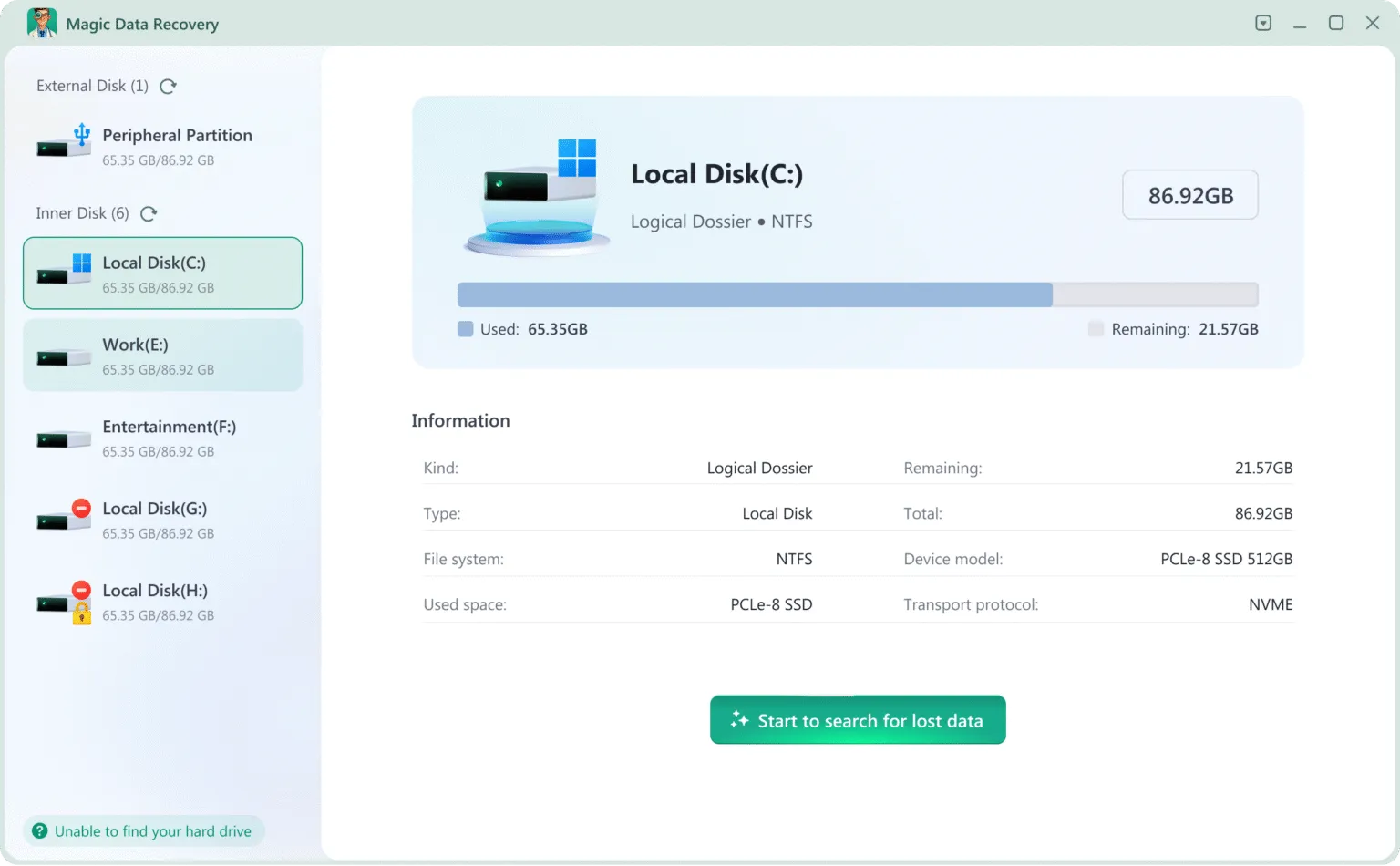
3. Start the scan. Allow the scan to finish for the most complete result.
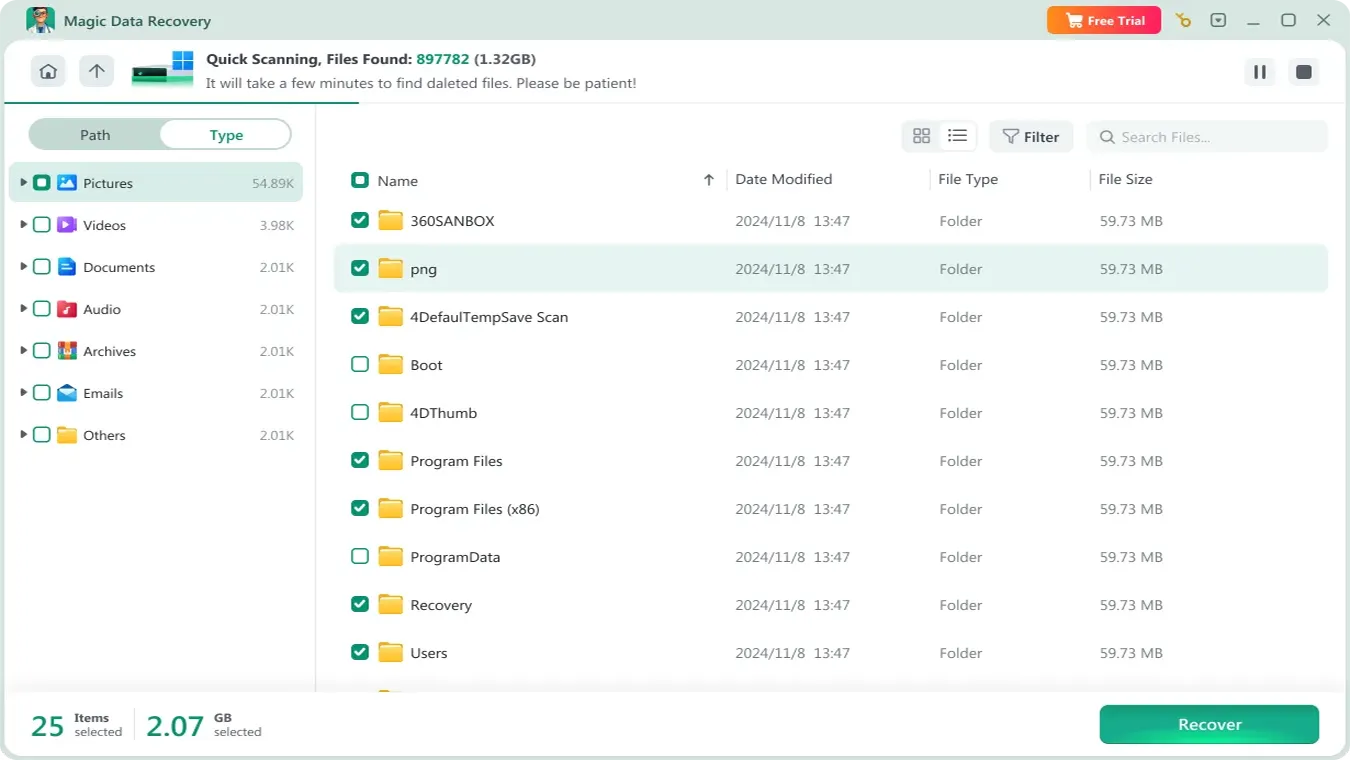
4. Find the executable. Search by filename, extension, original path, size, or modified date.
5. Select the correct version. Compare the metadata and nearby recovered folders.
6. Recover to another drive. Never save the output onto the source partition.
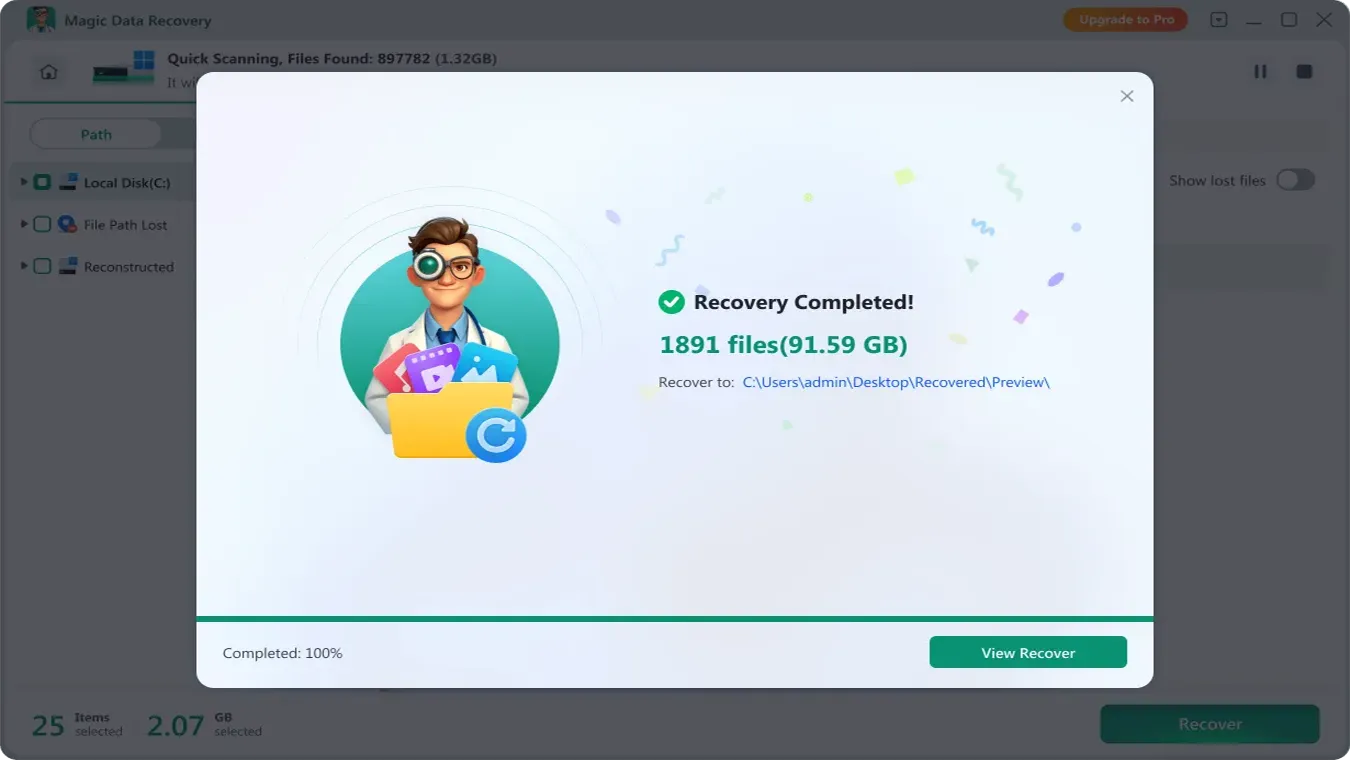
7. Verify before running. Scan the restored EXE and inspect its digital signature or publisher.
This approach helps users recover EXE files that built-in Windows methods cannot find. It also gives beginners a structured way to recover EXE files without composing command-line filters.
Moreover, it addresses a wider range of cases than Recycle Bin restoration because it can search formatted or logically damaged storage.
Why Magic Data Recovery Is a Practical Choice
Magic Data Recovery solves the main problem in EXE recovery: the file may no longer exist in any Windows backup or visible folder. Instead of relying only on a previous version, it scans storage data for recoverable records and file content.
Its primary advantages include:
- Support for deletion, formatting, inaccessible partitions, and file system errors
- Compatibility with common internal and external storage devices
- Search and filtering for a particular filename or extension
- A visual workflow for users who do not want command-line recovery
- A free 500MB recovery allowance for testing recoverable results
- Support for more than 5,000 file types
For example, a developer may accidentally delete an old compiled utility whose source code is no longer available. A technician may need a discontinued firmware installer from a formatted USB drive.
In both cases, reinstalling the latest software does not replace the missing historical EXE. A disk-level scan offers a more relevant solution.
If the partition shows RAW, requests formatting, or produces access errors, recover important data before attempting repairs. The file system error guide explains why repair operations can change disk structures.
How to Recover EXE Files Automatically Deleted by Windows
When an EXE disappears repeatedly, do not keep downloading and restoring it without finding the cause. Use this sequence:
- Check Windows Security Protection History.
- Check any third-party antivirus quarantine.
- Confirm that the browser did not block or rename the download.
- Verify the publisher and digital signature.
- Scan the download URL or file with your security tools.
- Obtain a fresh copy from the official source.
- Restore the quarantined file only after you establish that the detection is a false positive.
Repeated deletion often points to security software, malware, a damaged application updater, or an unsafe source. Data recovery can recover EXE files, but it cannot determine whether an unknown executable deserves trust. Security verification remains a separate step.
How to Recover EXE Files from a Formatted or RAW Drive
A formatted or RAW drive requires more caution than a normal deletion.
First, stop using the device. Do not format it again, run CHKDSK immediately, or install recovery software onto it.
Next, connect the drive to a stable Windows computer. Scan the physical disk or affected partition with Magic Data Recovery and restore found files to another device.
You may recover EXE files after a quick format because much of the original content can remain until overwritten. However, secure erase operations, SSD TRIM, repeated formatting, heavy reuse, encryption loss, or physical failure can reduce or eliminate recoverability.
If the drive clicks, disconnects repeatedly, reports the wrong capacity, or does not appear in Disk Management, stop DIY attempts. Those symptoms may indicate hardware damage that needs a professional recovery laboratory.
What If the Recovered EXE File Does Not Open?
A recovered filename does not guarantee a working program. Check these possibilities:
- The file was partially overwritten. Binary code or internal tables may be incomplete.
- The program needs other components. Missing DLLs, services, drivers, registry settings, or data folders can prevent launch.
- Windows blocked the file. Right-click it, open Properties, and review the security information.
- The architecture or version is wrong. A different build may not match the installed environment.
- The file is unsafe. Antivirus software may block a genuinely malicious executable.
- The original program is damaged. Reinstalling the complete application may solve the issue.
When you recover EXE files, compare the restored size with a known copy, check the digital signature, scan it, and test it in a controlled environment.
Avoid repeatedly launching a suspicious or corrupted executable on a production computer.
EXE Recovery Methods Compared
Method | Works Without Backup | Handles Formatting | Beginner-Friendly | Best Use |
Recycle Bin | Yes | No | High | Recent normal deletion |
Protection History | Yes | No | High | Defender quarantine |
Re-download or reinstall | Yes | Not applicable | High | Replaceable installers and app files |
File History or Previous Versions | No | Usually no | High | Earlier backed-up copy |
System Restore or SFC | No | No | Medium | Installed apps and Windows files |
Windows File Recovery | Yes | Sometimes | Low | Command-line local recovery |
Magic Data Recovery | Yes | Yes | High | Permanent deletion, formatting, RAW, and file system errors |
This recover files EXE comparison shows why no single method fits every scenario. The best solution depends on the file’s role.
Use replacement or repair for standard application files. Use backup restoration for protected folders. Use disk scanning when the executable is unique, permanently deleted, or trapped on damaged logical storage.
Tips to Prevent EXE File Loss
Use these practices after you recover EXE files:
- Keep unique installers and portable tools in a backed-up software archive.
- Store source code and build outputs in version control or a managed repository.
- Enable File History or another scheduled backup.
- Record the official download page, version, license information, and checksum.
- Avoid moving individual files out of installed program folders.
- Review antivirus alerts instead of disabling protection.
- Create recovery media and restore points before major system changes.
- Maintain at least one offline or external backup of irreplaceable executables.
Conclusion
The safest way to recover EXE files starts with diagnosis. Check the Recycle Bin and Protection History first. Re-download replaceable installers from the official publisher. Use File History, System Restore, SFC, or Windows File Recovery when they match the situation.
For permanently deleted, formatted, RAW, or file system error cases, Magic Data Recovery offers a clearer disk-scanning workflow than command-line tools. It supports multiple loss scenarios and lets ordinary Windows users locate specific executable files without relying on an existing backup.
For additional recovery planning, return to the deleted file recovery guide.
FAQs About How to Recover EXE Files
Can permanently deleted EXE files be recovered?
Yes, you may recover EXE files after Shift+Delete or an emptied Recycle Bin if their disk space has not been overwritten. Stop using the source drive immediately, then scan it with Windows File Recovery or Magic Data Recovery. Save restored files to another drive and verify their publisher and security status before running them.
Why does Windows Defender delete or quarantine EXE files?
Microsoft Defender may quarantine an EXE when its signatures, behavior, reputation, or download source appears risky. Sometimes the detection may be a false positive, but you should not assume that automatically. Review Protection History, verify the developer and digital signature, and restore the file only when you can confirm that it came from a trusted source.
Can I recover an EXE file from the Recycle Bin?
Yes. Open the Recycle Bin, search for the filename or .exe, right-click the item, and select Restore. Windows returns it to its original location. This method cannot recover EXE files removed with Shift+Delete, deleted after the bin was emptied, or erased from storage that bypasses the Recycle Bin.
Can System Restore recover a deleted EXE file?
System Restore can restore system files, registry settings, drivers, and installed program states, so it may help when an application EXE disappeared after an update or configuration change. It does not work as a normal personal-file backup. For a standalone EXE in Downloads or another personal folder, use File History, a backup, or recovery software instead.
How do I recover EXE files from a formatted drive?
Stop using the formatted drive and avoid writing new data to it. Connect it to a stable Windows PC, scan the affected disk with Magic Data Recovery, filter for .exe, and save found files to another device. Quick formatting may leave recoverable data, while secure erasure, TRIM, overwriting, or physical damage can sharply reduce recovery chances.
Why will my recovered EXE file not open?
The restored executable may be incomplete, partially overwritten, blocked by security software, or separated from required DLLs and configuration files. Compare its size and signature with a known copy. Scan it before opening. If it belongs to an installed application, repairing or reinstalling the complete program usually works better than restoring one isolated EXE.
Is it safe to run a recovered EXE file?
Run it only after you verify the original source, publisher, digital signature, expected filename, and security scan results. A recovered EXE can still contain malware, and disk recovery does not prove trustworthiness. When possible, replace the file with a fresh copy from the official developer. Test uncertain executables in an isolated environment rather than a production computer.
Can Magic Data Recovery recover files EXE from USB drives and SSDs?
Magic Data Recovery can scan USB drives, HDDs, SSDs, memory cards, and external storage for deleted or inaccessible files, including executables. However, results depend on overwrite, device condition, formatting method, and SSD TRIM behavior. To improve the chance to recover files EXE, stop using the device and restore the results to a different drive.

Jason has over 15 years of hands-on experience in the computer data security industry. He specializes in data recovery, backup and restoration, and file repair technologies, and has helped millions of users worldwide resolve complex data loss and security issues.