
EXT4 Recover Files: 7 Safe Methods
When important Linux data disappears, the first few actions often determine whether recovery remains possible. This EXT4 recover files guide explains how to restore files after accidental deletion, an rm command, formatting, file system corruption, a missing partition, or a failed Linux installation. Start by stopping all writes to the affected drive, then use the safest method for your situation. For a broader overview, see Amagicsoft’s deleted file recovery guide.
You will learn seven practical methods, from Trash and backups to extundelete, PhotoRec, TestDisk, and Magic Data Recovery. The goal is not to promise a guaranteed result. Instead, this guide helps you protect the remaining data, choose the right tool, and avoid recovery mistakes that can overwrite recoverable files.
Supports Windows 7/8/10/11 and Windows Server
Table of Contents
Quick Answer: Can EXT4 Recover Files After Deletion?
Yes, an EXT4 recover files attempt can succeed when the file content has not been overwritten and the storage device still works correctly. Recovery becomes harder after continued use, formatting, file system repairs, repartitioning, or SSD discard operations. Your best response is to unmount or shut down the affected system, create a disk image when the data is valuable, and save every recovered file to another drive.
For recently deleted files, check Trash, backups, and open file descriptors first. Use extundelete when journal metadata remains available. Use PhotoRec when metadata is damaged and raw file carving is acceptable. Use TestDisk when the partition itself is missing. For a guided Windows workflow, connect the EXT4 disk to a Windows computer and scan it with Magic Data Recovery.
What Is EXT4, and Why Is File Recovery Different?
EXT4 is a journaling Linux file system built around structures such as block groups, inode tables, allocation bitmaps, directory entries, and a journal. A directory entry maps a file name to an inode number, while the inode stores metadata and references the file’s data. This design supports reliable daily operation, but it does not provide a simple universal undelete command.
When Linux deletes a file, it removes or changes the references that make the file accessible and marks associated space as reusable. The underlying content may remain until another write replaces it. However, EXT4 deletion can remove location information that some undelete tools need. Therefore, the correct EXT4 recover files method depends on whether useful journal records, file metadata, partition structures, or only raw file signatures remain.
Common EXT4 Data-Loss Scenarios
Readers searching recover files EXT4 usually face one of these situations:
- A file was deleted through GNOME, KDE, Cinnamon, or another desktop file manager.
- A terminal command such as rm or rm -rf bypassed Trash.
- An EXT4 partition was formatted, reformatted, resized, or repartitioned.
- The partition no longer mounts or reports a superblock or file system error.
- A Linux installation, dual-boot change, or disk migration altered the partition layout.
- A server, NAS disk, external drive, or virtual disk lost files.
- The drive shows read errors, disconnects, clicks, or becomes unusually slow.
Each situation needs a different response. A Trash restore is safer than a sector scan. A partition-table problem calls for a different tool than permanent deletion. Physical symptoms require imaging or professional service rather than repeated software scans.
Before You Recover Files from EXT4: Follow These Rules
A technically correct tool can still fail if new writes overwrite the target data. Before starting any EXT4 recover files procedure, follow these rules.
1. Stop Using the Affected Partition
Do not download files, install packages, update Linux, browse heavily, create logs, or copy data onto the affected partition. If the deleted files were on the system partition, shut down the computer and boot from a Linux Live USB or remove the disk.
2. Unmount the Partition
Identify the device carefully:
- lsblk -f
Then unmount the affected partition:
- sudo umount /dev/sdX1
Replace /dev/sdX1 with the correct device. Never copy a command blindly. Selecting the wrong disk can damage healthy data.
3. Do Not Format or Repair First
Formatting creates new file system structures. File system repair tools can also change metadata or remove entries that they consider invalid. Copy accessible files and create an image before attempting repair. Recovery extracts data, while repair tries to make the file system structurally consistent.
4. Save Recovered Files Elsewhere
Use another internal disk, an external drive, a NAS share, or another computer. Saving results to the source partition may overwrite files that the scan has not found yet.
5. Image an Important or Unstable Disk
For valuable data, scan an image instead of repeatedly scanning the source. A basic image command is:
- sudo dd if=/dev/sdX of=/media/backup/ext4-disk.img bs=4M status=progress
For a disk with read errors, GNU ddrescue is a better choice:
- sudo ddrescue -f -n /dev/sdX /media/backup/ext4-disk.img /media/backup/ext4-disk.log
A full-disk image needs destination space at least as large as the source disk. If the drive clicks, repeatedly disconnects, or disappears from firmware, stop DIY recovery and contact a professional laboratory.
Which EXT4 Recover Files Method Should You Use?
Data-loss situation | Best first method | Main limitation |
Deleted through a desktop file manager | Trash | Does not help after Trash was emptied |
Backup or snapshot exists | Restore the backup | Only restores captured versions |
A running process still holds the deleted file | /proc file descriptor | Works only before the process closes |
Recent permanent deletion on EXT3/EXT4 | extundelete | Depends on journal and metadata |
Formatted or badly corrupted file system | PhotoRec or Magic Data Recovery | Raw carving may lose names and folders |
Missing or damaged partition table | TestDisk | Wrong write choices can worsen the layout |
User needs a graphical EXT2/3/4 scan | Magic Data Recovery on Windows | Linux disk must be connected to Windows |
This table is the core EXT4 recover files decision guide. Start with the least invasive method that fits the evidence. Do not begin with partition repair when the problem is only a deleted file.
Method 1: Restore Deleted EXT4 Files from Trash
If you deleted the file through a graphical file manager, open Trash or Deleted Files and choose Restore. You can also inspect the standard user Trash folder:
- ls ~/.local/share/Trash/files
To copy a found item to another disk:
- cp -r ~/.local/share/Trash/files/filename /media/backup/
This is the easiest EXT4 recover files method because it does not reconstruct deleted disk data. Instead, it restores a file that the desktop environment moved. It will not help when rm, a script, an application, or an emptied Trash permanently removed the entry.
Method 2: Recover Files EXT4 Backups Already Contain
Before running a deep scan, check Deja Dup, rsync destinations, external backups, cloud version history, server snapshots, NAS snapshots, virtual-machine snapshots, and application-specific backups. Restoring a verified backup preserves names, paths, timestamps, and file contents more reliably than reconstruction.
For example, if a project directory was synchronized with rsync, compare the backup date with the deletion time before restoring. If a database has native backups, use the database’s documented restore workflow rather than carving individual database files. In a professional EXT4 recover files plan, a known-good backup always comes before undelete software.
Method 3: Copy a Deleted File That Is Still Open
Linux can keep a deleted file accessible while a running process still holds its file descriptor. This situation often affects log files, databases, temporary files, and files opened by long-running applications.
Find open deleted files:
- sudo lsof | grep deleted
Note the process ID and file descriptor, then copy the file:
- sudo cp /proc/PID/fd/FD /media/backup/recovered-file
Replace PID and FD with the values reported by lsof. Do not restart or stop the relevant process before copying the file. Once the process closes its descriptor, this recover files EXT4 opportunity disappears.
Method 4: Use extundelete for Recent EXT4 Deletion
extundelete is an open-source utility designed to attempt recovery from EXT3 and EXT4 partitions. It uses information from the file system journal and related metadata. It works best soon after deletion, while the partition is unmounted and relevant records have not been overwritten.
Install it on a different system or Live USB environment, not on the affected partition:
- sudo apt install extundelete
Confirm the device with lsblk -f, unmount it, and create an output directory on another drive:
- mkdir -p /media/backup/ext4-output
- cd /media/backup/ext4-output
- sudo extundelete /dev/sdX1 –restore-all
To request a specific path:
- sudo extundelete /dev/sdX1 –restore-file home/user/Documents/report.docx
Use the path relative to the root of the partition. Recovered items normally appear under a RECOVERED_FILES directory.
When extundelete Is the Right Choice
Use it when files were recently deleted from an otherwise healthy EXT4 partition. It may retain useful names and paths when journal information survives. However, it can fail after extensive writes, formatting, journal changes, metadata corruption, or partial overwrite.
The official project also makes clear that recovery is not guaranteed. Therefore, extundelete should be one option in an EXT4 recover files workflow, not a guaranteed fix.
Method 5: Use PhotoRec for Formatted or Corrupted EXT4
PhotoRec is a signature-based file carver. It scans storage for recognizable file structures instead of depending on a healthy EXT4 directory tree. This makes it useful after formatting, metadata loss, or severe file system corruption.
Launch PhotoRec against the disk or, preferably, a disk image:
- sudo photorec /log /d /media/backup/photorec-output /dev/sdX
In the interface:
- Select the correct disk or image.
- Select the affected partition.
- Choose the file system family shown for EXT2/EXT3/EXT4.
- Scan unallocated space for deleted files or the whole partition for a corrupted file system.
- Limit file families when possible to reduce unnecessary results.
- Save the output to another drive.
PhotoRec can recover documents, photos, videos, archives, and many other recognizable formats. Its main limitation is organization: it usually cannot restore the original names or directory hierarchy. Use this EXT4 recover files method when recovering content matters more than preserving the original folder structure.
Method 6: Use TestDisk for a Lost EXT4 Partition
TestDisk is valuable when the entire EXT4 partition disappeared, the disk appears unallocated, or the partition table changed after repartitioning, installation, or a dual-boot operation. It can analyze the disk layout, locate partition candidates, and sometimes list files before you write any changes.
Start it with:
- sudo testdisk
Choose the physical disk, confirm the detected partition-table type, select Analyse, and run Quick Search. Use Deeper Search when the expected partition does not appear. If TestDisk can list the correct files, copy them to another disk before changing the partition table.
Do not treat TestDisk as a standard EXT4 undelete tool. Its official documentation explains that EXT3 and EXT4 deletion does not retain the data-location information needed for normal TestDisk undelete. In this recover files EXT4 guide, TestDisk is recommended for partition discovery and cautious file copying, not routine recovery of individual deleted files.
Method 7: Recover EXT4 Files with Magic Data Recovery
Command-line tools are useful, but they divide recovery into separate workflows. extundelete focuses on recent journal-assisted deletion. PhotoRec carves raw files but commonly loses names and folders. TestDisk mainly addresses partition structures. Users who need to recover files EXT4 after deletion, formatting, file system errors, or an inaccessible partition may prefer a graphical scan.
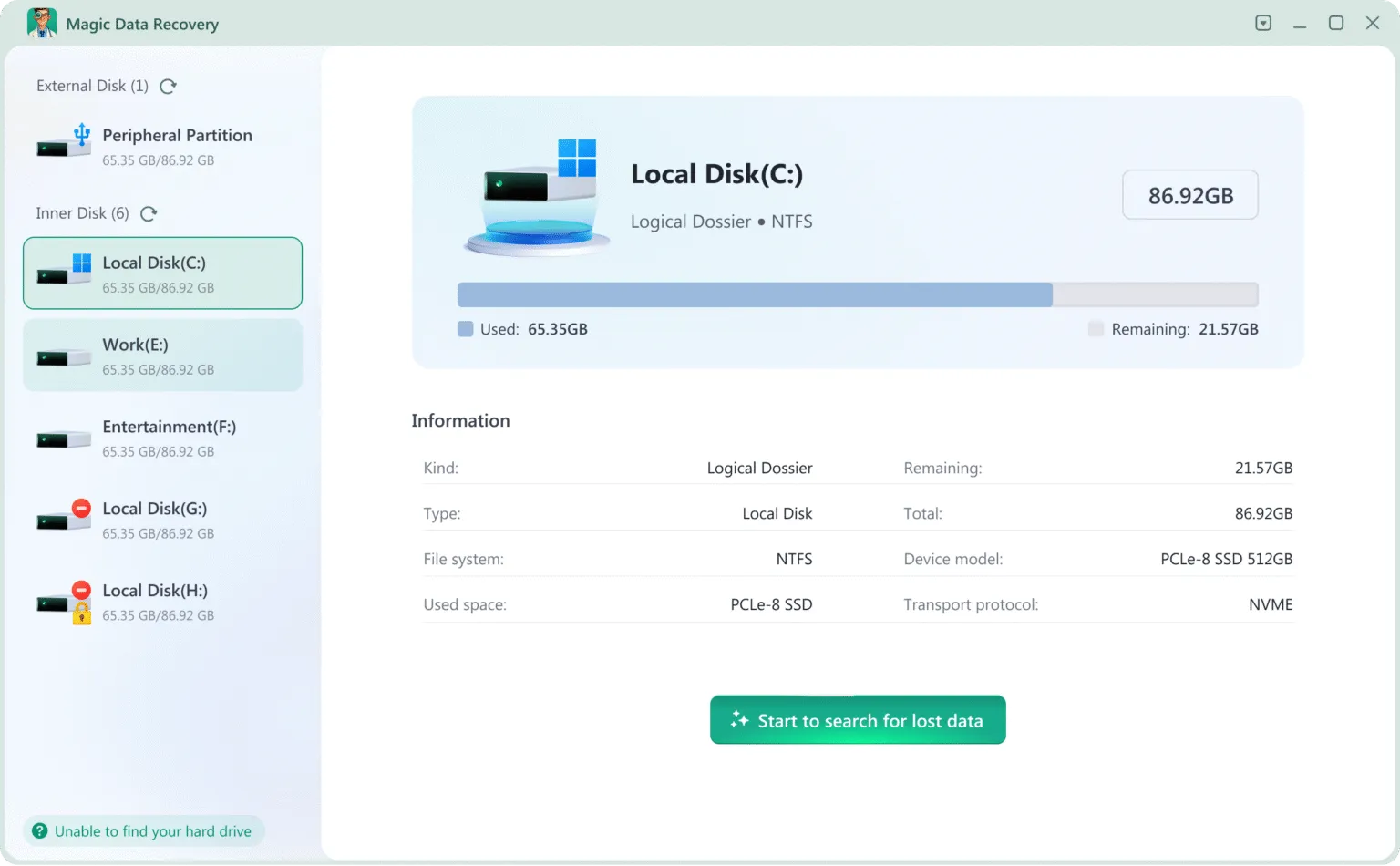
Magic Data Recovery runs on Windows and supports EXT2, EXT3, and EXT4 disks that Windows can detect as physical storage. It does not run directly inside Linux. Connect the Linux disk to a Windows PC through SATA, a USB enclosure, a docking station, or a suitable adapter. Then scan the EXT partition without formatting it.
Problems Magic Data Recovery Can Address
Magic Data Recovery provides a practical EXT4 recover files solution for:
- Accidentally deleted Linux files
- Formatted EXT4 partitions
- File system errors and inaccessible volumes
- Lost files after repartitioning or system reinstallation
- External Linux drives that no longer mount
- Disks removed from a NAS and connected directly to Windows
- Documents, photos, videos, archives, email data, and other supported formats
The program supports more than 5,000 file formats and presents scan results through a graphical workflow. It can search using file system information and recognizable file signatures, helping users review results without learning several recovery commands. Its official user guide lists EXT2/3/4 among the supported file systems.
Supports Windows 7/8/10/11 and Windows Server
How to Use Magic Data Recovery for EXT4
- Stop using the Linux disk and shut down the Linux computer.
- Remove the disk or disconnect the external drive.
- Connect it to a healthy Windows computer.
- Do not initialize, format, or repair the EXT4 disk when Windows prompts you.
- Install Magic Data Recovery on the Windows system drive or another healthy disk.
- Launch the program and select the physical Linux disk or EXT partition.
- Run the scan and allow it to examine the relevant storage space.
- Filter results by path, file type, size, or name when available.
- Preview important files to verify their content.
- Recover selected data to a different drive.
For more context on cross-platform recovery, read the Linux Data Recovery Guide. Detailed interface and compatibility information appears in the Magic Data Recovery User Guide.
Why This Option Can Be More Reliable for Ordinary Users
Reliability does not mean that any software can reverse overwritten sectors. It means the workflow reduces avoidable mistakes and matches more data-loss scenarios. Magic Data Recovery offers one interface for deletion, formatting, and logical file system problems. It also allows users to review recoverable files before saving them.
Consider a common case: an Ubuntu external HDD no longer mounts after a power interruption. extundelete may not suit damaged metadata, while PhotoRec may produce thousands of generically named files. Connecting the disk to Windows and scanning it with Magic Data Recovery gives a less technical EXT4 recover files workflow with filtering and preview.
If you are looking for a more efficient solution, try Magic Data Recovery before modifying the original partition.
EXT4 Recovery After Formatting, Corruption, or SSD TRIM
After Quick Formatting
A quick format replaces important file system structures but may leave parts of old file content until new data overwrites them. Stop using the drive and scan the entire affected area. Signature recovery may find files even when the old directory structure cannot be rebuilt. Repeated formatting, repartitioning, or new writes lower the chance of complete recovery.
After File System Corruption
If the volume fails to mount, first image the disk and copy any files that remain accessible. Run recovery scans against the image. Only consider fsck after important data has been extracted or the source has been cloned. Repair may restore access, but it can also alter or remove metadata that recovery tools would otherwise inspect.
On an EXT4 SSD
EXT4 can issue discard or TRIM commands for blocks that the file system no longer uses. Once the SSD processes discarded blocks, software recovery may become much harder or impossible. Shut down the system quickly and avoid mounting the volume.
An EXT4 recover files scan is still worth evaluating, but expectations should remain cautious.
Common Mistakes That Reduce EXT4 Recovery Success
Avoid these errors during any recover files EXT4 project:
- Continuing to boot and use the affected Linux installation
- Installing recovery tools on the same partition
- Recovering files back to the source disk
- Formatting because Windows cannot read EXT4
- Running repair commands before imaging valuable data
- Assuming TestDisk can undelete ordinary EXT4 files
- Scanning a physically failing disk repeatedly
- Writing a newly found partition table before copying files
- Expecting raw carving to preserve every name and folder
- Treating preview or file discovery as proof that every file is intact
A scan result is only a candidate list. Open recovered documents, test archives, play media from beginning to end, and verify important checksums when an original hash exists.
How to Verify Recovered EXT4 Files
After recovery, place the results on a healthy destination and check them before reusing the source disk.
- Open representative documents, spreadsheets, images, videos, and archives.
- Compare file sizes with known copies or application records.
- Check whether folder paths and names match expectations.
- Use sha256sum when you have previous checksums.
- Validate databases with their native integrity tools.
- Keep the source disk unchanged until verification is complete.
- Create at least one additional backup of critical recovered data.
This verification step separates a professional EXT4 recover files process from a simple “files found” claim. A file can have the correct name yet contain overwritten or incomplete data.
How to Prevent Future EXT4 Data Loss
Recovery is uncertain, so prevention should combine versioned backups, disk monitoring, and safer administrative habits.
- Follow the 3-2-1 backup principle for critical files.
- Keep versioned backups instead of one synchronized copy.
- Test restoration regularly.
- Use snapshots where they fit the workload, but do not treat snapshots as an off-device backup.
- Check scripts before running commands with wildcards or rm -rf.
- Use aliases or interactive safeguards carefully for manual deletion.
- Monitor SMART data and system logs for storage errors.
- Use a UPS for servers and storage systems sensitive to power loss.
- Document partition layouts before migrations or dual-boot changes.
- Keep recovery media and an empty destination drive available.
These practices make the next recover files EXT4 incident less urgent and may eliminate the need for reconstruction entirely.
Conclusion: The Safest Way to EXT4 Recover Files
The best EXT4 recover files method depends on what happened. Start with Trash or a verified backup. Copy files from /proc while a process still holds them open. Use extundelete for recent deletion, PhotoRec for raw recovery, and TestDisk for a missing partition. Image unstable disks before scanning, and never save recovered files to the source.
Magic Data Recovery is recommended when you need a clearer graphical workflow for an EXT2/3/4 disk and can connect that disk to Windows. It covers deletion, formatting, and logical file system errors in one interface, supports preview and filtering, and avoids the need to combine several command-line tools.
It cannot restore overwritten or physically destroyed data, but it provides a practical next step when free methods are unsuitable or too complex. For additional recovery planning and related solutions, return to the deleted file recovery hub.
Supports Windows 7/8/10/11 and Windows Server
FAQs About EXT4 Recover Files
Can I recover files deleted with rm from EXT4?
Yes, recovery may remain possible because rm usually removes the directory reference rather than instantly overwriting every data block. Stop using the partition, unmount it, and try extundelete for recent deletion or PhotoRec for signature-based recovery. Results depend on overwriting, journal availability, SSD discard behavior, and the condition of the storage device.
What is the best tool to recover deleted files from EXT4?
The best tool depends on the failure. Use extundelete for recent deletion on a healthy EXT4 partition, PhotoRec for raw recovery, and TestDisk for a missing partition. Magic Data Recovery suits users who can connect the EXT4 disk to Windows and want a graphical scan for deletion, formatting, or file system errors.
Can TestDisk recover deleted files from EXT4?
TestDisk is not the preferred tool for ordinary EXT4 undelete. Its documentation states that EXT3 and EXT4 may retain deleted names while losing the data-location information required for normal undelete. Use TestDisk primarily to find lost partitions and copy accessible files. For deleted content, consider extundelete, PhotoRec, or a compatible graphical recovery tool.
Can PhotoRec recover files from a formatted EXT4 drive?
PhotoRec can scan a formatted or corrupted EXT4 partition for known file signatures because it does not require a healthy directory tree. It may recover documents, media, archives, and other supported formats. However, it commonly assigns generic names and does not preserve the original folder structure, so expect additional sorting and integrity checks after recovery.
Does Magic Data Recovery run on Linux?
No. Magic Data Recovery runs on Windows. To scan an EXT4 disk, shut down Linux, connect the disk to a Windows computer, and select the detected physical drive or EXT partition. Do not format the disk when Windows prompts you. Recover the files to another healthy drive, not back to the original Linux storage device.
Can I recover files from an EXT4 SSD?
Possibly, but SSD recovery is less predictable. EXT4 may issue discard or TRIM requests for unused blocks, and the SSD can make discarded content unavailable to normal recovery software. Power down the system quickly, avoid remounting the partition, and evaluate the disk from another environment. Recent backups often provide the safest result for SSD data loss.
Should I run fsck before EXT4 file recovery?
Usually, copy accessible data and create a disk image before running fsck. File system repair aims to restore structural consistency and may change or remove metadata. Recovery tools may need that metadata to locate older files. Once important data is safely extracted or the disk is cloned, test repairs on the copy rather than risking the original source.
Where should recovered EXT4 files be saved?
Always save recovered files to a different physical disk or a verified network destination. Writing results to the original partition can overwrite additional recoverable content during the scan. Keep the source unchanged until you have opened representative files, validated important archives or databases, and created another backup of the recovered data.

Jason has over 15 years of hands-on experience in the computer data security industry. He specializes in data recovery, backup and restoration, and file repair technologies, and has helped millions of users worldwide resolve complex data loss and security issues.