Skip to content
amagicsoft logo icon
  • Home
  • Products
    • Magic Data Recovery
    • Magic Recovery Key
  • Store
  • Blog
  • More
    • About Amagicsoft
    • Contact US
    • Privacy Policy
    • Terms
    • License Agreement
    • Refund Policy
  • English
    • 日本語
    • 한국어
    • Deutsch
    • Français
    • 繁體中文
Wiki

Defragmentation

27.11.2025 Eddie Comments Off on Defragmentation
Defragmentation

Table of Contents

Disk Slowdowns Linked to Fragmentation

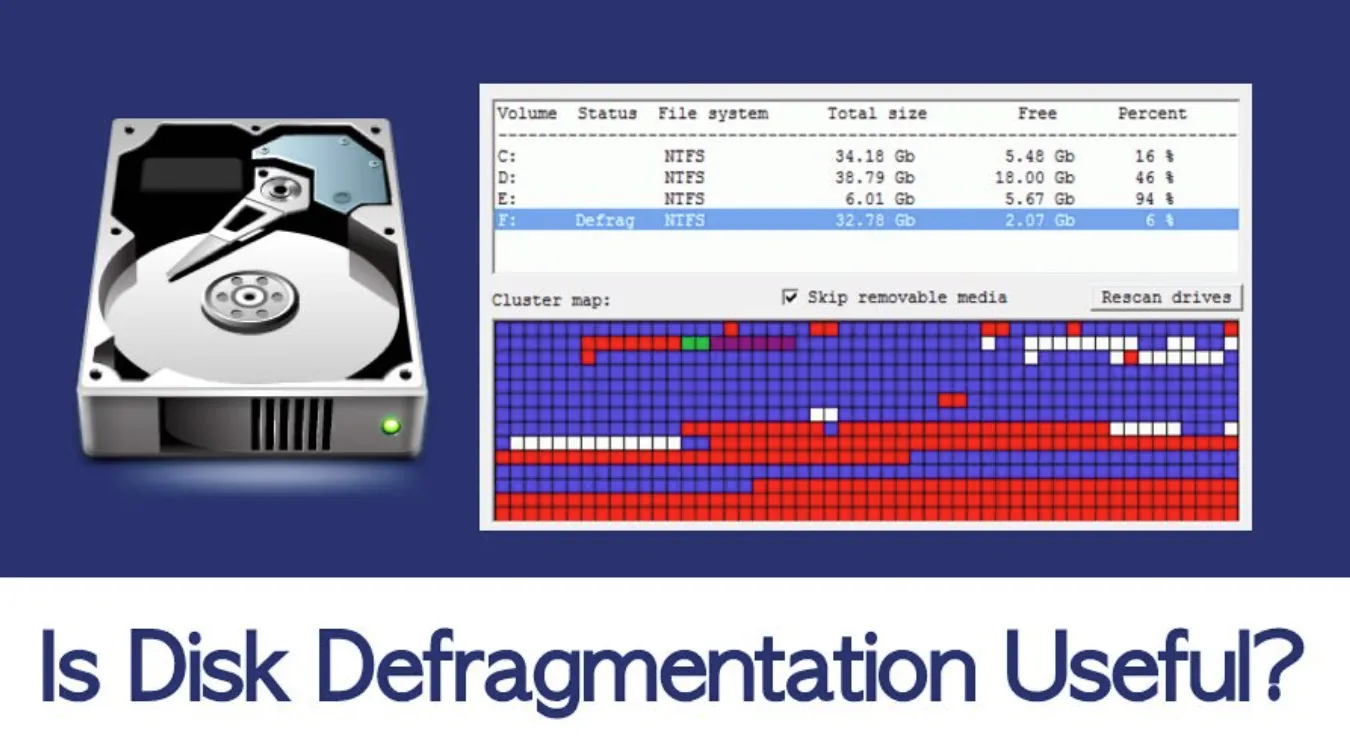
A computer that boots normally but opens folders slowly or pauses during large copies often suffers from fragmentation on its hard drive.
The operating system still reads the same files, yet it must jump between many separate locations on the platters.

On mechanical HDDs, this extra movement wastes seek time and produces stutter, noise, and latency.
Defragmentation rearranges those scattered pieces into a more orderly layout.
How Files Become Fragmented on a Hard Drive

An HDD stores data in fixed-size sectors and clusters across spinning platters.
When you create, modify, and delete files, free space breaks into many small gaps instead of one large region.

New or growing files then occupy multiple noncontiguous clusters:

  • The file system allocates space wherever it finds a gap.

  • Large files split into many fragments over time.

  • Head movement increases as the drive seeks each fragment.

The data itself stays intact, but access patterns become less efficient.

Defragmentation on Mechanical HDDs

Defragmentation takes fragmented files and rewrites them into contiguous clusters.
The process tries to compact related data and reduce the distance between frequently accessed areas.

A typical defrag cycle:

  1. Analyzes current fragmentation on the selected volume.

  2. Identifies fragmented files and suitable destination regions.

  3. Copies data into new contiguous space and updates file system metadata.

  4. Frees the old scattered clusters for future use.

After a successful pass, the heads perform fewer seeks during normal workloads, which improves access time for many HDDs.

Why SSDs Require a Different Approach

Solid-state drives do not rely on spinning platters or moving heads.
They access flash memory cells electronically with near-uniform seek times.

Heavy defragmentation offers almost no performance gain on SSDs, and it adds unnecessary write cycles.
Modern operating systems therefore:

  • Run TRIM and optimization tasks instead of classic defrag for SSD volumes.

  • Leave logical fragmentation largely untouched.

  • Focus on internal flash management and wear-leveling.

You should let Windows handle SSD maintenance automatically instead of scheduling manual defrag jobs for those drives.

Performance, Wear, and Data Safety Considerations

Defragmentation reads and writes a large volume of data.
On a healthy HDD, that extra I/O creates temporary load but no lasting damage.

On a marginal drive with growing bad sectors or unusual noises, defrag can accelerate failure or expose hidden weakness.
When you suspect physical problems, you should treat defrag as a last step, not an early optimization.

Good practice:

  • Run SMART checks before long maintenance operations.

  • Avoid defrag on drives that show frequent I/O errors.

  • Focus on backup and data recovery first, then on layout optimizations.

Preparation Checklist Before Defragmenting

Before you launch any defragmentation job, take a few minutes to prepare the system.

Recommended checklist:

  • Confirm that the volume resides on an HDD, not an SSD.

  • Back up critical files to another drive or network location.

  • Close large applications, virtual machines, and active databases.

  • Check available free space; defrag needs room to move data.

  • Review SMART attributes for warning signs of hardware trouble.

This routine reduces the chance of data loss if a disk fails during heavy I/O.

Running Defrag in Windows: Practical Steps

Windows includes a built-in tool for defragmentation on HDDs.
You can access it from the graphical interface and schedule regular runs for suitable volumes.

  1. Open Start and search for Defragment and Optimize Drives.

  2. Select the HDD volume you want to optimize.

  3. Check the Media type column to confirm you target a hard disk, not an SSD.

  4. Click Analyze to see the current fragmentation level.

  5. Select Optimize to run defragmentation on that drive.

  6. Optionally configure a schedule that includes only HDDs.

During the process, you can continue light tasks, but you should avoid heavy writes on the same drive.

Defragmentation and Data Recovery with Amagicsoft

Defragmentation changes where data lives on the disk.
When you run it after accidental deletion or corruption, you increase the chance of overwriting remnants that recovery tools could still read.

A safer sequence for data-focused work:

  1. Pause plans for defrag if you lost important files or partitions.

  2. Use a dedicated tool such as Amagicsoft Data Recovery to scan the affected drive.

  3. Recover needed data to a separate physical disk.

  4. Verify that recovered files open correctly.

  5. Only then consider defragmentation or a full volume rebuild.

Amagicsoft Data Recovery reads sectors in a controlled, read-only manner and reconstructs files from existing structures.
After you secure your data, layout optimization becomes far less risky.

Supports Windows 7/8/10/11 and Windows Server.

Closing Notes on Modern Defragmentation

Defragmentation still matters for busy HDDs that handle large files, archives, and project folders.
On those drives, a careful defrag cycle can shorten load times and reduce mechanical wear.

SSDs, in contrast, rely on internal firmware and logical optimization rather than classic defrag.
By distinguishing between disk types and prioritizing data protection, users gain performance improvements without sacrificing recoverability.


Download Magic Data Recovery

Supports Windows 7/8/10/11 and Windows Server

 FAQ

What is defragmentation in computer?

Defragmentation reorganizes scattered file fragments on a hard disk into contiguous sequences. The process reduces head movement and improves average read and write times on mechanical drives. Users typically run defrag on HDD volumes that store large projects, games, or archives after heavy installation, update, or delete activity.

Should I defrag my SSD?

Manual defragmentation offers almost no benefit on SSDs and creates extra write cycles. Modern versions of Windows detect SSDs and schedule optimization tasks that focus on TRIM and internal maintenance instead. You should leave those defaults in place and avoid third-party tools that run full, traditional defrag operations on solid-state drives.

What is an example of defragmentation?

A common example appears on a workstation with a busy project drive. After months of editing large video files, the HDD slows noticeably. Running Defragment and Optimize Drives on that specific volume rearranges those fragmented clips into contiguous clusters, which shortens seek times and smooths playback and export operations.

Does defragging speed up PC?

Defragging can improve performance on HDD-based systems, especially when fragmentation affects frequently used files and folders. Boot times, application launches, and sequential reads often benefit most. On SSD-based systems, you rarely see a speed gain because access times already stay low and the hardware does not rely on head movement.

Do newer computers need to be defragmented?

Newer computers with SSD-only storage usually do not need classic defragmentation. Windows handles SSD optimization automatically through scheduled maintenance. Systems that still use mechanical HDDs for data storage can benefit from periodic defrag, but only when you confirm disk health and run the operation at appropriate intervals.

Is defragging the same as disk cleanup?

Defragging rearranges data on the disk to reduce fragmentation, while disk cleanup removes unnecessary files. Cleanup targets temporary files, caches, and old installers to free space. Defrag focuses on layout and access patterns. Using both together on HDDs often gives better results than running either task alone.

Why don't we need to defrag anymore?

Many users no longer notice defrag because SSDs and modern storage design changed performance characteristics. SSDs deliver fast random access regardless of fragmentation, and operating systems schedule background optimization automatically. Mechanical drives still benefit from defrag, but they appear less often in everyday desktops that rely on solid-state storage for primary workloads.

Is 1TB of SSD overkill?

A 1TB SSD suits many modern use cases, particularly when you store games, virtual machines, or media libraries. The capacity allows fast access to large datasets and reduces reliance on slower external drives. For light office or web-only usage, smaller SSDs work, but additional space provides flexibility as software and files grow.

What are the disadvantages of defragmentation?

Defragmentation consumes time, CPU, and disk I/O, especially on large HDDs. On weak or failing drives, the heavy read and write activity can expose new bad sectors or trigger complete failure. During the operation, power loss and crashes also create risk, so you should back up important data before long defrag cycles.

What are the signs I need to defragment?

Signs include slow folder browsing on HDDs, longer application launch times, and noticeable delays when opening large projects. Analysis in Defragment and Optimize Drives may show high fragmentation percentages on work volumes. When the drive passes hardware checks and holds sufficient free space, a defrag pass often helps reduce those specific delays.
  • WiKi
Eddie

Eddie is an IT specialist with over 10 years of experience working at several well-known companies in the computer industry. He brings deep technical knowledge and practical problem-solving skills to every project.

文章导航

Previous
Next

Search

Categories

  • Bitlocker Recovery
  • Deleted File Recovery
  • Format File Recovery
  • Hard Drive Recovery
  • License Key Recovery
  • Lost File Recovery
  • Memory Card Recovery
  • News
  • Photo Recovery
  • SSD Recovery
  • Uncategorized
  • USB Drive Recovery
  • User Guide
  • Wiki

Recent posts

  • The Pros and Cons of SSDs as External Hard Drives
    The Pros and Cons of SSDs as External Hard Drives
  • How to Use Target Disk Mode and Share Mode on Mac Computers
    How to Use Target Disk Mode and Share Mode on Mac Computers: A Complete Guide
  • Duplicate File Finder
    Duplicate File Finder

Tags

How to Magic Data Recovery Magic Recovery Key WiKi

Related posts

Duplicate File Finder
Wiki

Duplicate File Finder

02.12.2025 Eddie No comments yet

Table of Contents Duplicate Files Are Not Real Backups Many users keep “extra safety” copies of documents by dragging them into new folders or external drives.Over time, these copies multiply and turn into clutter rather than protection. Duplicate files waste storage, slow backups, and make data recovery more confusing.A Duplicate File Finder helps identify redundant copies so […]

Context Switch
Wiki

Context Switch

02.12.2025 Eddie No comments yet

Table of Contents CPU Time as a Shared Resource Modern operating systems juggle dozens or hundreds of active threads.Only a few CPU cores exist, so most threads wait in queues while a small subset runs. A context switch lets the scheduler pause one running thread and resume another.This rapid switching creates the illusion of parallelism […]

Data Acquisition
Wiki

Data Acquisition

02.12.2025 Eddie No comments yet

Table of Contents  Incident Scene: Data at Risk Before Collection When an incident occurs, the first instinct often involves “looking around” the live system.Unplanned clicks, root logins, or file copies can alter timestamps, logs, and unallocated space before anyone records a clean state. Data acquisition solves this problem.It focuses on collecting data in a controlled […]

amagicsoft logo icon

Our vision is to become a globally renowned software brand and service provider, delivering top-tier products and services to our users.

Products
  • Magic Data Recovery
  • Magic Recovery Key
Policy
  • Terms
  • Privacy Policy
  • Refund Policy
  • License Agreement
Company
  • About Amagicsoft
  • Contact US
  • Store
Follow Us

Copyright © 2025 Amagicsoft. All Rights Reserved.

  • Terms
  • Privacy Policy