
MFT Master File Table: Fix Errors & Recovery Guide
When a hard drive suddenly turns RAW or shows the error “File record segment is unreadable,” the root cause often involves the MFT Master File Table. At first glance, the problem appears catastrophic. Files disappear, folders become inaccessible, and Windows may even suggest formatting the disk.
However, formatting or repairing the drive immediately is not always the best decision. In fact, acting too quickly can reduce recovery success. Therefore, understanding how the MFT works—and how to approach corruption safely—becomes essential.
In this guide, you will learn what the Master File Table is, how it functions inside NTFS, what causes damage, and how to fix errors step by step. More importantly, you will discover why recovering files before repair often protects your data more effectively.
Table of Contents
What Is the MFT Master File Table in NTFS?
The MFT is the core database of the NTFS file system. In simple terms, it acts as a master index for every file and folder stored on the drive.
Whenever you open, edit, or delete a file, NTFS references the MFT to locate the corresponding data clusters. Without this structure, Windows cannot match file names to physical disk locations.
Specifically, each MFT record stores:
- File name
- Timestamps
- Permissions
- File size
- Cluster mapping information
Because NTFS uses this structured database model, it offers better reliability than FAT systems. However, when the MFT becomes corrupted, access issues arise immediately.
How the MFT Master File Table Works
MFT Record Structure
Each file typically has a 1024-byte record inside the MFT. This record contains multiple attributes, such as:
- $STANDARD_INFORMATION
- $FILE_NAME
- $DATA
For small files, NTFS may store the content directly inside the MFT record. In contrast, larger files store references to external clusters. As a result, NTFS balances speed and storage efficiency.
The Role of $MFTMirr
In addition, NTFS maintains a backup called $MFTMirr. This mirror keeps a copy of essential entries from the beginning of the MFT.
If minor corruption occurs, the system may rebuild critical metadata using this mirror. However, severe corruption usually requires manual repair or data recovery tools.
What Causes MFT Master File Table Corruption?
Although NTFS is robust, several real-world scenarios can damage the MFT.
Common Causes
First, sudden power loss interrupts write operations.
Second, unsafe shutdowns may leave incomplete metadata entries.
Third, bad sectors can physically affect MFT storage areas.
Additionally, malware may alter file system structures.
Finally, interrupted cloning processes often corrupt metadata tables.
For example, if cloning stops midway, NTFS may not complete MFT entries. Consequently, the partition may appear as RAW.
Typical Symptoms
When the Master File Table becomes damaged, you may notice:
- RAW partition status
- “File record segment is unreadable”
- Missing files or folders
- Windows prompting to format the disk
Importantly, these symptoms do not always mean data is permanently lost. Instead, metadata corruption prevents proper access.
How to Fix MFT Master File Table Errors Step by Step
Repairing the MFT requires a structured approach. Otherwise, you may accidentally overwrite recoverable data.
Recover Data Before Repair
Before attempting any fix, consider whether the disk contains important files. If it does, recovering them first is safer.
Why does this matter?
- CHKDSK may remove damaged entries.
- Repair processes may rewrite metadata.
- Repeated scans may stress unstable sectors.
Therefore, securing data first reduces long-term risk.
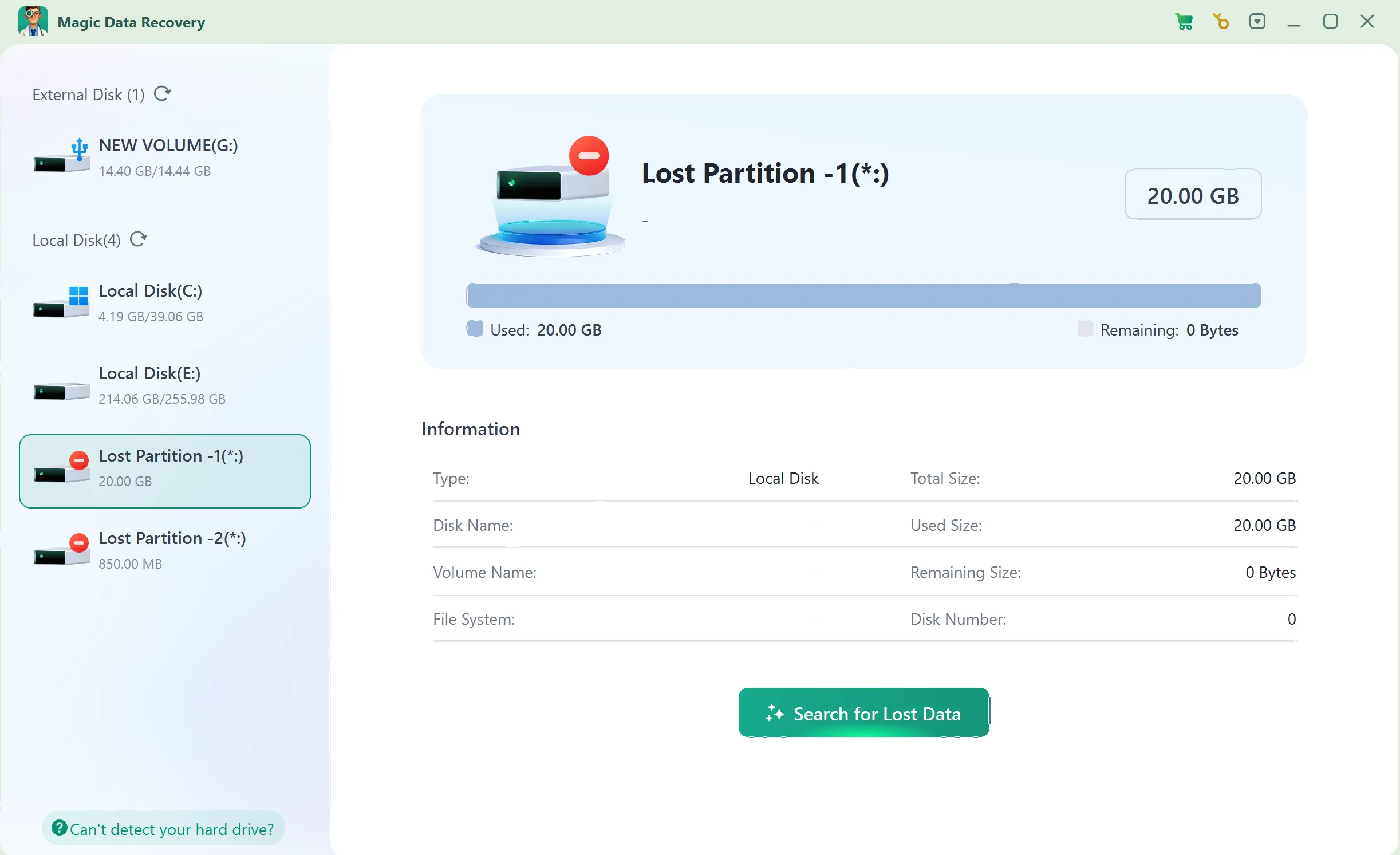
Use Magic Data Recovery Before Repair
Instead of immediately repairing the MFT, start by extracting your files.
Magic Data Recovery addresses key problems:
- RAW NTFS partitions
- Logical MFT corruption
- Accidental formatting
- Inaccessible drives
Why This Approach Works
Unlike traditional repair utilities, Magic Data Recovery focuses on file extraction rather than structural modification. As a result, it minimizes additional damage.
Moreover, it provides:
- Deep scanning beyond intact MFT records
- File preview before saving
- Recovery to a separate drive
- Support for NTFS logical corruption
For instance, after a power outage damages the Master File Table, you can scan the disk, preview files, and save them externally. Only afterward should you attempt repair.
If you need a safer workflow, try Magic Data Recovery before running repair commands.
Step 1: Run CHKDSK
After data recovery, run:
chkdsk X: /f /r/f parameter fixes logical errors.Meanwhile, /r scans for bad sectors.
However, run this step only after securing important files.
Step 2: Use Windows Recovery Environment
If CHKDSK does not resolve the issue, boot into WinRE. Then, attempt startup repair or system restore. In some cases, these tools stabilize the master file table when corruption remains limited.
Can You Recover Data Without an Intact MFT Master File Table?
Yes, recovery remains possible in many cases. When the MFT fails, file carving techniques can identify data by signature patterns. However, original folder structures may not be preserved.
Therefore, early recovery improves results significantly. Additionally, disk health plays a major role. If physical damage exists, software recovery may not succeed.
MFT vs FAT: Why the MFT Master File Table Matters
Feature | NTFS (MFT Master File Table) | FAT |
Structure | Database-based | Table-based |
Journaling | Yes | No |
Reliability | Higher | Lower |
Metadata support | Advanced | Basic |
Because NTFS relies on the MFT, it supports journaling and advanced metadata. Consequently, it offers stronger reliability. Nevertheless, corruption requires careful handling.
Conclusion
The MFT Master File Table forms the backbone of NTFS. When corruption occurs, Windows loses access to file metadata even though the data itself may still exist. Although repair tools can sometimes restore structure, they may also modify entries. Therefore, recovering files before repair provides a safer and more professional workflow.
Magic Data Recovery supports this strategy by extracting files from damaged or RAW NTFS partitions before structural changes begin. Because it prioritizes data safety, it offers a more controlled solution when handling MFT errors.
If you encounter MFT corruption, secure your files first. Then proceed with repair confidently and strategically.
Supports Windows 7/8/10/11 and Windows Server
FAQs About the MFT Master File Table
What does MFT stand for?
How large can the MFT grow?
Can the MFT be deleted?
Does formatting rebuild the MFT?
Can CHKDSK repair MFT corruption?
Is data recoverable without MFT metadata?
Should I repair or recover first?

Vasilii is a data recovery specialist with around 10 years of hands-on experience in the field. Throughout his career, he has successfully solved thousands of complex cases involving deleted files, formatted drives, lost partitions, and RAW file systems. His expertise covers both manual recovery methods using professional tools like hex editors and advanced automated solutions with recovery software. Vasilii's mission is to make reliable data recovery knowledge accessible to both IT professionals and everyday users, helping them safeguard their valuable digital assets.