
How to Find Windows Server Product Key on Server 2016, 2019, 2022 & 2025
If you need to find Windows Server product key for reinstallation, activation, license audit, or server migration, there are several safe ways to check it. Depending on how your server was licensed, you may be able to retrieve the Windows Server product key using CMD, PowerShell, Registry Editor, Microsoft account records, or a dedicated Windows Server product key finder.
This guide covers practical methods for Windows Server 2016, 2019, 2022, and 2025. If built-in commands only show a partial key or return a blank result, Magic Recovery Key can help scan stored license keys from the local server or an external system drive.
Supports Windows 7/8/10/11 and Windows Server
Table of Contents
Quick Answer: Best Ways to Find a Windows Server Product Key
The fastest way to find a Windows Server product key is to run Command Prompt as administrator and use the WMIC command. However, this only works when the key is stored in BIOS, UEFI, or the local licensing service. If CMD returns a blank result, check the Registry, review purchase records, sign in to your Microsoft or volume licensing account, or use a Windows Server product key finder such as Magic Recovery Key.
| Method | Best For | Works for Full Key? | Difficulty |
|---|---|---|---|
| CMD | OEM or digitally stored keys | Sometimes | Easy |
| PowerShell | OEM or digitally stored keys | Sometimes | Easy |
| Registry | Stored BackupProductKeyDefault value | Sometimes | Medium |
| slmgr command | Checking license status and last 5 characters | No | Easy |
| Microsoft account or volume licensing portal | Retail, MAK, or volume license purchases | Yes | Medium |
| Magic Recovery Key | Lost keys, old servers, external drives, non-bootable systems | Often | Easy |
Before You Start: Know What Type of Windows Server License You Have
Before you try to find a Windows Server product key, identify how the server was licensed. This helps you choose the right recovery method and avoid wasting time on commands that may return a blank result.
Retail or OEM license: The key may be stored locally, printed on a Certificate of Authenticity label, included in purchase materials, or saved in a confirmation email.
Volume license: The key may be managed through Microsoft volume licensing, MAK activation, or KMS activation. In this case, built-in commands may not show the original full key.
Digital or embedded key: Some systems store the key in BIOS, UEFI, or the software licensing service. CMD or PowerShell may retrieve it, but results are not guaranteed.
For volume licensing, Microsoft notes that volume license product keys are intended for licensed organizational use and can be found through Microsoft’s volume licensing management channels.
How to Find Windows Server Product Key: 7 Effective Methods
Method 1: Find Windows Server Product Key Using CMD
If you want to find Windows Server product key using CMD, start with the WMIC command. This method is fast and does not require third-party software, but it only works when the key is stored in the system’s licensing service or embedded in firmware.
Steps:
- Press Start and type cmd.
- Right-click Command Prompt and choose Run as administrator.
- Enter the following command:
wmic path softwareLicensingService get OA3xOriginalProductKey
- If the key is available, CMD will display a 25-character Windows Server product key.
If the command returns a blank result, it does not always mean your server is not licensed. It usually means the full product key is not stored in a location that CMD can read. This is common with volume licensing, KMS activation, or some upgraded systems.
Method 2: Find Windows Server Product Key in Registry
You can also check the Windows Registry for a stored Windows Server license key. This method is useful when you need to find Windows Server 2019 product key in registry or check whether a backup product key value exists.
Steps:
- Press Win + R, type regedit, and press Enter.
- Go to this path:
HKEY_LOCAL_MACHINE\SOFTWARE\Microsoft\Windows NT\CurrentVersion\SoftwareProtectionPlatform
- Look for the value named BackupProductKeyDefault.
- If available, the value may show a Windows Server product key.
You can also check the same value using CMD:
reg query "HKLM\SOFTWARE\Microsoft\Windows NT\CurrentVersion\SoftwareProtectionPlatform" /v BackupProductKeyDefault
Important: The Registry does not always store the full original key. On some systems, it may show a generic key, an old key, or no readable key at all. Do not change or delete Registry values unless you know exactly what they do.
Method 3: Find Windows Server Product Key Using PowerShell
PowerShell can read the same licensing value as CMD. It is useful if you prefer PowerShell or if Command Prompt is restricted on the server.
Steps:
- Right-click Start and select Windows PowerShell (Admin) or Terminal (Admin).
- Run this command:
(Get-WmiObject -query 'select * from SoftwareLicensingService').OA3xOriginalProductKey
- If the key is stored locally, PowerShell will display the Windows Server product key.
If PowerShell returns no result, try the Registry method, check your Microsoft or volume licensing account, or use a product key finder tool.
Method 4: Check Windows Server License Status with slmgr
The slmgr command cannot usually reveal the full Windows Server product key, but it can help you check activation status, license type, and the last part of the installed key.
Open Command Prompt as administrator and run:
slmgr /dli
For more detailed license information, run:
slmgr /dlv
To check whether Windows Server is permanently activated, run:
slmgr /xpr
This method is useful when you need to confirm whether the server is activated before reinstalling, upgrading, or migrating. If you only see the last 5 characters of the key, use purchase records, volume licensing records, or Magic Recovery Key to locate the full key.
Method 5: Use a Windows Server Product Key Finder
If CMD, PowerShell, and Registry do not show the full key, a Windows Server product key finder can save time. Magic Recovery Key is designed to locate Windows and Windows Server license keys, as well as product keys for Microsoft Office, SQL Server, Adobe, PDF tools, and many other programs.
This method is especially useful when:
You inherited a server without purchase records.
The server is old and the original license document is missing.
CMD only shows a blank result.
You need to scan an external system drive from a non-bootable server.
You want to export and back up license keys before reinstalling Windows Server.
Step-by-Step:
1. Download & Install: Get it from amagicsoft.com (supports Windows Server/desktop OS).
Supports Windows 7/8/10/11 and Windows Server
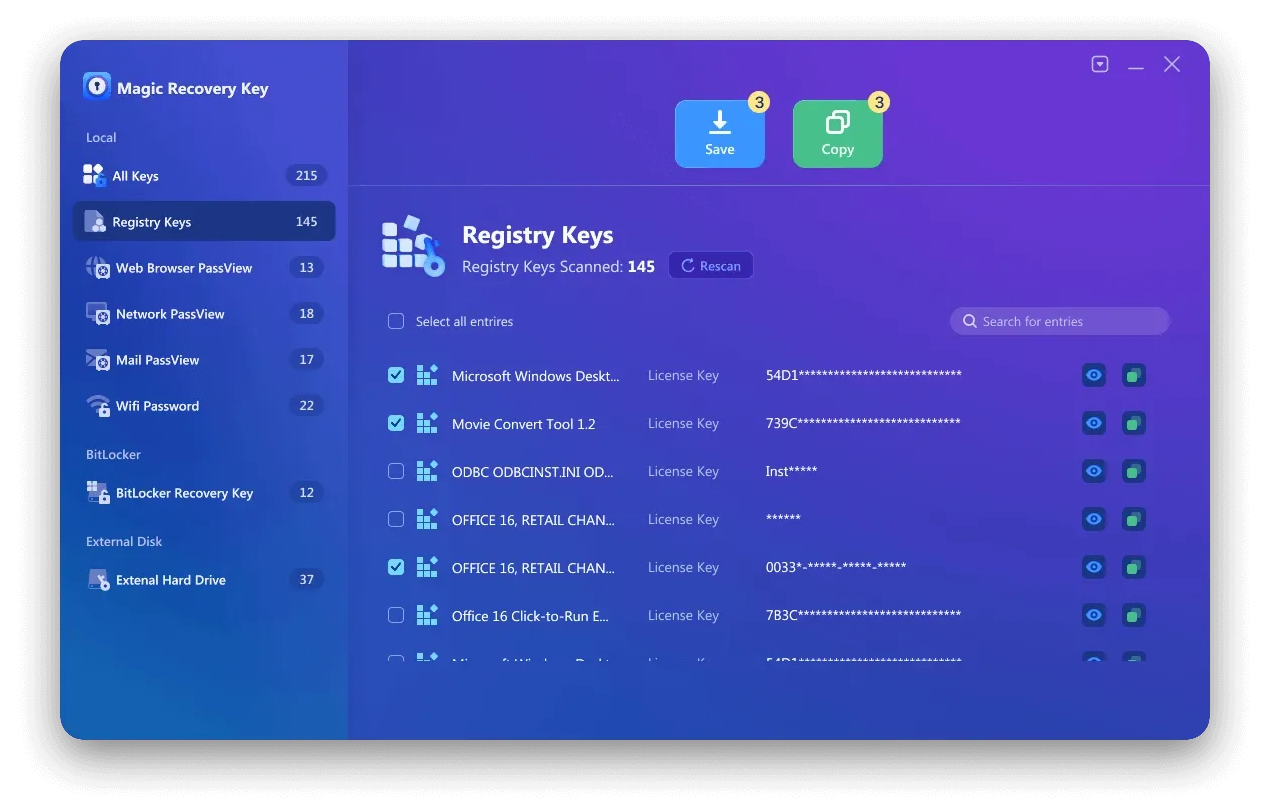
2. Scan for Keys: Launch the tool > Under “Local,” click “Registry Keys” (scans for stored product keys in 10–30 seconds).

3. Copy/Save: Select the “Microsoft Windows Server [Version]” entry > Click “Copy” (to clipboard) or “Save” (as a text file).
Note: Magic Recovery Key helps retrieve keys stored on systems you own or are authorized to manage. It does not generate free Windows Server product keys or bypass Microsoft licensing.
Method 6: Check Purchase Records, COA Label, or Microsoft Account
If you purchased Windows Server as a retail license, OEM license, or digital download, the product key may be available outside the server itself.
Check these places first:
Physical package: Look for a Certificate of Authenticity label, product key card, DVD sleeve, or purchase document.
Email receipt: Search your inbox for terms such as “Windows Server product key,” “Windows Server license key,” “Microsoft order,” or “activation key.”
Microsoft account: If the license was purchased or linked online, sign in to the account used for the purchase and check order history or services.
OEM server vendor: If Windows Server came with Dell, HP, Lenovo, or another server, check the original invoice, service tag records, or vendor license documents.
This method is often the safest option because it gives you the original purchased key instead of a key stored or converted by the operating system.
Method 7: Find Windows Server Product Key from Volume Licensing, KMS, or MAK
If your organization uses volume licensing, the full Windows Server product key may not be recoverable through CMD, PowerShell, or Registry. Many Windows Server systems are activated by MAK or KMS, and the locally installed key may be a generic volume license key rather than the original purchased key.
What to check:
Microsoft 365 admin center or volume licensing portal
Your organization’s license agreement records
The IT administrator who manages KMS or MAK activation
Microsoft Volume License support
Server purchase documents from your reseller or OEM vendor
If the server uses KMS activation, do not treat the local GVLK as your purchased product key. KMS client setup keys are used to activate volume licensing editions through a KMS host and are not the same as a unique retail product key.
How to Fix “The Product Key You Entered Didn’t Work” 0xc004f050
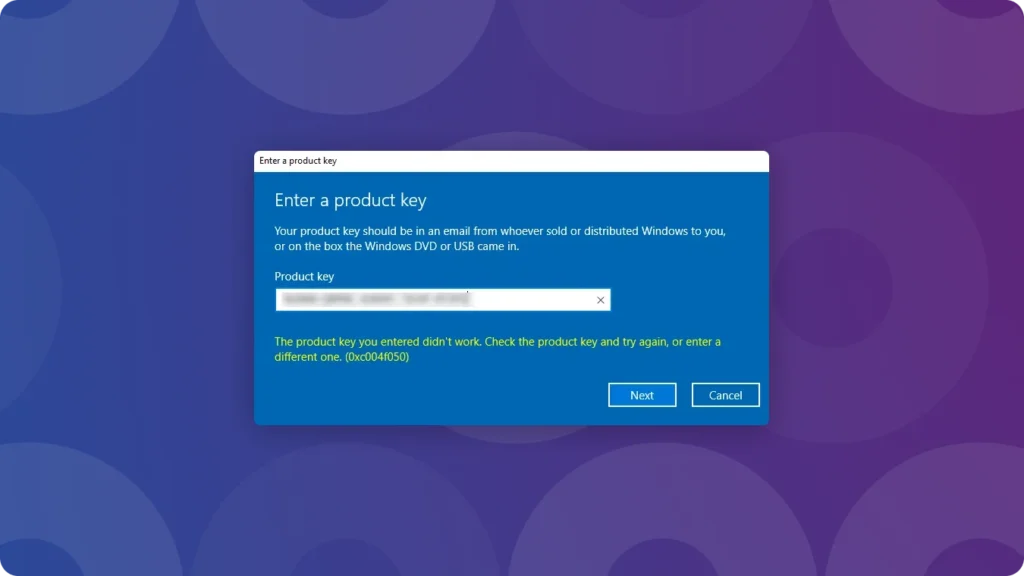
If you see the error “The product key you entered didn’t work” with code 0xc004f050, the key may not match the Windows Server edition installed on the machine, or it may not be a valid key for that activation scenario. Microsoft explains that 0xc004f050 can appear when a product key cannot be used to activate Windows.
Try these fixes:
Check the edition: Make sure the key matches Windows Server Standard, Datacenter, Essentials, or the installed edition.
Check the version: A Windows Server 2016 key cannot always activate a different Windows Server version.
Avoid public “free keys”: Generic or leaked keys may fail activation and can create licensing risks.
Confirm volume licensing: If your company uses KMS or MAK activation, contact your license administrator.
Retrieve the original key: Use purchase records, Microsoft licensing records, or Magic Recovery Key if the key was stored on your server.
Contact Microsoft or your reseller: If you purchased a valid license but activation still fails, provide your order ID, agreement number, or invoice.
Final Tips: Back Up Your Windows Server License Key Safely
Once you find your Windows Server product key, save it before making system changes. Server reinstallations, motherboard replacements, migrations, and failed drives can make key recovery harder later.
Recommended practices:
Save the product key in an encrypted password manager.
Keep a secure offline backup for IT administrators.
Record the Windows Server version, edition, purchase date, and license type.
Do not store the only copy of the key on the same server.
For businesses, maintain a license inventory for Windows Server, SQL Server, Office, Adobe, and other paid software.
Before reinstalling or replacing a server drive, run Magic Recovery Key to export available license keys from the system.
Supports Windows 7/8/10/11 and Windows Server
FAQs
What does 0xc004f050 mean when activating Windows Server?
Does Magic Recovery Key work on non-bootable servers?
Is using Magic Recovery Key legal?
What versions of Windows Server does Magic Recovery Key support?
Can I find a Windows Server key from a Volume Licensing account?
Will checking the registry always show my Windows Server product key?
Is the PowerShell method reliable for all Windows Server licenses?
What should I do if I can’t find my product key online or in email receipts?
Can I find Windows Server 2016 product key using CMD?
Can I find Windows Server 2019 product key in Registry?

Erin Smith is recognized as one of the most professional writers at Amagicsoft. She has continually honed her writing skills over the past 10 years and helped millions of readers solve their tech problems.