
SSD Data Recovery: What Can Be Recovered?

SSD data recovery has become increasingly important as solid-state drives replace traditional hard disk drives in laptops, desktops, gaming systems, and business environments. Although SSDs offer exceptional speed, reliability, and energy efficiency, they are still vulnerable to data loss caused by accidental deletion, formatting, partition corruption, firmware issues, malware attacks, and unexpected hardware failures.
Unlike conventional hard drives, SSDs use NAND flash memory and advanced technologies such as TRIM, garbage collection, and wear leveling to optimize performance. While these features improve speed and lifespan, they can also make recovering lost files from SSDs more challenging. As a result, many users mistakenly believe that once data is deleted from an SSD, it is gone forever.
The good news is that SSD data recovery is still possible in many situations, especially when you need to recover files from a RAW partition, or recover information from an SSD that is no longer accessible. This guide explains how SSD recovery works, the impact of TRIM on recoverability, and the most effective methods for restoring lost data. For users looking for a reliable recovery solution, Magic Data Recovery provides specialized tools designed to recover files from SSDs safely and efficiently.
Supports Windows 7/8/10/11 and Windows Server
Table of Contents
SSD Data Recovery After Deletion or Formatting: Why It’s Difficult
Many users hope to restore files after accidental deletion or formatting, but SSD recovery is not as straightforward. This is mainly due to the TRIM command.
- What TRIM Does: TRIM is designed to optimize SSD performance by automatically clearing unused blocks.
- Impact on Recovery: Once TRIM has been executed, the chances of recovering deleted files become extremely low because the data blocks are overwritten.
This means that in most cases, recovering files after deletion or formatting on an SSD is not possible, unlike with traditional HDDs. But for very small files (around 1-2KB) like text documents, a successful recovery is often still possible. This is because they can be stored entirely within the file system’s record, so if you attempt the recovery quickly, the data can be retrieved.
How to Check if TRIM is Enabled on Your SSD
Since TRIM plays a critical role in SSD Data Recovery, it’s important to know whether it’s enabled on your system. Here’s how you can check in Windows:
1.Open Command Prompt: Click Start menu, type cmd, then right-click and choose Run as administrator.

2.Enter the Command: Type the following and press Enter:
fsutil behavior query DisableDeleteNotify

3.Read the Result:
- If you see DisableDeleteNotify = 0, TRIM is enabled.
- If you see DisableDeleteNotify = 1, TRIM is disabled.
For more details, you can refer to the official Microsoft guide:
👉 Check TRIM Status using fsutil command (Microsoft Docs)
If TRIM is enabled, chances of recovering deleted or formatted data are extremely low.
SSD Data Recovery for Logical Errors and Solutions
While recovering deleted files from an SSD is challenging, data loss is often not permanent. Many SSD failures are caused by logical errors, including:
- File system corruption
- A damaged partition table
- Drive corruption from sudden power loss
In these scenarios, a successful SSD data recovery is far more likely.
Using CHKDSK (With Caution)
One commonly suggested fix for SSD errors is running CHKDSK (Check Disk) in Windows.
- How It Works: CHKDSK scans the drive for errors and attempts to repair corrupted file systems.
- Risks: While CHKDSK may restore access to the drive, it can also lead to further data loss, especially if file structures are already damaged.
For this reason, CHKDSK should only be used when you are prepared to risk losing some files.
Safe and Reliable ssd data recovery with Magic Data Recovery
For users who want a safer and more reliable solution, Magic Data Recovery offers a powerful yet easy-to-use option.
- User-Friendly: No technical expertise required—just install, scan, and recover.
- Secure: Unlike risky command-line tools, it performs a read-only scan to ensure your original data is never altered or damaged during the recovery process.
- Versatile: Supports recovery from SSDs, HDDs, USB drives, memory cards, and more.
- Efficient: Scans deeply for lost and inaccessible partitions, ensuring the highest recovery rate possible.
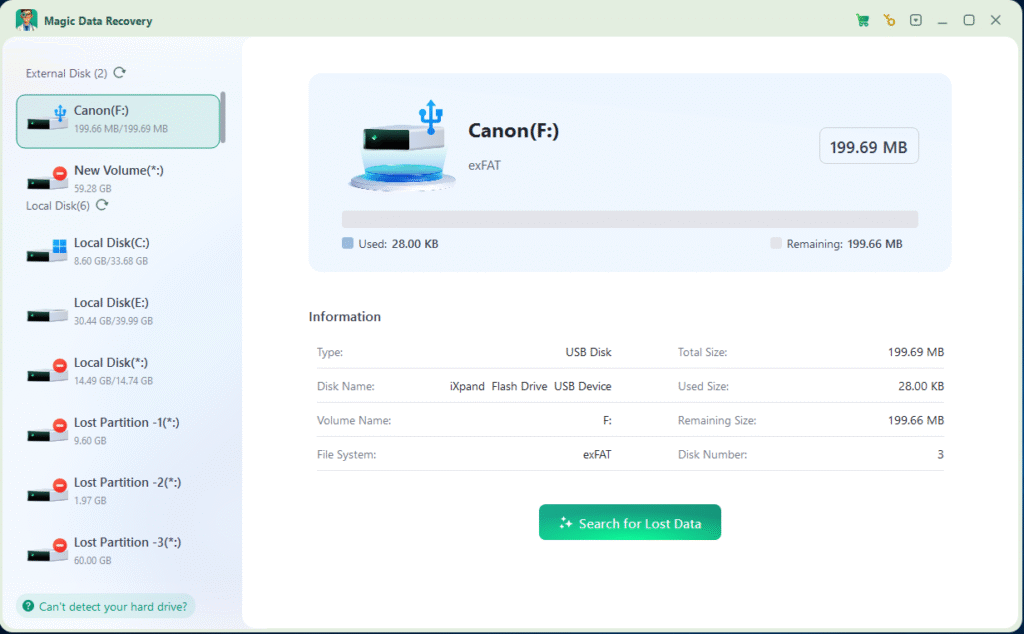
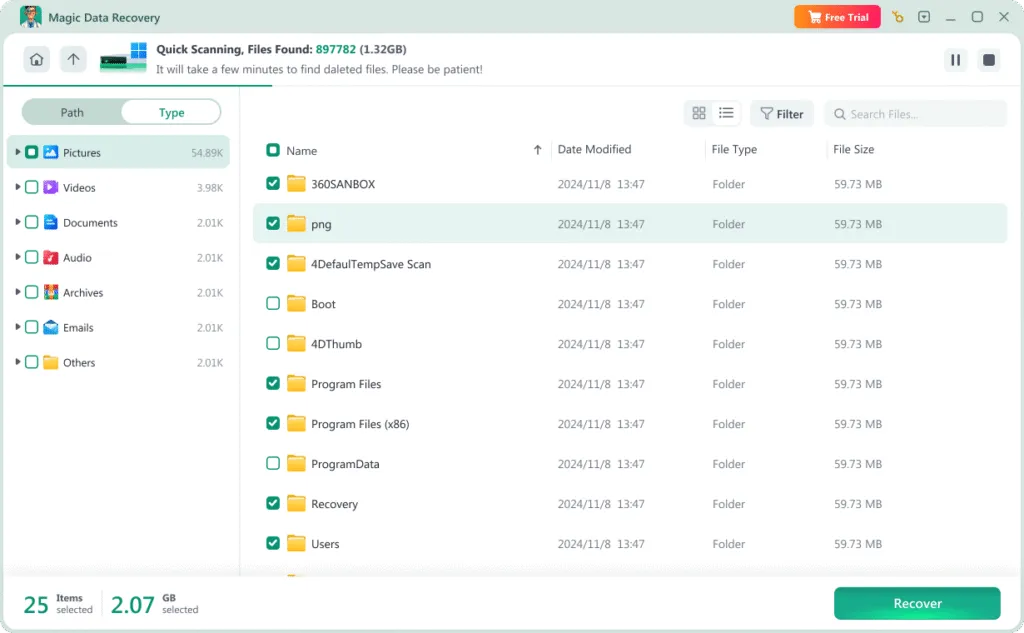
Instead of relying on trial-and-error fixes, Magic Data Recovery provides a professional-grade tool designed specifically for secure data recovery with following steps:
1.Download and Install the software from the official website.
Supports Windows 7/8/10/11 and Windows Server


Conclusion
SSD data recovery is often possible, even though modern SSD technologies such as TRIM and garbage collection can make the recovery process more complex than traditional hard drive recovery. Whether data loss is caused by accidental deletion, formatting, partition corruption, RAW file systems, firmware issues, or SSD detection problems, taking immediate action can significantly improve the chances of successful recovery from SSDs.
The most important step is to stop using the SSD as soon as data loss occurs. Continued use may trigger additional write operations that permanently overwrite recoverable files. Before attempting repairs, formatting, or system fixes, it is always advisable to recover important data first.
With the right recovery approach and professional recovery software, many SSD data loss scenarios can be resolved without requiring expensive laboratory services. Magic Data Recovery helps users recover lost files from SSDs while providing a safe and user-friendly recovery experience for both beginners and advanced users.
Supports Windows 7/8/10/11 and Windows Server
FAQ
Can SSD data be recovered after deletion?
Can I recover data from a formatted SSD?
Does TRIM make SSD data recovery impossible?
Can a dead or failed SSD be recovered?
Can files be recovered from an SSD that is not detected?
How can I improve the chances of SSD data recovery?

Vasilii is a data recovery specialist with around 10 years of hands-on experience in the field. Throughout his career, he has successfully solved thousands of complex cases involving deleted files, formatted drives, lost partitions, and RAW file systems. His expertise covers both manual recovery methods using professional tools like hex editors and advanced automated solutions with recovery software. Vasilii's mission is to make reliable data recovery knowledge accessible to both IT professionals and everyday users, helping them safeguard their valuable digital assets.