
Recover Formatted USB Drive Free: 4 Ways
Formatting the wrong USB drive can make photos, documents, videos, and work files disappear within seconds. Fortunately, it may still be possible to recover formatted USB drive free, especially after a quick format and before new data is written to the device.
This guide explains four practical recovery methods, including Windows tools, open-source software, and Magic Data Recovery. You will also learn what affects recovery success and which actions to avoid. For more information about similar data-loss situations, visit Amagicsoft’s formatted drive recovery guide.
Most importantly, stop using the USB immediately. Do not copy new files to it, format it again, or save recovered data back to the same device.
Supports Windows 7/8/10/11 and Windows Server
Table of Contents
Can You Recover a Formatted USB Drive?
In many cases, yes. A quick format usually recreates the file system and marks the previous storage space as available. It does not always erase every file immediately.
Recovery software may still locate the original file records or identify files through their signatures. However, the chance of successfully completing a recover formatted USB drive task depends on several factors:
- Whether the USB received a quick or full format
- Whether new files were saved afterward
- Whether the flash drive is physically healthy
- Which file system it uses
- Whether the missing files were fragmented
A full format, secure erase, or heavy reuse can overwrite the old data. Once a storage block has been overwritten, ordinary recovery software cannot restore its previous contents.
What to Do Before Recovering the USB
Before trying to recover a formatted USB drive, follow these precautions:
- Stop using the USB drive.
- Do not format it again.
- Avoid running CHKDSK before recovery.
- Install recovery software on the computer.
- Save recovered files to another drive.
- Stop DIY attempts if the USB disconnects or overheats.
CHKDSK repairs file-system errors but is not designed to recover formatted files. Because it can modify file-system records, running it too early may reduce the quality of later recovery results.
If Windows asks you to format the USB before using it, do not accept the prompt when important data remains on the device. The file system may have become RAW or corrupted. In that case, refer to this RAW USB recovery guide.
Quick Format vs. Full Format
The type of format has a major effect on recovery.
Formatting situation | Recovery outlook |
Quick format with no reuse | Often recoverable |
Quick format followed by limited use | Partial recovery may be possible |
Full format | Recovery is much less likely |
Secure erase | Software recovery is generally ineffective |
USB converted to installation media | Some files may survive in areas not overwritten |
Most accidental formatting cases involve a quick format. For example, a user may select the wrong drive in File Explorer or choose an external USB while creating Windows installation media.
In these situations, the sooner you begin recovery, the better your chances of finding intact files.
Method 1: Recover Formatted USB Files from a Backup
Before scanning the USB, check whether another copy of the files exists. This is the safest way to recover formatted USB files because it does not modify or scan the affected device.
Look in:
- OneDrive, Google Drive, or Dropbox
- Windows File History
- Another computer or external drive
- Email attachments
- Messaging or collaboration platforms
- The camera, phone, or recorder that created the files
- Previous project exports or archives
Backups usually preserve the original file names, folders, and dates. However, this method only works when the files were copied or synchronized before the USB was formatted.
Method 2: Recover Formatted USB Drive Free with Windows File Recovery
Windows File Recovery is a free Microsoft command-line utility. It can scan USB drives, external disks, and internal storage.
This method suits users who want to recover formatted USB drive free and are comfortable entering commands.
Step 1: Prepare Another Drive
The source and destination drives must be different.
For example:
- Formatted USB: E:
- Recovery destination: D:
Confirm the drive letters in File Explorer before continuing.
Step 2: Install Windows File Recovery
Install Windows File Recovery from the Microsoft Store. Save the application to the computer, not the affected USB drive.
Step 3: Run the Recovery Command
Open the program as an administrator and enter a command such as:
winfr E: D: /extensive /n *.docx /n *.jpg /n *.pdf
Replace E: and D: with the correct drive letters.
The /extensive option is suitable for formatted drives and common USB file systems such as FAT32 and exFAT. The /n filters limit the scan to selected file types.
For example:
- /n *.xlsx searches for Excel files.
- /n *.mp4 searches for MP4 videos.
- /n *.png searches for PNG images.
Windows File Recovery costs nothing, but it lacks a normal preview interface. Reviewing large numbers of recovered files can therefore take time.
Method 3: Recover a Formatted USB Stick with PhotoRec
PhotoRec is a free, open-source recovery program available for Windows, macOS, and Linux. Instead of relying only on the original file system, it searches the drive for recognizable file signatures.
This approach can help recover formatted USB stick data when the device appears empty, RAW, or corrupted.
How to Use PhotoRec
- Download TestDisk and PhotoRec from the official CGSecurity website.
- Extract the files to the computer.
- Open QPhotoRec or PhotoRec.
- Select the formatted USB device.
- Choose the relevant partition and file-system type.
- Select the file formats you need.
- Choose a destination on another drive.
- Start the scan.
PhotoRec can recover many common file types without payment. However, it often assigns generic names to recovered files and may not restore the original folder structure.
It can also return duplicates, thumbnails, and incomplete fragments. For a small number of important files, manual sorting may be manageable. For a large USB drive, the results can become difficult to organize.
Method 4: Recover Formatted USB Drive Free with Magic Data Recovery
Users who prefer a visual recovery process can try Magic Data Recovery. It supports accidental formatting, deleted files, RAW drives, damaged file systems, and lost partitions.
The software supports more than 5,000 file types, including photos, videos, Office documents, PDFs, archives, and project files. Its free version allows users to recover up to 500 MB.
Supports Windows 7/8/10/11 and Windows Server
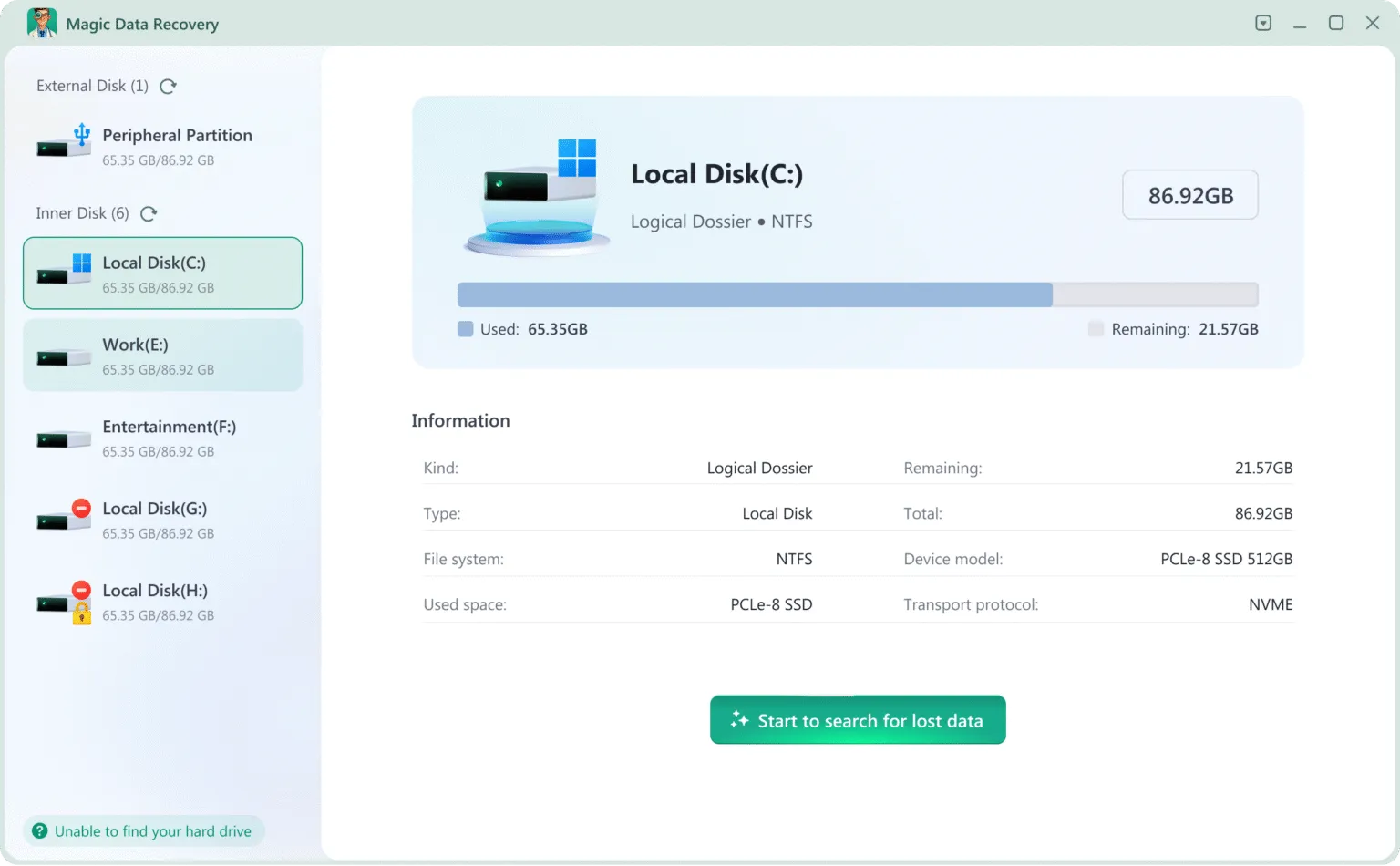
Step 1: Select the USB
Install Magic Data Recovery on the computer. Connect the formatted USB, open the program, and identify the correct device by its capacity and drive letter.
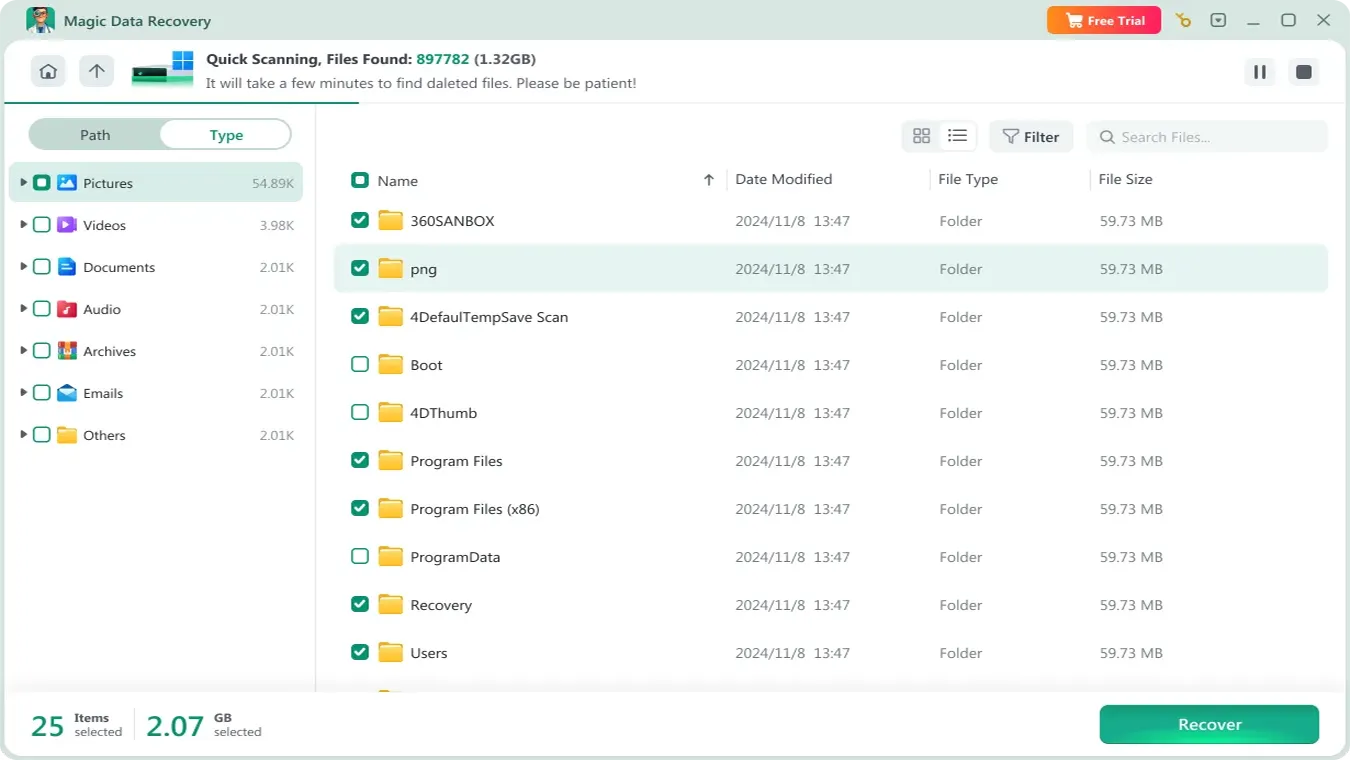
Step 2: Scan and Preview Files
Start the scan, then use file type, name, size, or path filters to narrow the results. Preview important files when possible to check whether they remain readable.
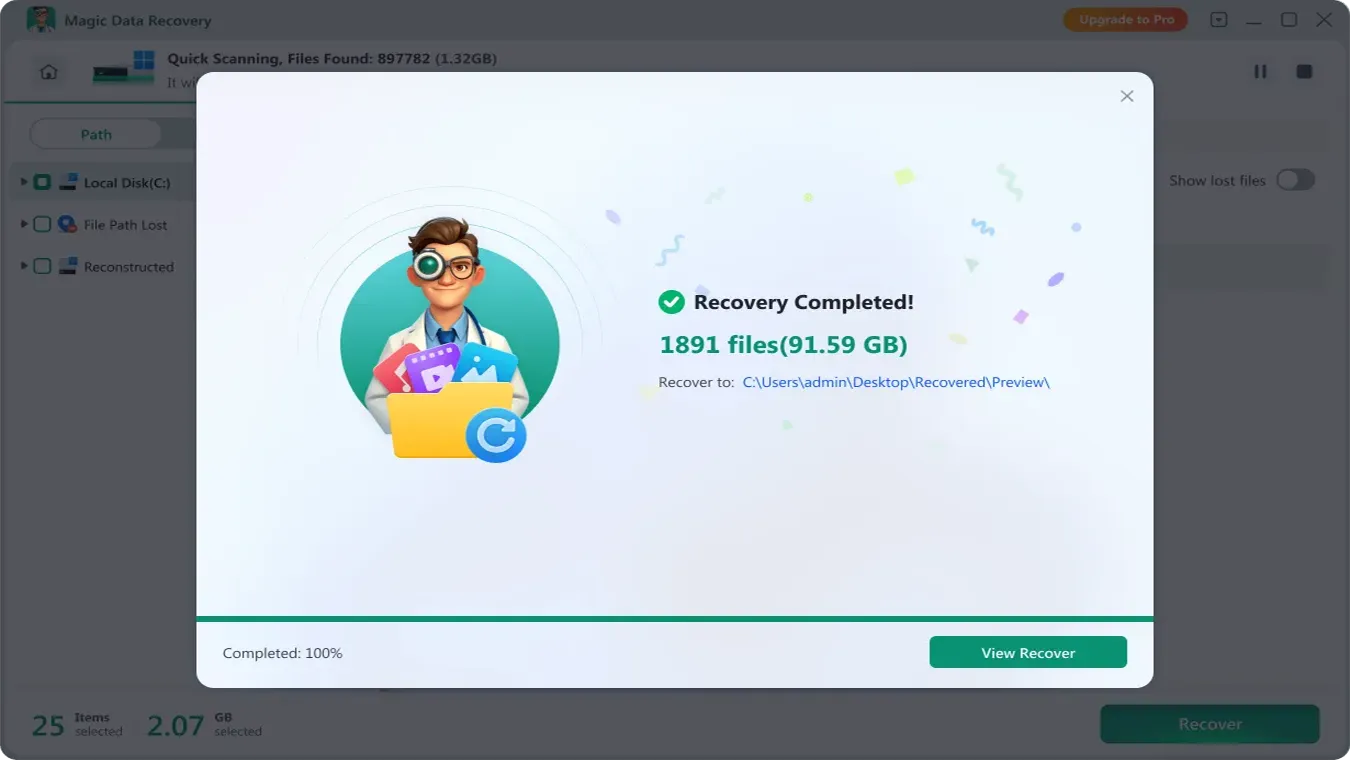
Step 3: Recover to Another Drive
Select the files you need and save them to the computer or another external disk. Do not restore them to the formatted USB because this could overwrite other recoverable data.
Magic Data Recovery is useful when Windows File Recovery feels too technical or when PhotoRec produces too many unnamed files. Its visual interface, file filters, previews, and support for several data-loss scenarios make it easier to locate relevant files.
For more detailed instructions, see the Magic Data Recovery user guide.
Free USB Recovery Methods Compared
Method | Best for | Main limitation |
Backup or cloud storage | Restoring original files and folders | Requires an existing copy |
Windows File Recovery | Free command-line recovery | Limited preview and navigation |
PhotoRec | Free deep file-signature scanning | Often loses file names and folders |
Magic Data Recovery | Visual scanning, filtering, and preview | Free recovery is limited to 500 MB |
Professional service | Physical USB damage | Usually expensive |
Start with backups because they provide the cleanest result. Next, try Windows File Recovery or PhotoRec if you are comfortable with more technical tools.
Magic Data Recovery is better suited to users who need a guided interface and want to preview files before recovering them.
Can CMD Recover Formatted USB Files?
Standard commands such as attrib and CHKDSK cannot undo a format.
The attrib command can reveal files hidden by malware or incorrect attributes, but it does not restore files removed from the file system. CHKDSK repairs logical errors and may create recovered fragments, yet it is not a reliable method for formatted-drive recovery.
Windows File Recovery is the relevant Microsoft command-line solution because it scans storage for lost content and saves results to another drive.
Avoid DiskPart commands such as clean, convert, and format before recovery. These commands modify the disk and may reduce the chance of finding the missing data.
Why Recovered Files May Lose Their Names
Formatting often removes the directory information that connects file content with its original name, folder, date, and location.
Recovery software may still identify a JPEG, PDF, ZIP, or DOCX file by recognizing its internal structure. However, if the original file-system record no longer exists, the tool may assign a generic name.
Programs that combine file-system analysis with file-signature scanning have a better chance of preserving useful information. Pure file-carving tools tend to recover the content but not the original directory structure.
When Free Recovery Software Will Not Help
Software is designed for logical data loss. It cannot repair physical damage.
Stop using recovery tools and consider professional assistance when:
- The USB is not detected on multiple computers.
- Its capacity appears as zero.
- The connector is bent or broken.
- The device becomes unusually hot.
- It repeatedly disconnects.
- It suffered water or electrical damage.
- The data is too important to risk.
Repeatedly connecting a physically damaged USB may make the problem worse. A recovery laboratory may need to repair the controller or read the memory chips directly.
Tips to Improve USB Recovery Results
To improve your chances of successfully completing a recover data from formatted USB task:
- Begin recovery as soon as possible.
- Keep the source USB unchanged.
- Use a stable USB port.
- Allow deep scans to finish.
- Recover the most important files first.
- Preview several files before saving them.
- Save results to another storage device.
- Keep the USB untouched until the recovered files are verified.
After the recovery is complete, copy the restored files to at least one additional location. You may then test and reformat the USB. This guide explains how to format a USB drive to FAT32 after your data is safe.
Conclusion
It is often possible to recover formatted USB drive free when the device received a quick format and has not been reused.
Backups provide the safest solution. Windows File Recovery offers a free Microsoft option, while PhotoRec is useful for deep file-signature scanning. Both tools can work well, although they require more technical effort and may return disorganized results.
Magic Data Recovery is recommended for users who want a clearer recovery workflow. It combines formatted-drive scanning, file filters, previews, support for more than 5,000 file types, and 500 MB of free recovery.
Whichever method you choose, never save recovered files back to the affected USB. For additional precautions and recovery solutions, visit Amagicsoft’s formatted drive recovery guide.
FAQs
Can I recover a formatted USB drive completely free?
Yes. Windows File Recovery and PhotoRec can restore files without charging a recovery fee, although both require more technical knowledge. Magic Data Recovery also offers up to 500 MB of free recovery with file filtering and previews. Recovery success still depends on whether the original data has been overwritten.
Does formatting a USB permanently delete everything?
A quick format usually removes file-system references and marks the storage as available, but the underlying data may remain until new files overwrite it. A full format or secure erase is more destructive. Stop using the USB immediately if you want to preserve the best possible recovery chance.
Can I recover formatted USB files without software?
You can recover them without recovery software only when another copy exists. Check cloud storage, File History, email attachments, another computer, or the original device that created the files. File Explorer cannot restore formatted files directly because their original file-system records are no longer normally accessible.
Can Recuva recover a formatted USB drive?
Recuva may recover files after a quick format, especially when the USB remains healthy and has not been reused. However, results vary by file system, overwrite level, and file fragmentation. When the first scan finds little data, compare the results with a deeper formatted-drive recovery tool.
Should I run CHKDSK on a formatted USB?
Run recovery software before CHKDSK when the missing files are important. CHKDSK repairs file-system errors and may modify the drive’s metadata, but it does not reverse a format. After recovering and verifying your files, you can use CHKDSK to test whether the USB remains usable.
Why are some recovered USB files corrupted?
A recovered file may be unreadable because part of its content was overwritten, the file was fragmented, or the USB has failing memory blocks. Recovery software may also locate only a partial file signature. Preview important files and recover them before continuing to scan or reuse the device.
Can files be recovered after formatting a USB twice?
Recovery may still be possible when both operations were quick formats and no new files were written afterward. However, repeated formatting can replace more file-system information, making original names and folders harder to reconstruct. Run a deep scan promptly and save all results to another storage device.
Should I format a USB when Windows asks me to?
Do not format it when the USB contains important files. Windows may display the prompt because the file system is corrupted or appears as RAW. Scan and recover the files first. Once the recovered data has been opened, verified, and backed up, you can safely reformat and test the USB.

Jason is a data recovery and technical support specialist with over 15 years of hands-on experience. He has worked extensively with frontline users, troubleshooting difficult data loss cases and providing practical recovery solutions for accidental deletion, formatted drives, damaged file systems, lost partitions, system failures, and other recovery emergencies. His expertise also includes backup and restoration, file repair, and disaster recovery, with a strong emphasis on safe, reliable, and technically accurate guidance.