
General Data Protection Regulation (GDPR) Explained

The general data protection regulation (GDPR) is the European Union’s primary data privacy law, created to regulate how personal data is collected, processed, stored, and protected. Introduced in May 2018, GDPR replaced fragmented national laws and established a single, unified framework across all EU member states.
More importantly, GDPR gives individuals meaningful control over their personal information. At the same time, it provides organizations with clear rules for lawful and transparent data processing. As a result, GDPR has become the global benchmark for modern privacy legislation.
Table of Contents
What Is the General Data Protection Regulation?
GDPR is a legally binding framework that governs personal data processing. GDPR applies whenever organizations collect or use personal data relating to an identifiable individual, regardless of whether they operate in the public or private sector.
In practice, GDPR ensures that data is processed fairly, securely, and for legitimate purposes only. Therefore, organizations must clearly explain why data is collected and how it will be used before processing begins. According to the European Commission, GDPR establishes consistent data protection rules across the European Union.
Personal Data Under GDPR vs. Stored Files on Physical Devices
When discussing the general data protection regulation, it is important to distinguish between two related but fundamentally different concepts of “data.”
Under GDPR, the term personal data refers to information that can identify an individual, such as names, email addresses, IP addresses, cookies, or location data. This is a legal definition that focuses on the content and its impact on individual privacy, rather than on how the data is technically stored.
In practice, however, personal data almost always exists in the form of stored files on physical or digital devices. Documents, images, databases, emails, and system logs are typically saved on hard drives, solid-state drives, servers, or removable storage media. These files often contain personal data, even though the files themselves do not qualify as personal data by definition.
This distinction becomes critical when technical issues occur. If a hard drive fails, files are accidentally deleted, or storage becomes corrupted, the affected files may include personal data covered by GDPR. From a compliance perspective, the legal obligations remain, even though the problem originates at the storage or file level rather than at the data processing level.
Therefore, GDPR compliance is not limited to policies and consent mechanisms. It also depends on how organizations manage, protect, and maintain access to the files and storage systems that contain personal data. Technical failures affecting stored files can quickly turn into regulatory issues if personal data becomes unavailable, inaccurate, or unrecoverable.
What Counts as Personal Data Under GDPR?
Under GDPR, personal data includes any information that can directly or indirectly identify an individual. This broad definition ensures comprehensive protection.
Examples include:
- Names and contact details
- Email addresses and IP addresses
- Identification numbers
- Location data
- Online identifiers and cookies
- Health, financial, or biometric data
Because of this wide scope, most organizations handle GDPR-covered data in some form.
Who Must Comply With the General Data Protection Regulation?
The general data protection regulation applies to:
1. Organizations established in the EU
2. Organizations outside the EU that offer goods or services to EU residents
3. Organizations that monitor the behavior of individuals within the EU
As a result, GDPR has global reach. Even small websites collecting email addresses from EU visitors may fall under its requirements.
Key Principles of the General Data Protection Regulation
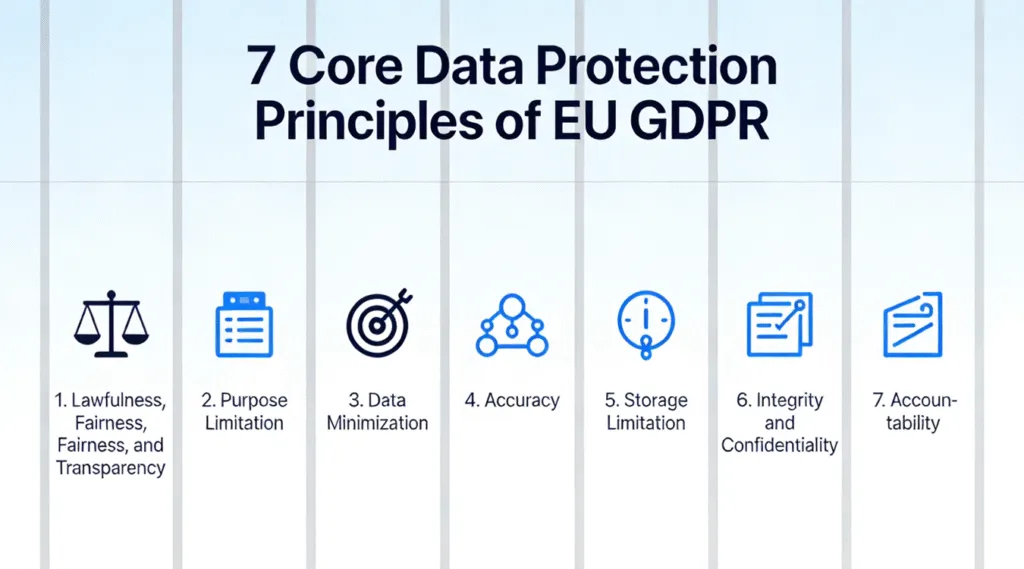
GDPR is built on seven fundamental principles that guide lawful data processing:
- Lawfulness, fairness, and transparency
- Purpose limitation
- Data minimization
- Accuracy
- Storage limitation
- Integrity and confidentiality
- Accountability
Together, these principles ensure that personal data is handled responsibly and securely throughout its lifecycle.
Individual Rights Under the General Data Protection Regulation
One of the most important features of GDPR is the rights it grants to individuals.
These include:
- The right to access personal data
- The right to correct inaccurate information
- The right to erasure (“right to be forgotten”)
- The right to restrict processing
- The right to data portability
- The right to object to certain processing activities
Consequently, organizations must implement clear procedures for responding to these requests promptly.
GDPR and Data Security Responsibilities
GDPR requires organizations to implement appropriate technical and organizational safeguards. These measures may include encryption, access controls, and secure storage environments.
In addition, Organizations must report personal data breaches to supervisory authorities within 72 hours. If the risk to individuals is high, organizations must inform affected users without delay.
Why the General Data Protection Regulation Matters Globally
Although GDPR is an EU regulation, its influence extends far beyond Europe. Many countries have adopted similar privacy laws inspired by the general data protection regulation.
For individuals, this means greater transparency and stronger privacy rights. For organizations, GDPR establishes trust, accountability, and long-term data governance standards.
Conclusion
The general data protection regulation has reshaped how personal data is handled in the digital age. By establishing clear rules for transparency, accountability, and security, GDPR creates a balanced framework that protects individual rights while enabling organizations to operate responsibly. More importantly, it encourages a culture of trust, where personal data is treated as a valuable asset rather than an afterthought.
For individuals, GDPR offers greater control and visibility over personal information. For organizations, it provides a consistent standard for lawful data processing and long-term compliance. When applied correctly, the general data protection regulation is not just a legal obligation—it is a foundation for sustainable, privacy-focused data management in a global environment.
People Also Like To Read
FAQ
What is the general data protection regulation?
Does GDPR apply outside the EU?
What penalties exist for GDPR violations?
Is consent always required under GDPR?
What is the right to be forgotten?
How long can personal data be stored?
Is GDPR relevant to small businesses?

Vasilii is a data recovery specialist with around 10 years of hands-on experience in the field. Throughout his career, he has successfully solved thousands of complex cases involving deleted files, formatted drives, lost partitions, and RAW file systems. His expertise covers both manual recovery methods using professional tools like hex editors and advanced automated solutions with recovery software. Vasilii's mission is to make reliable data recovery knowledge accessible to both IT professionals and everyday users, helping them safeguard their valuable digital assets.